

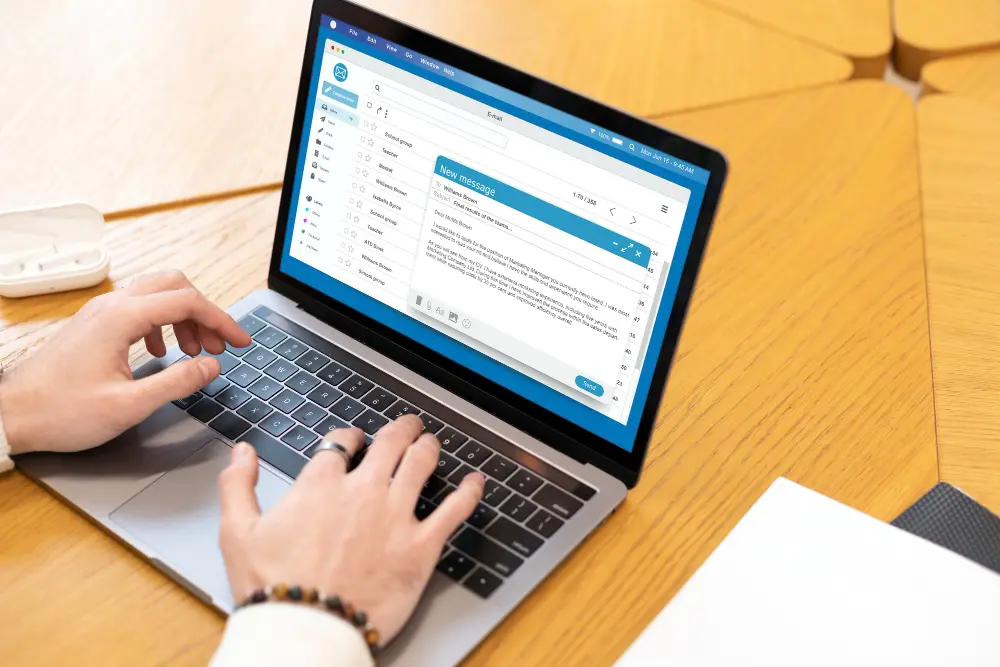
Escribir un email de seguimiento efectivo en inglés requiere un enfoque estructurado que respete los códigos culturales anglosajones. La comunicación profesional en inglés favorece un tono más directo y menos ceremonioso mientras mantiene el respeto por las jerarquías.
Si ya dominas los conceptos básicos, aprende cómo redactar un email profesional en inglés para profundizar tus habilidades.
¿Qué tan formal deberías ser?
Antes de redactar tu email de seguimiento en inglés, evalúa tu relación con el destinatario. ¿Conoces bien a esta persona? ¿Cuántas veces te has reunido con ella? ¿Es un primer contacto?
Distinguimos cinco niveles diferentes de formalidad: informal, amigable, respetuoso, formal y legal.
Informal – Usado con colegas cercanos y miembros del equipo interno. Si trabajas en un ambiente relajado donde las relaciones son casuales, este tono es perfectamente apropiado.
Amigable – Nivel intermedio, cortés pero accesible. Adecuado para clientes habituales y socios comerciales con quienes mantienes buenas relaciones.
Respetuoso – Tono profesional estándar, muy cortés pero menos rígido que el formal. Recomendado para nuevos clientes y prospectos calificados.
Formal – Reservado para personas importantes, dirección de empresa y clientes institucionales. Usado en sectores tradicionales o durante primeros contactos oficiales.
Legal – Tono más protocolario, usado para notificaciones formales, reclamaciones contractuales y correspondencia legal. No se tolera ninguna familiaridad.
El inglés profesional es generalmente más directo que otros idiomas. Se considera apropiado usar nombres de pila rápidamente y evitar cortesía excesiva.
Elementos estructurales por nivel de formalidad
Saludos de apertura
Informal: Hi John
Amigable: Hello John
Respetuoso: Dear John
Formal: Dear Mr. Smith
Legal: Dear Sir/Madam
Frases de cortesía de apertura
Informal: Hope you’re doing well
Amigable: Hope you’re well
Respetuoso: I hope you are well
Formal: I trust this email finds you well
Legal: We acknowledge receipt of your correspondence
Frases de apertura para seguimiento
Informal: Just checking in on this
Amigable: I was just writing to see if you had received my last email
Respetuoso: I wanted to get in touch to see if you had had a chance to consider my previous email
Formal: I am recontacting you with regards to my previous email
Legal: We hereby formally notify you regarding
Solicitar aclaraciones
Informal: Any thoughts on what I mentioned?
Amigable: I was just wondering what you thought about it
Respetuoso: Could you let me know what you think about the points raised?
Formal: Would it be possible to clarify the points I raised in the email?
Legal: We require clarification on the following matters
Solicitar acción
Informal: Can you sort that out?
Amigable: Could you take care of that for me?
Respetuoso: Would you be able to take care of those issues?
Formal: If it’s not too much trouble, I was wondering if you could follow up on these issues
Legal: We formally request immediate action regarding
Frases de cierre
Informal: Let me know if there’s anything else
Amigable: Thanks for your help, let me know if you need anything from me
Respetuoso: Thank you for your time and please do not hesitate to contact me
Formal: I would like to thank you once again for your time, and if I can be of any assistance, please do not hesitate to contact me
Legal: We await your prompt response within the specified timeframe
Despedidas
Informal: Speak soon
Amigable: Many thanks
Respetuoso: Kind regards
Formal: Yours sincerely
Legal: Yours faithfully
10 plantillas de emails de seguimiento
Entre colegas y equipo interno
Plantilla 1: Seguimiento entre colegas
Hi Sarah,

Just following up on the budget report we discussed yesterday.
Any chance you could send it over by end of day?

Thanks!
Mike
Plantilla 2: Seguimiento de equipo interno
Hi team,

Quick reminder about the project timeline we need to finalize.
Can we get everyone's input by Friday?

Cheers,
Alex
Clientes habituales y socios
Plantilla 3: Cliente habitual
Hello David,

Hope you're well! Just checking in on the proposal I sent last week.
Would love to hear your thoughts when you have a moment.

Many thanks,
Emma
Plantilla 4: Socio comercial
Hello Lisa,

Thanks again for last week's meeting.
Following up on the partnership agreement - any updates from your side?

Best,
James
Nuevos clientes y prospectos
Plantilla 5: Nuevo prospecto
Dear Mark,

I hope this email finds you well.
I wanted to follow up on my previous message regarding our digital marketing services.
Would you be available for a brief call this week?

Kind regards,
Sophie Laurent
Plantilla 6: Cliente calificado
Dear Ms. Johnson,

Thank you for your interest in our solutions.
I'm writing to see if you had a chance to review the documentation I sent.
Please let me know if you need any clarification.

Best regards,
Thomas Wilson
Dirección y clientes institucionales
Plantilla 7: Dirección de empresa
Dear Mr. Anderson,

I trust this email finds you well.
I am writing to follow up on our proposal submitted on March 15th regarding the IT infrastructure upgrade.
We would be grateful for your feedback at your earliest convenience.

Yours sincerely,
Catherine Moore
Senior Account Manager
Plantilla 8: Cliente institucional
Dear Dr. Roberts,

I trust you are well.
Further to our meeting of February 20th, I would like to discuss the implementation timeline for the new system.
Would it be possible to schedule a follow-up meeting next week?

Yours faithfully,
Jonathan Clarke
Director of Operations
Correspondencia legal
Plantilla 9: Notificación formal
Dear Sir/Madam,

We formally request your immediate attention to the outstanding payment of invoice No. 2024-157, dated January 15th, 2024.
Despite our previous reminders dated February 10th and March 5th, this amount remains unpaid.
We require settlement within 10 business days to avoid further action.

Yours faithfully,
Legal Department
ABC Corporation Ltd.
Plantilla 10: Reclamación contractual
Dear Mr. Stevens,

We hereby formally notify you of the breach of contract terms as outlined in Section 4.2 of our agreement dated December 1st, 2023.
We request your written response within 14 days detailing your proposed remedial action.
Failure to respond may result in termination of the contract.

Yours sincerely,
Legal Affairs Department
XYZ Solutions Ltd.
Diferencias culturales en la comunicación en inglés
Enfoque británico vs americano
El inglés británico favorece un estilo más indirecto con uso frecuente de «would,» «could,» y «might.» Los británicos escriben: «I was wondering if you might have had a chance to review…» o «Would it be possible to…»
El inglés americano adopta un enfoque más directo con formulaciones activas: «Can you please review…» o «Let me know your thoughts on…»
Expresiones a favorecer en inglés
Para solicitar una respuesta, prefiere «I look forward to hearing from you» en lugar de «I’m waiting for your response.»
Para crear urgencia, usa «Time-sensitive matter» en lugar de «Urgent and important.»
Para ser cortés, escribe «At your convenience» en lugar de «When you have the time.»
Para recordar contexto, usa «Following up on our conversation» y evita formulaciones incómodas.
Errores comunes de traducción
Evita traducciones directas de otros idiomas. Los errores comunes incluyen formulaciones incómodas que no suenan naturales para hablantes nativos de inglés.
Otros errores frecuentes: «I return toward you» debería ser «I’m getting back to you,» «Thank you for your return» se convierte en «Thank you for your response,» y construcciones excesivamente formales deberían simplificarse para mayor claridad.
Cuándo enviar tu seguimiento
Tiempo óptimo por nivel
Para niveles informal y amigable, espera 2-3 días después del primer contacto. El nivel respetuoso requiere 3-5 días hábiles. El nivel formal requiere 5-7 días hábiles. El nivel legal sigue plazos contractuales, generalmente 10-15 días.
Señales de parada
Deja de hacer seguimiento después de tres intentos sin respuesta, en caso de solicitud explícita de parar, o durante cambios de contexto como alguien dejando la empresa.
Frases clave esenciales por nivel
Aperturas efectivas
El nivel informal usa «Just touching base» o «Quick follow-up.» El amigable prefiere «Hope you’re well» o «Checking in.» El respetuoso emplea «I hope this finds you well» o «Following up on.» El formal elige «I trust this email finds you well» o «Further to our discussion.» El legal opta por «We hereby notify» o «This serves as formal notice.»
Llamadas a la acción apropiadas
El informal simplemente dice «Let me know» o «Can you…» El amigable sugiere «Would love to hear your thoughts» o «When you have a moment.» El respetuoso formula «I would appreciate your feedback» o «Please let me know.» El formal escribe «We would be grateful for your response» o «At your earliest convenience.» El legal exige «We require immediate action» o «Response required within [timeframe].»
Errores comunes a evitar
Por nivel de formalidad
En el nivel informal, evita «Dear» o «Yours sincerely» que crean distancia inapropiada. En el nivel amigable, exceso de familiaridad con extraños puede ser chocante. El nivel respetuoso prohíbe contracciones como «don’t» o «won’t.» El nivel formal evita expresiones demasiado directas que pueden parecer agresivas. El nivel legal no tolera ambigüedad o tono amigable.
Optimizando tus líneas de asunto
Estructura efectiva
Adopta la estructura: [Acción]: [Contexto breve] – [Urgencia si es necesario]. Ejemplos: «Follow-up: Marketing proposal discussion,» «Reminder: Invoice #2024-089 payment due,» o «Urgent: Contract review required.»
Limita tus asuntos a 50 caracteres para asegurar legibilidad en dispositivos móviles.
Dominar los cinco niveles de formalidad transforma tus seguimientos en herramientas de comunicación efectivas. Adapta sistemáticamente tu tono al contexto y tu interlocutor para maximizar tus posibilidades de respuesta.