


La lectura es esencial para aprender un nuevo idioma. Los estudiantes de inglés siempre deberían leer obras de ficción y no ficción para enriquecer su vocabulario, aprender expresiones idiomáticas y mejorar su gramática.
En este artículo, listamos diez excelentes poemas en inglés que los estudiantes deberían leer al aprender inglés, para principiantes, intermedios y avanzados. La progresión de los poemas va desde lenguaje y conceptos simples hasta estructuras e imágenes más complejas.
Todos ofrecen una buena diversidad de estilos, temas y desafíos lingüísticos. Te darán amplias oportunidades para mejorar tu comprensión y dominio general del idioma en varios niveles de dificultad.
Poema 1: «The Swing» de Robert Louis Stevenson (1891)

«How do you like to go up in a swing, / Up in the air so blue?»
Es un poema alegre, tierno y rítmico sobre columpiarse. Habla de un adorable niño pequeño que disfruta balanceándose. Con su perro a su lado, cree poder volar. Y quién sabe, en su columpio, quizás tenga razón.
How do you like to go up in a swing,
             Up in the air so blue?
Oh, I do think it the pleasantest thing
             Ever a child can do!

Up in the air and over the wall,
             Till I can see so wide,
River and trees and cattle and all
             Over the countryside—

Till I look down on the garden green,
              Down on the roof so brown—
Up in the air I go flying again,
              Up in the air and down!
Poema 2: «The Tyger» de William Blake (1794)
«Tyger! Tyger! burning bright, In the forests of the night.»
Es un poema repetitivo y rítmico sobre un tigre misterioso. Desde su primera infancia, Blake hablaba de tener visiones. Gran parte del contenido del poema tiene imágenes poderosas.
Tyger Tyger, burning bright,
In the forests of the night;
What immortal hand or eye,
Could frame thy fearful symmetry?

In what distant deeps or skies
Burnt the fire of thine eyes?
On what wings dare he aspire?
What the hand, dare seize the fire?

And what shoulder, & what art,
Could twist the sinews of thy heart?
And when thy heart began to beat.
What dread hand? & what dread feet?

What the hammer? what the chain,
In what furnace was thy brain?
What the anvil? what dread grasp.
Dare its deadly terrors clasp?

When the stars threw down their spears
And water'd heaven with their tears:
Did he smile his work to see?
Did he who made the Lamb make thee?

Tyger Tyger burning bright,
In the forests of the night:
What immortal hand or eye,
Dare frame thy fearful symmetry?
Poema 3: «I Wandered Lonely as a Cloud» de William Wordsworth (1802)
«I wandered lonely as a cloud, That floats on high o’er vales and hills, / When all at once I saw a crowd, A host, of golden daffodils».
Lo que me gusta especialmente es que este poema lírico describe la naturaleza de forma tan hermosa. Es uno de sus más populares, inspirado por un paseo con su hermana Dorothy, cuando vieron un «largo cinturón» de narcisos en el Distrito de los Lagos.
Su tono reflexivo puede ayudarte a expandir tu capacidad de ser descriptivo con tu vocabulario, especialmente tus adjetivos con frases como ‘golden daffodils’, ‘milky way’, ‘sprightly dance’ y ‘pensive mood’.
I wandered lonely as a cloud
That floats on high o'er vales and hills,
When all at once I saw a crowd,
A host, of golden daffodils;
Beside the lake, beneath the trees,
Fluttering and dancing in the breeze.

Continuous as the stars that shine
And twinkle on the milky way,
They stretched in never-ending line
Along the margin of a bay:
Ten thousand saw I at a glance,
Tossing their heads in sprightly dance.

The waves beside them danced; but they
Out-did the sparkling waves in glee:
A poet could not but be gay,
In such a jocund company:
I gazed — and gazed — but little thought
What wealth the show to me had brought:

For oft, when on my couch I lie
In vacant or in pensive mood,
They flash upon that inward eye
Which is the bliss of solitude;
And then my heart with pleasure fills,
And dances with the daffodils.
Poema 4: «If» de Rudyard Kipling (1895)
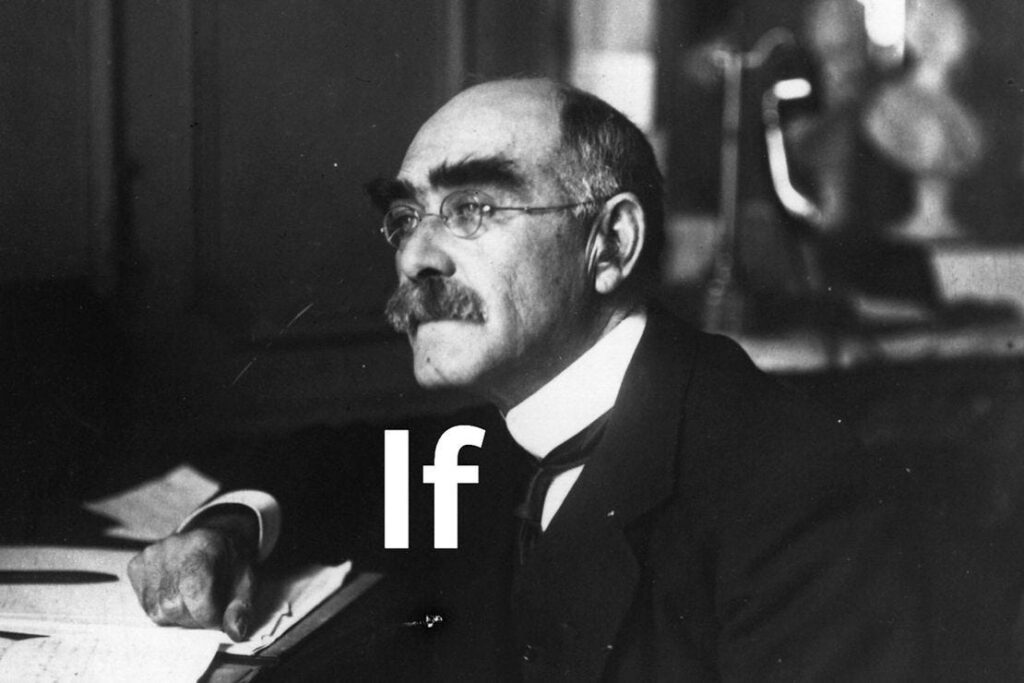
«If you can keep your head when all about you, / Are losing theirs and blaming it on you.»
Este poema está escrito en forma de consejo paternal al hijo del poeta, John. Tiene un mensaje moral transmitido en un tono directo y simple pero motivador. Será muy efectivo para ayudarte a aprender oraciones condicionales (aquellas que típicamente comienzan con la palabra ‘if’ o ‘unless’).
If you can keep your head when all about you
    Are losing theirs and blaming it on you,
If you can trust yourself when all men doubt you,
    But make allowance for their doubting too;
If you can wait and not be tired by waiting,
    Or being lied about, don't deal in lies,
Or being hated, don't give way to hating,
    And yet don't look too good, nor talk too wise:

If you can dream—and not make dreams your master;
    If you can think—and not make thoughts your aim;
If you can meet with Triumph and Disaster
    And treat those two impostors just the same;
If you can bear to hear the truth you've spoken
    Twisted by knaves to make a trap for fools,
Or watch the things you gave your life to, broken,
    And stoop and build 'em up with worn-out tools:

If you can make one heap of all your winnings
    And risk it on one turn of pitch-and-toss,
And lose, and start again at your beginnings
    And never breathe a word about your loss;
If you can force your heart and nerve and sinew
    To serve your turn long after they are gone,
And so hold on when there is nothing in you
    Except the Will which says to them: 'Hold on!'

If you can talk with crowds and keep your virtue,
    Or walk with Kings — nor lose the common touch,
If neither foes nor loving friends can hurt you,
    If all men count with you, but none too much;
If you can fill the unforgiving minute
    With sixty seconds' worth of distance run,
Yours is the Earth and everything that's in it,
    And—which is more — you'll be a Man, my son!
Poema 5: «Jabberwocky» de Lewis Carroll (1872)
Es un poema divertido y sin sentido sobre matar a una criatura llamada «the Jabberwock».
Te ayudará a entender cómo crear palabras con vocabulario original e inusual con neologismos (palabras nuevas) como ‘chortle’, un tipo de risa que es una mezcla de ‘chuckle’ y ‘snort’. Sin embargo, no te preocupes demasiado por aprender el vocabulario de este poema. Palabras como «jubjub», «frumious», «mimsy», «vorpal» y «galumphing» son simplemente coloridas e imaginativas pero no están en el diccionario.
'Twas brillig, and the slithy toves
      Did gyre and gimble in the wabe:
All mimsy were the borogoves,
      And the mome raths outgrabe.

"Beware the Jabberwock, my son!
      The jaws that bite, the claws that catch!
Beware the Jubjub bird, and shun
      The frumious Bandersnatch!"

He took his vorpal sword in hand;
      Long time the manxome foe he sought—
So rested he by the Tumtum tree
      And stood awhile in thought.

And, as in uffish thought he stood,
      The Jabberwock, with eyes of flame,
Came whiffling through the tulgey wood,
      And burbled as it came!

One, two! One, two! And through and through
      The vorpal blade went snicker-snack!
He left it dead, and with its head
      He went galumphing back.

"And hast thou slain the Jabberwock?
      Come to my arms, my beamish boy!
O frabjous day! Callooh! Callay!"
      He chortled in his joy.

'Twas brillig, and the slithy toves
      Did gyre and gimble in the wabe:
All mimsy were the borogoves,
      And the mome raths outgrabe.
Poema 6: «Ozymandias» de Percy Bysshe Shelley (1818)
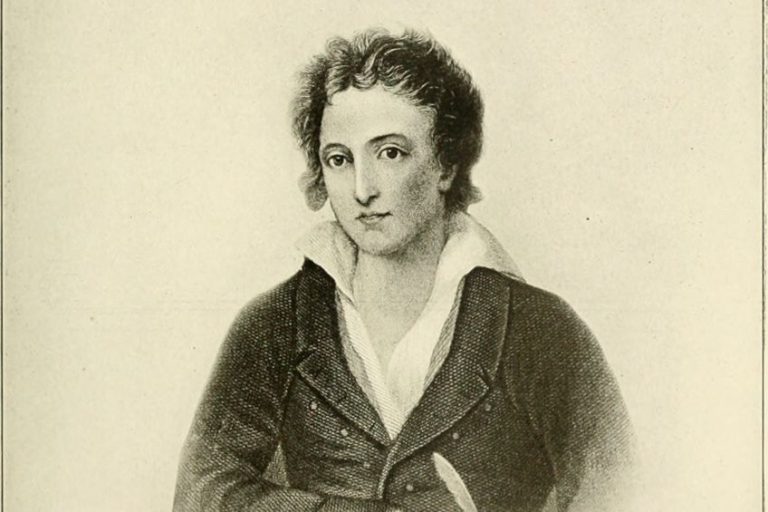
Me encanta «I met a traveller from an antique land» porque es un verso de apertura impresionante.
Para mí, es un poema que invita a la reflexión, un soneto (14 versos) sobre la inevitable caída de los gobernantes poderosos. Shelley fue una de las grandes figuras del romanticismo inglés y aquí usa herramientas literarias avanzadas como la aliteración con frases como ‘boundless and bare’, ‘lone and level’ y ‘sands stretch’.
I met a traveller from an antique land,
Who said — "Two vast and trunkless legs of stone
Stand in the desert. . . . Near them, on the sand,
Half sunk a shattered visage lies, whose frown,
And wrinkled lip, and sneer of cold command,
Tell that its sculptor well those passions read
Which yet survive, stamped on these lifeless things,
The hand that mocked them, and the heart that fed;
And on the pedestal, these words appear:
My name is Ozymandias, King of Kings;
Look on my Works, ye Mighty, and despair!
Nothing beside remains. Round the decay
Of that colossal Wreck, boundless and bare
The lone and level sands stretch far away."
Poema 7: «Sonnet 18» de William Shakespeare (1609)
«Shall I compare thee to a summer’s day? / Thou art more lovely and more temperate».
Este es quizás el más conocido de los 154 sonetos de Shakespeare. En él, el hablante se pregunta si debe comparar al Fair Youth con un día de verano, pero nota que tiene cualidades que superan un día de verano, lo cual es uno de los temas del poema. Aquí exhibe la forma poética del soneto con sus metáforas y comparaciones.
Shall I compare thee to a summer's day?
Thou art more lovely and more temperate:
Rough winds do shake the darling buds of May,
And summer's lease hath all too short a date;
Sometime too hot the eye of heaven shines,
And often is his gold complexion dimm'd;
And every fair from fair sometime declines,
By chance or nature's changing course untrimm'd;
But thy eternal summer shall not fade,
Nor lose possession of that fair thou ow'st;
Nor shall death brag thou wander'st in his shade,
When in eternal lines to time thou grow'st:
   So long as men can breathe or eyes can see,
   So long lives this, and this gives life to thee.
Poema 8: «Paradise Lost» Libro 1 de John Milton (1667)
Este poema épico comienza con estos versos: «Of Man’s First Disobedience, and the Fruit / Of that Forbidden Tree, whose mortal taste Brought Death into the World, and all our woe.» Y así informa al lector sobre toda la trama que va a relatar. El mandato de Milton es para esta Musa que «Sing», que instruya, inspire y lo apoye en su composición, diseñada con el propósito de afirmar «th’ Eternal Providence» y justificar «the wayes of God to Men».
Es un poema épico extraordinario que trata todo tipo de grandes temas que involucran tanto el bien como el mal, así como el libre albedrío. Utiliza una gama de complejidades, en particular formas lingüísticas arcaicas.
OF Mans First Disobedience, and the Fruit
Of that Forbidden Tree, whose mortal taste
Brought Death into the World, and all our woe,
With loss of Eden, till one greater Man
Restore us, and regain the blissful Seat,
Sing Heav'nly Muse, that on the secret top
Of Oreb, or of Sinai, didst inspire
That Shepherd, who first taught the chosen Seed,
In the Beginning how the Heav'ns and Earth
Rose out of Chaos: or if Sion Hill
Delight thee more, and Siloa's brook that flow'd
Fast by the Oracle of God; I thence
Invoke thy aid to my adventrous Song,
That with no middle flight intends to soar
Above th' Aonian Mount, while it pursues
Things unattempted yet in Prose or Rhime.
And chiefly Thou, O Spirit, that dost prefer
Before all Temples th' upright heart and pure,
Instruct me, for Thou know'st; Thou from the first
Wast present, and with mighty wings outspread
Dove-like satst brooding on the vast Abyss
And mad'st it pregnant: What in me is dark
Illumin, what is low raise and support;
That to the highth of this great Argument
I may assert Eternal Providence,
And justifie the wayes of God to men.
(...)
El poema completo puede leerse aquí.
Poema 9: «Ode to a Nightingale» de John Keats (1819)
«My heart aches, and a drowsy numbness pains, / My sense, as though of hemlock I had drunk» son los versos de apertura directos y vívidos.
Compuesto en Hampstead, Londres: es un poema romántico complejo que trata sobre la mortalidad, la belleza y la naturaleza.
My heart aches, and a drowsy numbness pains
         My sense, as though of hemlock I had drunk,
Or emptied some dull opiate to the drains
         One minute past, and Lethe-wards had sunk:
'Tis not through envy of thy happy lot,
         But being too happy in thine happiness,—
                That thou, light-winged Dryad of the trees
                        In some melodious plot
         Of beechen green, and shadows numberless,
                Singest of summer in full-throated ease.

O, for a draught of vintage! that hath been
         Cool'd a long age in the deep-delved earth,
Tasting of Flora and the country green,
         Dance, and Provençal song, and sunburnt mirth!
O for a beaker full of the warm South,
         Full of the true, the blushful Hippocrene,
                With beaded bubbles winking at the brim,
                        And purple-stained mouth;
         That I might drink, and leave the world unseen,
                And with thee fade away into the forest dim:

Fade far away, dissolve, and quite forget
         What thou among the leaves hast never known,
The weariness, the fever, and the fret
         Here, where men sit and hear each other groan;
Where palsy shakes a few, sad, last gray hairs,
         Where youth grows pale, and spectre-thin, and dies;
                Where but to think is to be full of sorrow
                        And leaden-eyed despairs,
         Where Beauty cannot keep her lustrous eyes,
                Or new Love pine at them beyond to-morrow.
(...)
El poema completo puede encontrarse aquí.
Poema 10: «The Waste Land» – Extracto: «The Burial of the Dead» – de T.S. Eliot (1922)
«April is the cruellest month, breeding, / Lilacs out of the dead land, mixing / Memory and desire, stirring / Dull roots with spring rain».
Conocido por su dificultad, este poema es difícil de comprender, lleno de referencias culturales oblicuas, estructuras fragmentadas y un rico simbolismo.
April is the cruellest month, breeding
Lilacs out of the dead land, mixing
Memory and desire, stirring
Dull roots with spring rain.
Winter kept us warm, covering
Earth in forgetful snow, feeding
A little life with dried tubers.
Summer surprised us, coming over the Starnbergersee
With a shower of rain; we stopped in the colonnade,
And went on in sunlight, into the Hofgarten,
And drank coffee, and talked for an hour.
Bin gar keine Russin, stamm' aus Litauen, echt deutsch.
And when we were children, staying at the archduke's,
My cousin's, he took me out on a sled,
And I was frightened. He said, Marie,
Marie, hold on tight. And down we went.
In the mountains, there you feel free.
I read, much of the night, and go south in the winter.
El poema completo puede leerse aquí.
Conclusión
Estos diez poemas en inglés recomendados para estudiantes son solo una pequeña selección de la enorme cantidad de hermosa poesía creada por poetas de habla inglesa a lo largo de los siglos.
Esperamos que te inspiren a profundizar más en las complejidades, la imaginería impactante y el significado profundo producido por los más asombrosos magos del idioma inglés que la historia nos ha dado.