


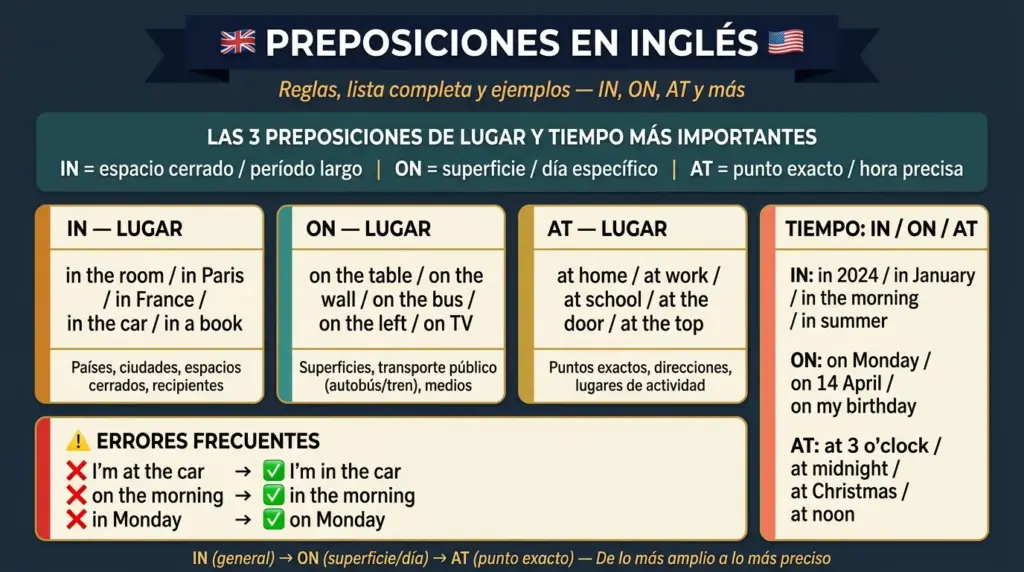
- In / On / At (lugar): in para un espacio cerrado, on para una superficie, at para un punto preciso
- In / On / At (tiempo): in para períodos largos, on para días y fechas, at para horas y momentos precisos
- Since / For: since indica un punto de partida (desde cuándo), for indica una duración (durante cuánto tiempo)
- Verbos + preposición: las combinaciones son fijas y no lógicas: listen to, look for, wait for… se aprenden de memoria
- Preposición al final de la frase: en inglés coloquial, la preposición puede colocarse después del verbo, como en Who are you waiting for?
Las preposiciones en inglés plantean dificultades particulares a los hispanohablantes: una misma preposición en español a menudo corresponde a varias preposiciones en inglés según el contexto, y viceversa. In, on y at se traducen las tres como «a», «en» o «dentro de» según la situación.
¿Qué es una preposición en inglés?
Una preposición es una palabra corta e invariable que conecta un sustantivo, un pronombre o un grupo nominal con el resto de la oración. Especifica una relación de lugar, tiempo, dirección, causa o pertenencia.
| Tipo | Preposiciones comunes | Ejemplo |
|---|---|---|
| Lugar | in, on, at, above, below, behind, between, near, next to, in front of | The keys are on the table. |
| Tiempo | in, on, at, before, after, during, since, for, by, until | She arrives at 9am. |
| Dirección | to, into, towards, from, out of, through, across | He walked into the room. |
| Causa / Propósito | because of, thanks to, for, due to | She stayed home because of the rain. |
| Pertenencia | of | The title of the book. |
| Agente / Medio | by, with | The painting was done by hand. |
En inglés, la preposición se coloca normalmente antes de su complemento. A diferencia del español, el inglés coloquial acepta e incluso prefiere colocar la preposición al final de la frase, especialmente en preguntas y oraciones relativas.
Who are you waiting for? (¿A quién esperas?)
That’s the colleague I told you about. (Es el colega del que te hablé.)
This is the house I grew up in. (Es la casa donde crecí.)
La forma formal desplaza la preposición antes de la palabra interrogativa o relativa: For whom are you waiting? / This is the house in which I grew up. Estas construcciones son gramaticalmente correctas pero poco naturales al hablar.
In, On, At: preposiciones de lugar
Estas tres preposiciones comparten traducciones comunes al español, lo que las hace difíciles de distinguir. La lógica espacial es la clave.
| Preposición | Uso | Ejemplos |
|---|---|---|
| In | Espacio cerrado o delimitado (ciudad, país, habitación, caja) | in the kitchen, in Paris, in France, in a box |
| On | Superficie horizontal o vertical, transporte (autobús, tren, avión) | on the table, on the wall, on the bus, on the phone |
| At | Punto preciso, dirección, lugar funcional | at the door, at 5 Main Street, at school, at work, at home |
Excepción transporte: se usa in (y no on) para el coche y el taxi: She’s in the car. Para todos los demás transportes colectivos (autobús, tren, avión, metro), es on.
Algunos casos frecuentes para memorizar:
| Expresión | Traducción | Observación |
|---|---|---|
| at the top / bottom | arriba / abajo | punto preciso en una escala |
| in the corner (of a room) | en la esquina (de una habitación) | espacio delimitado |
| on the corner (of a street) | en la esquina (de una calle) | superficie, punto de encuentro |
| at the corner | en la esquina (punto preciso) | posición exacta |
| in the newspaper | en el periódico | espacio delimitado (páginas) |
| on TV / on the radio | en la tele / en la radio | superficie/canal de difusión |
In, On, At: preposiciones de tiempo
La misma lógica se aplica al tiempo: in para períodos largos, on para días y fechas precisos, at para horas y momentos puntuales.
| Preposición | Uso | Ejemplos |
|---|---|---|
| In | Meses, años, estaciones, siglos, partes del día (excepto at night) | in March, in 2010, in summer, in the morning, in the 20th century |
| On | Días de la semana, fechas precisas, festividades (con artículo) | on Monday, on 14 July, on Christmas Day, on my birthday |
| At | Horas precisas, momentos puntuales, períodos festivos (sin artículo) | at 6pm, at noon, at midnight, at Christmas, at Easter |
Excepciones comunes: at night (y no in the night, excepto para una noche específica). At the weekend (inglés británico) vs on the weekend (inglés americano). No hay preposición delante de last, next, this, every: I saw her last Monday / every Friday.
Since, For, During, By, Until
Estas preposiciones expresan duración o posición en el tiempo y a menudo se confunden.
| Preposición | Uso | Ejemplo |
|---|---|---|
| Since | Punto de partida (con present perfect o past perfect) | I’ve lived here since 2018. |
| For | Duración total | I’ve lived here for six years. |
| During | Dentro de un período nombrado | He fell asleep during the film. |
| By | A más tardar, límite de tiempo | Send the report by Friday. |
| Until / Till | Hasta un momento preciso (continuidad) | The shop is open until 8pm. |
She has worked here since January. Ella trabaja aquí desde enero. (punto de partida preciso)
She has worked here for three months. Ella trabaja aquí desde hace tres meses. (duración)
Finish this by Monday. Termine esto para el lunes / a más tardar el lunes.
Wait here until I come back. Espera aquí hasta que vuelva.
To, Into, Towards, From: preposiciones de dirección
Las preposiciones de dirección expresan un movimiento o una trayectoria. Se distinguen de las de lugar, que indican una posición estática.
| Preposición | Sentido | Ejemplo |
|---|---|---|
| to | Hacia un destino (con verbo de movimiento) | She went to the office. |
| into | Movimiento hacia el interior (penetración) | He walked into the building. |
| towards | En dirección a (sin necesariamente alcanzar) | She looked towards the window. |
| from | Punto de partida | The train from London arrives at noon. |
| out of | Movimiento hacia el exterior | She walked out of the room. |
| through | A través, de un lado a otro | They drove through the tunnel. |
| across | De un lado a otro (sobre una superficie) | She swam across the river. |
Go home sin preposición: a diferencia del español «volver a casa», el inglés no usa preposición delante de home con un verbo de movimiento. I’m going home es correcto, no I’m going to home.
Verbos seguidos de una preposición
En inglés, muchos verbos forman combinaciones fijas con una preposición. Estas asociaciones no se deducen lógicamente y se aprenden frase por frase. Aquí están los grupos más comunes.
Look + preposición
| Expresión | Sentido | Ejemplo |
|---|---|---|
| look at | mirar (algo) | Look at that painting. |
| look for | buscar | I’m looking for my keys. |
| look after | cuidar de | She looks after her neighbour’s cat. |
| look into | examinar, investigar | We will look into the matter. |
| look forward to | esperar con impaciencia | I’m looking forward to the weekend. |
Otros verbos comunes + preposición
| Expresión | Sentido | Ejemplo |
|---|---|---|
| listen to | escuchar | She’s listening to a podcast. |
| wait for | esperar | We’ve been waiting for the bus. |
| ask for | pedir (algo) | He asked for advice. |
| talk to / with | hablar con | I need to talk to the manager. |
| arrive at / in | llegar a (lugar preciso) / a (ciudad, país) | She arrived at the airport. / They arrived in Tokyo. |
| depend on | depender de | It depends on the weather. |
| agree with / on | estar de acuerdo con / sobre | I agree with you. / We agreed on a plan. |
| apologise for | disculparse por | She apologised for being late. |
| consist of | constar de | The team consists of ten people. |
| belong to | pertenecer a | This bag belongs to my sister. |
Adjetivos seguidos de una preposición
Algunos adjetivos en inglés siempre se construyen con una preposición específica. Estas combinaciones a menudo difieren del español.
| Expresión | Sentido | Ejemplo |
|---|---|---|
| good at | bueno en | She’s good at maths. |
| bad at | malo en | I’m bad at spelling. |
| interested in | interesado en | He’s interested in history. |
| afraid of | tener miedo de | She’s afraid of spiders. |
| proud of | orgulloso de | They’re proud of their team. |
| responsible for | responsable de | He’s responsible for the project. |
| different from | diferente de | This model is different from the previous one. |
| similar to | similar a | The new version is similar to the old one. |
| married to | casado con | She’s married to a doctor. |
| full of | lleno de | The room was full of people. |
Error frecuente: different from (estándar en inglés británico y americano). Different than se usa en inglés americano en algunos contextos, different to en inglés británico informal. Different of siempre es incorrecto.
Ejercicio práctico
Pon a prueba tus conocimientos sobre las preposiciones en inglés:
Pregunta 1: She has been working at this company ___ 2019.
Pregunta 2: We met ___ a Tuesday ___ June.
Pregunta 3: Please submit your application ___ Friday.
Pregunta 4: She walked ___ the room without saying a word.
Pregunta 5: I’m not very good ___ cooking, but I enjoy it.
Pregunta 6: He arrived ___ the airport two hours early.
Pregunta 7: Can you look ___ my cat while I’m away?
Pregunta 8: This design is very different ___ what we had before.