

Here’s my list of the 10 best American and British comic books to learn English (for beginners, intermediate & advanced learners). Learning with comic books is one of the most enjoyable and effective strategies for language development and coming to terms with the basic rudiments of the English language. Comics combine visual storytelling with dialogue and help learners understand vocabulary and grammar. The images provide contextual clues, making it easier to grasp the meaning even if you don’t understand every word. These titles below are engaging, culturally significant, and linguistically rich.
Beginner Level
(which uses simple, accessible vocabulary, everyday expressions, and a degree of basic grammar and visual humour that supports any understanding)
1. Peanuts by Charles M. Schulz
Peanuts is a syndicated daily and Sunday American comic strip written and illustrated by Charles M. Schulz. This classic American comic strip follows Charlie Brown, Snoopy and their friends. The strip originally ran from 1950 to 2000. with 17,897 strips published in all, it makes it “arguably the longest story ever told by one human being”. It’s great for beginners as it has short, simple dialogue, everyday vocabulary, and clear emotional expressions.
2. Garfield by Jim Davis
Garfield is an American comic strip originally published locally as Jon in 1976 (later changed to Garfield in 1977). It chronicles the life of the title character, Garfield the cat, Odie the dog, and their owner Jon Arbuckle. It’s helpful as the grammar is simple, there are repetitive themes (food, sleep, laziness), and the humour is based on daily life. Garfield’s sarcastic personality helps learners understand tone and humour.
3. Winnie-the-Pooh by A. A. Milne

Originally based on the books by the British author A. A. Milne who named the character Winnie-the-Pooh after a teddy bear owned by his son, Christopher Robin Milne, the inspiration behind the character Christopher Robin. The remainder of Christopher Milne’s toys (Kanga, Roo, Piglet, Eeyore and Tigger) were incorporated into Milne’s stories. Two more characters, Owl and Rabbit, were introduced by Milne’s imagination. The comic adaptations are gentle and simple. It works for learners with soft, repetitive vocabulary, simple sentence patterns and clear emotional storytelling.
Intermediate Level
(these comics introduce more complex grammar and a more varied and expanded vocabulary with natural dialogue)
4. Archie by Bob Montana & Vic Bloom
Archie (aka Archie Comics and published from 1942 through 2020) is a comic book series featuring the Archie Comics character Archie Andrews. It’s a long-running American teen comic series set in high school. The title concluded in September 2020, but it has recently been announced that it would be relaunching the monthly ongoing series. It’s excellent for intermediate learners as the teenage conversations are realistic and there’s slang and informal speech.
5. Calvin & Hobbes by Bill Watterson
Bill Watterson’s Calvin and Hobbes is an iconic daily American strip blending childhood wonder, satire and imagination. With over 3000 published strips, one is introduced to both Calvin, an imaginative 6-year-old, and Hobbes, his tiger companion. Together they mix everyday childhood events, whether building snowmen, defying babysitters, or else considering life’s most immense questions beneath the stars. What makes it rated ‘intermediate level’ is the humour which often relies on wordplay, exaggeration and situations rather than complex vocabulary, which encourages learners to explore the subtle nuances in English.
6. The Beano published by DC Thomson
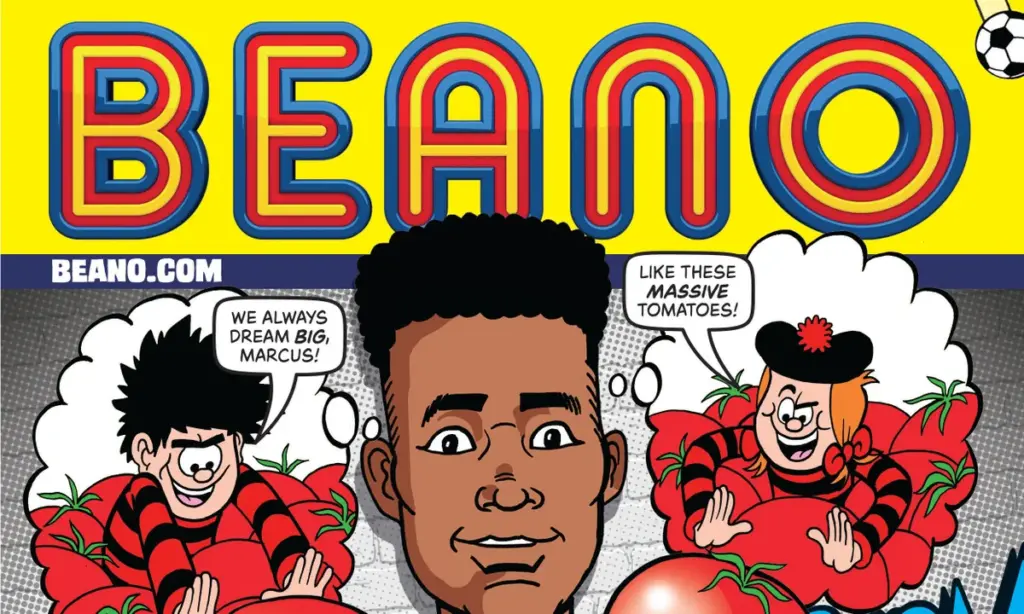
First issued in 1938, this famous British comic magazine began in Dundee. Its name comes from the word “beano,” which means “a party or a good time.” It features characters like Dennis the Menace, Minnie the Minx, Ivy the Terrible, General Jumbo, The Bash Street Kids, Roger the Dodger, Billy Whizz, Lord Snooty and His Pals, Jonah, and Biffo the Bear. It’s ideal for learning as there are British English expressions, humour-driven storytelling and short episodic stories.
7. Spider-Man published by Marvel Comics
Spider-Man (Peter Parker) was the original everyman superhero who appeared first in 1962 in American comic books published by Marvel Comics. As an American teenager, Peter Parker, a poor sickly orphan, is bitten by a radioactive spider. As a result of the bite, he gains superhuman strength, speed, and agility along with the ability to cling to walls. He’s been around for over five decades and has appeared in 788 issues. It’s good for intermediate learners as it balances dialogue and narration, includes emotional and action vocabulary, as well as everyday life mixed with superhero themes.
Advanced Level
(these comics contain deeper themes, advanced vocabulary, literary language and sophisticated dialogue which delivers faster, more complex sentence structures as well as regional accents and niche vocabulary)
8. Batman: The Dark Knight Returns by Frank Miller
This is a 1986 four-issue comic book mini-series which tells a version of 55-year-old Bruce Wayne, who returns from ten years of retirement to confront crime despite opposition from the Gotham City police force and the US government. It also features the return of his classic enemies, Two-Face and the Joker, and finishes in a confrontation with Superman, who is now in the thrall of the government.
It’s considered advanced as there are complex political themes, mature vocabulary, and the language is more literary and layered.
Perfect for learners aiming at near-native fluency.
9. Watchmen by Alan Moore
This is a comic book limited series by a British creative team. It depicts a different version of history in which superheroes emerged across the 1940s-1960s and in whose presence history was altered whereby the US won the Vietnam War and the Watergate scandal was never brought into the open. It’s challenging with its non-linear storytelling, philosophical discussions and rich symbolism.
It also exposes learners to formal and poetic language.
10. V for Vendetta by Alan Moore
Set in a dystopian UK, it revolves around a curious person behind a white porcelain mask, called V, whose idea for freeing the masses involves horrendous acts of terrorism. It’s linguistically demanding with political rhetoric, formal British English, and sophisticated dialogue. The character “V” also often speaks in elaborate, theatrical language.
Whether you’re a beginner starting with Peanuts, building fluency with Spider-Man, or challenging yourself with Watchmen, comic books offer a fun and powerful path to English mastery. By gradually moving from simple strips to complex graphic novels, you will not only expand your vocabulary, but also deepen your understanding of American and British culture.

This article was written by BIE’s blog contributor Adam Jacot de Boinod.