

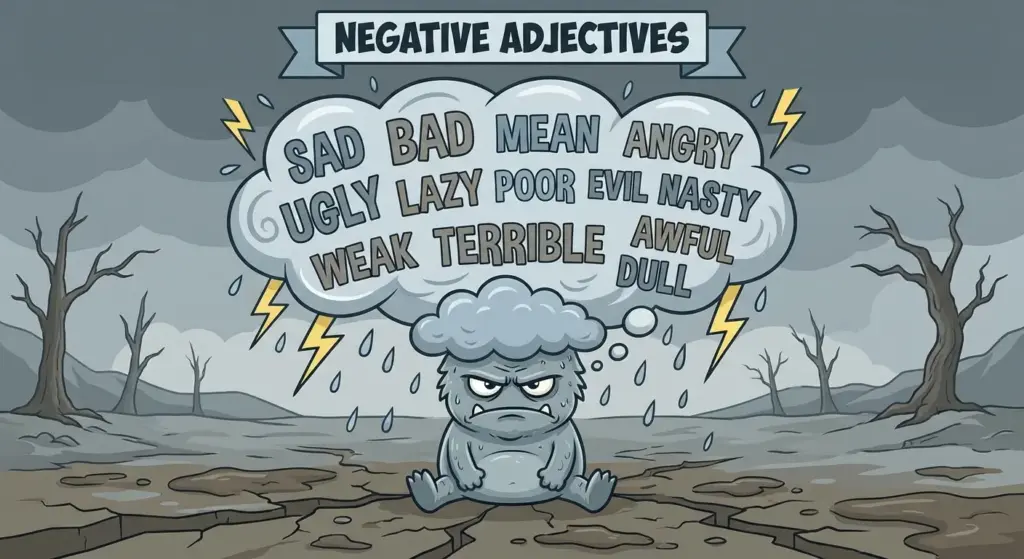
Negative Adjektive ermöglichen es Schreibern und Sprechern, ungünstige Eigenschaften, unangenehme Situationen oder kritische Meinungen präzise zu beschreiben. Die Beherrschung dieses Wortschatzes hilft direkt im beruflichen Alltag und beim Geschichtenerzählen, indem es Nuancen zu Beschreibungen von Personen, Orten und Objekten hinzufügt, die über einfache Begriffe wie «bad» oder «sad» hinausgehen.
Negative Adjektive für Persönlichkeit und Charakter
- Abrasive : Showing little concern for the feelings of others — Harsh, rough
- Aggressive : Ready to attack or confront — Hostile, belligerent
- Aloof : Not friendly or forthcoming; cool and distant — Detached, standoffish
- Amoral : Lacking a moral sense; unconcerned with the rightness or wrongness of something — Unprincipled
- Angry : Feeling or showing strong annoyance or hostility — Irate, furious
- Apathetic : Showing or feeling no interest or enthusiasm — Indifferent, uninterested
- Arrogant : Having an exaggerated sense of one’s own importance — Haughty, conceited
- Artificial : Insincere or affected — Fake, phony
- Authoritarian : Favoring or enforcing strict obedience to authority — Dictatorial, domineering
- Belligerent : Hostile and aggressive — Combative, threatening
- Bigoted : Obstinately attached to a belief or opinion, often prejudiced — Intolerant, narrow-minded
- Boastful : Showing excessive pride in one’s own achievements — Bragging, crowing
- Boring : Not interesting; tedious — Dull, monotonous
- Bossy : Fond of giving people orders; domineering — Overbearing, controlling
- Callous : Showing or having an insensitive and cruel disregard for others — Heartless, cold
- Careless : Not giving sufficient attention to avoiding harm or errors — Negligent, sloppy
- Childish : Silly and immature — Infantile, puerile
- Clingy : Too dependent on someone else — Needy, possessive
- Compulsive : Resulting from an irresistible urge — Obsessive, uncontrollable
- Cowardly : Lacking courage — Fearful, spineless
- Critical : Expressing disapproving comments or judgments — Judgmental, fault-finding
- Cruel : Willfully causing pain or suffering to others — Brutal, inhumane
- Cynical : Believing that people are motivated by self-interest — Skeptical, distrustful
- Deceitful : Guilty of or involving deception — Dishonest, untrustworthy
- Defensive : Very anxious to challenge or avoid criticism — Protective, guarded
- Demanding : Making others work hard or meet high standards — Exacting, difficult
- Dishonest : Behaving or prone to behave in an untrustworthy or fraudulent way — Deceptive, lying
- Disloyal : Failing to be loyal to a person, country, or organization — Unfaithful, treacherous
- Disobedient : Refusing to obey rules or someone in authority — Defiant, unruly
- Disorganized : Not properly planned or controlled — Chaotic, messy
- Disrespectful : Showing a lack of respect or courtesy — Impolite, rude
- Domineering : Asserting one’s will over another in an arrogant way — Overbearing, imperious
- Egotistical : Excessively conceited or absorbed in oneself — Self-centered, selfish
- Envious : Feeling or showing envy — Jealous, covetous
- Fickle : Changing frequently, especially as regards one’s loyalties or affections — Capricious, variable
- Finicky : Fussy about one’s needs or requirements — Picky, fastidious
- Flaky : Unreliable or unconventional — Undependable, eccentric
- Foolish : Lacking good sense or judgment — Stupid, unwise
- Forgetful : Apt or likely not to remember — Absent-minded
- Frivolous : Not having any serious purpose or value — Trivial, silly
- Greedy : Having an intense and selfish desire for something, especially wealth or power — Avaricious, grasping
- Grumpy : Bad-tempered and irritable — Cantankerous, grouchy
- Gullible : Easily persuaded to believe something — Credulous, naive
- Hateful : Arousing, deserving, or filled with hatred — Loathsome, detestable
- Hostile : Unfriendly; antagonistic — Opposed, aggressive
- Humorless : Lacking a sense of humor — Serious, dry
- Hypocritical : Behaving in a way that suggests one has higher standards than is the case — Insincere, two-faced
- Ignorant : Lacking knowledge or awareness in general — Uneducated, uninformed
- Impatience : Having or showing a tendency to be quickly irritated or provoked — Restless, short-tempered
- Impulsive : Acting or done without forethought — Rash, hasty
- Incompetent : Not having or showing the necessary skills to do something successfully — Unskilled, inept
- Indecisive : Not providing a clear and definite result — Hesitant, uncertain
- Inflexible : Unwilling to change or compromise — Rigid, obstinate
- Insecure : Uncertain or anxious about oneself; not confident — Unconfident, self-doubting
- Insensitive : Showing or feeling no concern for others’ feelings — Thoughtless, unfeeling
- Intolerant : Not tolerant of views, beliefs, or behavior that differ from one’s own — Bigoted, narrow-minded
- Irresponsible : Not showing a proper sense of responsibility — Reckless, unreliable
- Jealous : Feeling or showing envy of someone or their achievements — Envious, resentful
- Judgmental : Having or displaying an excessively critical point of view — Critical, disapproving
- Lazy : Unwilling to work or use energy — Indolent, slothful
- Machiavellian : Cunning, scheming, and unscrupulous — Devious, crafty
- Malicious : Intending or intended to do harm — Spiteful, malevolent
- Manipulative : Exercising unscrupulous control or influence over a person or situation — Controlling, scheming
- Materialistic : Excessively concerned with material possessions — Money-oriented, consumerist
- Mean : Unkind, spiteful, or unfair — Nasty, cruel
- Moody : Giving an impression of melancholy or mystery — Temperamental, glum
- Naive : Showing a lack of experience, wisdom, or judgment — Innocent, unsophisticated
- Narcissistic : Having an excessive interest in oneself and one’s physical appearance — Vain, self-obsessed
- Narrow-minded : Not willing to listen to or tolerate other people’s views — Intolerant, prejudiced
- Neglectful : Not giving proper care or attention to someone or something — Remiss, careless
- Neurotic : Abnormally sensitive, obsessive, or anxious — Unstable, nervous
- Obnoxious : Extremely unpleasant — Offensive, repulsive
- Obsessive : Of the nature of an obsession — Fixated, consuming
- Obstinate : Stubbornly refusing to change one’s opinion — Stubborn, mulish
- Overbearing : Unpleasantly overpowering — Domineering, oppressive
- Paranoid : Unreasonably or obsessively anxious, suspicious, or mistrustful — Suspicious, fearful
- Passive : Accepting or allowing what happens or what others do, without active response — Submissive, inactive
- Pathetic : Arousing pity, especially through vulnerability or sadness — Pitiful, feeble
- Pessimistic : Tending to see the worst aspect of things — Negative, gloomy
- Petty : Of little importance; trivial — Trivial, minor
- Possessive : Demanding someone’s total attention and love — Controlling, jealous
- Prejudiced : Having or showing a dislike or distrust that is derived from prejudice — Biased, discriminatory
- Pretentious : Attempting to impress by affecting greater importance than is actually possessed — Ostentatious, showy
- Reckless : Without thinking or caring about the consequences of an action — Rash, careless
- Resentful : Feeling or expressing bitterness or indignation — Bitter, aggrieved
- Rigid : Not able to be changed or adapted — Inflexible, unyielding
- Ruthless : Having or showing no pity or compassion for others — Merciless, cruel
- Sarcastic : Marked by or given to using irony in order to mock or convey contempt — Sardonic, snarky
- Scheming : Given to or involved in making secret and underhanded plans — Conniving, calculating
- Secretive : Inclined to conceal feelings and intentions or not to disclose information — Reticent, guarded
- Selfish : Lacking consideration for others; concerned chiefly with one’s own personal profit or pleasure — Egotistical, self-centered
- Shallow : Not exhibiting, requiring, or capable of serious thought — Superficial, trivial
- Short-tempered : Quick to lose one’s temper — Irascible, touchy
- Sneaky : Furtive; sly — Underhanded, deceitful
- Snobbish : Relating to or characteristic of a snob — Elitist, superior
- Spoiled : Harmed in character by being treated too leniently — Pampered, indulged
- Stingy : Unwilling to give or spend; ungenerous — Miserly, tight-fisted
- Stubborn : Having or showing dogged determination not to change one’s attitude — Obstinate, headstrong
- Stupid : Lacking intelligence or common sense — Unintelligent, foolish
- Superficial : Existing or occurring at or on the surface — Shallow, external
- Suspicious : Having or showing a cautious distrust of someone or something — Mistrustful, wary
- Tactless : Having or showing a lack of adroitness and sensitivity in dealing with others — Undiplomatic, insensitive
- Temperamental : Liable to unreasonable changes of mood — Volatile, emotional
- Thoughtless : Not showing consideration for the needs of other people — Inconsiderate, selfish
- Timid : Showing a lack of courage or confidence — Shy, fearful
- Touchy : Overly sensitive and irritable — Oversensitive, defensive
- Unreliable : Not able to be relied upon — Untrustworthy, dependable
- Unstable : Prone to change, fail, or give way — Volatile, insecure
- Vain : Having or showing an excessively high opinion of one’s appearance — Conceited, narcissistic
- Vengeful : Seeking to harm someone in return for a perceived injury — Vindictive, revengeful
- Violent : Using or involving physical force intended to hurt — Brutal, aggressive
- Volatile : Liable to change rapidly and unpredictably, especially for the worse — Unpredictable, explosive
- Vulgar : Lacking sophistication or good taste — Rude, coarse
- Weak-willed : Lacking the determination to achieve something — Spineless, submissive
- Withdrawn : Not wanting to communicate with other people — Introverted, reclusive
Negative Adjektive für körperliches Erscheinungsbild
- Bald : Having a scalp wholly or partly lacking hair (can be used negatively in descriptions) — Hairless
- Blemished : Spoiled by imperfections — Flawed, spotted
- Bloated : Swollen with fluid or gas — Puffy, distended
- Bony : Very thin so that the bones are visible — Skeletal, emaciated
- Chubby : Plump and rounded — Plump, rotund
- Clumsy : Awkward in movement or in handling things — Ungraceful, awkward
- Disfigured : Spoiled in appearance — Deformed, scarred
- Disheveled : Untidy; disordered — Messy, unkempt
- Dowdy : Unfashionable and without style — Frumpy, drab
- Drab : Lacking brightness or interest; drearily dull — Dull, colorless
- Emaciated : Abnormally thin or weak — Gaunt, skeletal
- Fat : Having a large amount of excess flesh — Overweight, obese
- Filthy : Disgustingly dirty — Grimy, muck-covered
- Flabby : Soft, loose, and fleshy — Sagging, untoned
- Frail : Weak and delicate — Fragile, feeble
- Frumpy : Old-fashioned and untidy — Dowdy, unstylish
- Gangly : Tall, thin, and awkward — Lanky, awkward
- Gaunt : Lean and haggard, especially because of suffering, hunger, or age — Haggard, drawn
- Ghastly : Causing great horror or fear; frightful or macabre — Deathly, pale
- Greasy : Covered with or resembling an oily substance — Oily, slick
- Grimy : Covered with grime; dirty — Filthy, sooty
- Grotesque : Comically or repulsively ugly or distorted — Malformed, monstrous
- Haggard : Looking exhausted and unwell — Drained, gaunt
- Hideous : Extremely ugly — Repulsive, unsightly
- Homely : Unattractive in appearance — Plain, unattractive
- Ill-proportioned : Not having parts that relate well to each other — Misshapen
- Lanky : Ungracefully thin and tall — Gangling, tall
- Mangled : Severely mutilated, disfigured, or damaged — Crushed, twisted
- Messy : Untidy or dirty — Disordered, chaotic
- Obese : Grossly fat or overweight — Corpulent, heavy
- Pale : Light in color or having little color — Wan, pallid
- Plain : Not decorated or elaborate; simple or ordinary in character — Unadorned, simple
- Pudgy : Slightly fat — Chubby, tubby
- Repulsive : Arousing intense distaste or disgust — Revolting, disgusting
- Scrawny : Unattractively thin and bony — Skinny, gaunt
- Scruffy : Shabby and untidy or dirty — Ragged, unkempt
- Shabby : In poor condition through long or hard use or lack of care — Worn, threadbare
- Sickly : Often ill; in poor health — Unhealthy, ailment-prone
- Skeletal : Very thin; emaciated — Bony, gaunt
- Skinny : Unattractively thin — Underweight, thin
- Sloppy : Careless and unsystematic; excessively casual — Untidy, messy
- Slouching : Standing, moving, or sitting in a lazy, drooping way — Stooped, drooping
- Stout : Somewhat fat or of heavy build — Portly, rotund
- Sweaty : Covered in sweat — Perspiring, damp
- Tacky : Showing poor taste and quality — Cheap, gaudy
- Ugly : Unpleasant or repulsive, especially in appearance — Unattractive, hideous
- Unattractive : Not pleasing or appealing to look at — Plain, ugly
- Ungainly : Awkward; clumsy — Clumsy, awkward
- Unkempt : Having an untidy or disheveled appearance — Messy, disordered
- Unsightly : Unpleasant to look at; ugly — Eyesore, hideous
- Wrinkled : Having slight lines or folds — Creased, lined
Negative Adjektive für Emotionen und Gefühle
- Afraid : Feeling fear or anxiety — Scared, frightened
- Agitated : Feeling or appearing troubled or nervous — Upset, flustered
- Alarmed : Cause to feel frightened, disturbed, or in danger — Frightened, panicked
- Alienated : Experiencing or inducing feelings of isolation or estrangement — Isolated, estranged
- Angry : Feeling or showing strong annoyance, displeasure, or hostility — Mad, furious
- Annoyed : Slightly angry; irritated — Irritated, bothered
- Anxious : Experiencing worry, unease, or nervousness — Worried, uneasy
- Apprehensive : Anxious or fearful that something bad or unpleasant will happen — Uneasy, concerned
- Ashamed : Embarrassed or guilty because of one’s actions — Guilty, embarrassed
- Bewildered : Perplexed and confused; very puzzled — Confused, baffled
- Bitter : Angry, hurt, or resentful because of one’s bad experiences — Resentful, sour
- Bored : Feeling weary and restless through lack of interest — Uninterested, tired
- Confused : Unable to think clearly; bewildered — Puzzled, disoriented
- Crushed : Deformed, pulverized, or forced inwards by compression — Devastated, heartbroken
- Defeated : Having been beaten in a battle or other contest — Beaten, conquered
- Depressed : In a state of general unhappiness or despondency — Sad, miserable
- Desperate : Feeling, showing, or involving a hopeless sense that a situation is so bad as to be impossible to deal with — Hopeless, frantic
- Devastated : Destroyed or ruined — Shattered, ruined
- Disappointed : Sad or displeased because someone or something has failed to fulfill one’s hopes or expectations — Let down, dissatisfied
- Discouraged : Having lost confidence or enthusiasm; disheartened — Disheartened, dispirited
- Disgusted : Feeling or showing an intense revulsion or disapproval — Repulsed, sickened
- Distressed : Suffering from anxiety, sorrow, or pain — Upset, troubled
- Disturbed : Having had its normal pattern or function disrupted — Troubled, unsettled
- Embarrassed : Feeling or showing embarrassment — Ashamed, humiliated
- Enraged : Very angry; furious — Furious, irate
- Exhausted : Drained of one’s physical or mental resources; very tired — Tired, fatigued
- Fearful : Feeling afraid; showing fear or anxiety — Scared, terrified
- Frustrated : Feeling or expressing distress and annoyance — Exasperated, annoyed
- Furious : Extremely angry — Enraged, livid
- Grieving : Suffering grief — Mourning, sorrowing
- Guilty : Culpable of or responsible for a specified wrongdoing — Culpable, remorseful
- Helpless : Unable to defend oneself or to act without help — Powerless, weak
- Hopeless : Feeling or causing despair about something — Despairing, futile
- Horrified : Filled with horror; extremely shocked — Shocked, appalled
- Humiliated : Make (someone) feel ashamed and foolish by injuring their dignity and self-respect — Disgraced, shamed
- Hurt : Physically or mentally injured — Injured, wounded
- Inadequate : Lacking the quality or quantity required; insufficient for a purpose — Insufficient, deficient
- Insulted : Disrespectful or scornfully abusive — Offended, slighted
- Irritated : Showing or feeling slight anger; annoyed — Annoyed, bothered
- Lonely : Sad because one has no friends or company — Isolated, solitary
- Lost : Unable to find one’s way; not knowing one’s whereabouts — Disoriented, misplaced
- Melancholy : A feeling of pensive sadness, typically with no obvious cause — Sadness, sorrow
- Miserable : Wretchedly unhappy or uncomfortable — Unhappy, sad
- Mortified : Cause (someone) to feel embarrassed, ashamed, or humiliated — Humiliated, ashamed
- Nervous : Easily agitated or alarmed; tending to be anxious; highly strung — Anxious, edgy
- Overwhelmed : Bury or drown beneath a huge mass — Overpowered, inundated
- Panic-stricken : Affected with panic; very frightened — Terrified, panicked
- Powerless : Without ability, influence, or power — Helpless, impotent
- Regretful : Feeling or showing regret — Remorseful, sorry
- Rejected : Dismiss as inadequate, inappropriate, or not to one’s taste — Refused, declined
- Remorseful : Filled with remorse; sorry — Regretful, sorry
- Resentful : Feeling or expressing bitterness or indignation at having been treated unfairly — Bitter, aggrieved
- Sad : Feeling or showing sorrow; unhappy — Unhappy, sorrowful
- Scared : Fearful; frightened — Afraid, terrified
- Shocked : Cause (someone) to feel surprised and upset — Surprised, stunned
- Sorrowful : Feeling or showing grief — Sad, unhappy
- Stressed : Subject to pressure or tension — Anxious, strained
- Terrified : Cause to feel extreme fear — Frightened, scared
- Threatened : State one’s intention to take hostile action against someone in retribution for something done or not done — Intimidated, endangered
- Tired : In need of sleep or rest; weary — Exhausted, sleepy
- Troubled : Beset by problems or conflict — Worried, anxious
- Unhappy : Not happy — Sad, miserable
- Unwanted : Not or no longer desired — Unwelcome, rejected
- Upset : Make (someone) unhappy, disappointed, or worried — Distressed, troubled
- Vulnerable : Susceptible to physical or emotional attack or harm — Exposed, defenseless
- Worried : Anxious or troubled about actual or potential problems — Anxious, concerned
- Worthless : Having no real value or use — Useless, valueless
Negative Adjektive für Orte und Umgebungen
- Abandoned : Having been deserted or cast off — Deserted, forsaken
- Barren : Too poor to produce much or any vegetation — Desolate, infertile
- Bleak : Charmless and inhospitable; dreary — Dreary, desolate
- Chaotic : In a state of complete confusion and disorder — Disordered, messy
- Claustrophobic : Inducing claustrophobia — Confining, cramping
- Cold : Of or at a low or relatively low temperature — Chilly, freezing
- Congested : So crowded with traffic or people as to hinder freedom of movement — Crowded, blocked
- Contaminated : Make (something) impure by exposure to or addition of a poisonous or polluting substance — Polluted, tainted
- Cramped : Uncomfortably small or restricted — Confined, restricted
- Crowded : Full of people, leaving little or no room for movement; packed — Packed, congested
- Damp : Slightly wet — Moist, humid
- Dangerous : Able or likely to cause harm or injury — Hazardous, risky
- Dark : With little or no light — Dim, gloomy
- Dead : No longer alive — Deceased, lifeless
- Decaying : Rotting or decomposing — Rotting, decomposing
- Depressing : Causing misery or despondency — Dismal, gloomy
- Desolate : Bleak and dismal emptiness — Barren, stark
- Dilapidated : In a state of disrepair or ruin as a result of age or neglect — Run-down, ramshackle
- Dirty : Covered or marked with an unclean substance — Filthy, soiled
- Dismal : Depressing; dreary — Gloomy, bleak
- Dreary : Dull, bleak, and lifeless; depressing — Dull, boring
- Dusty : Covered with, full of, or resembling dust — Dirty, powdery
- Eerie : Strange and frightening — Spooky, creepy
- Forbidding : Unfriendly or threatening in appearance — Hostile, unwelcoming
- Foul : Offensive to the senses, especially through having a disgusting smell or taste — Disgusting, repulsive
- Frozen : Turned into ice or become solid because of cold — Icy, frigid
- Gloomy : Dark or poorly lit; causing feelings of sadness — Dim, somber
- Hazardous : Risky; dangerous — Perilous, unsafe
- Hostile : Unfriendly; antagonistic — Unwelcoming, aggressive
- Impoverished : Made poor — Poverty-stricken, deprived
- Inhospitable : Not welcoming or generous to visitors or guests — Unwelcoming, unfriendly
- Isolated : Far away from other places, buildings, or people — Remote, secluded
- Lonely : Unfrequented and remote; isolated — Desolate, solitary
- Misty : Full of, covered with, or accompanied by mist — Foggy, hazy
- Muddy : Covered in or full of mud — Mucky, dirty
- Musty : Having a stale, moldy, or damp smell — Stale, moldy
- Neglected : Not receiving proper attention; disregarded — Abandoned, uncared-for
- Noisy : Making or given to making a lot of noise — Loud, clamorous
- Oppressive : Inflicting harsh and authoritarian treatment — Harsh, tyrannical
- Overcrowded : Filled with an excessive number of people — Congested, packed
- Polluted : Contaminated with harmful or poisonous substances — Contaminated, tainted
- Remote : Far away in distance or time — Isolated, distant
- Rough : Having an uneven or irregular surface — Uneven, rugged
- Rundown : In a poor or neglected state after having been prosperous — Dilapidated, decrepit
- Secluded : Not seen or visited by many people; sheltered and private — Isolated, private
- Shabby : In poor condition through long use or lack of care — Dilapidated, worn
- Sinister : Giving the impression that something harmful or evil is happening or will happen — Threatening, ominous
- Squalid : Extremely dirty and unpleasant, especially as a result of poverty or neglect — Filthy, wretched
- Stale : No longer fresh and pleasant to eat; hard, musty, or dry — Old, musty
- Stifling : Making one feel constrained or oppressed — Suffocating, oppressive
- Stuffy : Lacking fresh air or ventilation — Airless, close
- Treacherous : Guilty of or involving betrayal or deception — Dangerous, hazardous
- Uninviting : Not attractive or appealing — Unwelcoming, unappealing
- Unsafe : Not safe; dangerous — Hazardous, risky
- Unsanitary : Not hygienic; dirty or likely to cause disease — Unhygienic, unhealthy
- Unwelcoming : Unfriendly or inhospitable — Hostile, cold
- Vacant : Empty; not occupied — Empty, unoccupied
- Waste : Eliminated or discarded as no longer useful or required — Barren, desolate
Negative Adjektive für Situationen und Umstände
- Adverse : Preventing success or development; harmful — Unfavorable, hostile
- Awkward : Causing difficulty; hard to do or deal with — Uncomfortable, difficult
- Catastrophic : Involving or causing sudden great damage or suffering — Disastrous, calamitous
- Challenging : Testing one’s abilities; demanding — Difficult, demanding
- Chaotic : In a state of complete confusion and disorder — Disordered, confused
- Complicated : Consisting of many interconnecting parts or elements; intricate — Complex, convoluted
- Critical : Having the potential to become disastrous; at a point of crisis — Crucial, serious
- Damaging : Having a detrimental effect on someone or something — Harmful, injurious
- Destructive : Causing great and irreparable harm or damage — Damaging, ruinous
- Detrimental : Tending to cause harm — Harmful, damaging
- Difficult : Needing much effort or skill to accomplish — Hard, challenging
- Dire : Extremely serious or urgent — Desperate, critical
- Disastrous : Causing great damage — Catastrophic, calamitous
- Distressing : Causing anxiety, sorrow or pain — Upsetting, worrying
- Dysfunctional : Not operating normally or properly — Malfunctioning, broken
- Extreme : Reaching a high or the highest degree; very great — Severe, intense
- Fatal : Leading to failure or disaster — Deadly, lethal
- Futile : Incapable of producing any useful result; pointless — Useless, vain
- Grave : Giving cause for alarm; serious — Serious, critical
- Grim : Forbidding or depressing — Harsh, severe
- Harmful : Causing or likely to cause harm — Damaging, injurious
- Hopeless : Feeling or causing despair about something — Desperate, impossible
- Impossible : Not able to occur, exist, or be done — Unattainable, unachievable
- Inadequate : Lacking the quality or quantity required; insufficient — Insufficient, deficient
- Inevitable : Certain to happen; unavoidable — Unavoidable, inescapable
- Ineffective : Not producing any significant or desired effect — Useless, ineffectual
- Inefficient : Not achieving maximum productivity — Wasteful, unproductive
- Overwhelming : Very great in amount — Overpowering, crushing
- Precarious : Not securely held or in position; dangerously likely to fall or collapse — Unstable, insecure
- Problematic : Constituting or presenting a problem or difficulty — Difficult, troublesome
- Risky : Involving or full of risk; dangerous — Hazardous, perilous
- Severe : Very great; intense — Harsh, extreme
- Tragic : Causing or characterized by extreme distress or sorrow — Disastrous, calamitous
- Troublesome : Causing difficulty or annoyance — Problematic, difficult
- Uncertain : Not able to be relied on; not known or definite — Unsure, unpredictable
- Unfavorable : Not favorable or advantageous — Adverse, negative
- Unfortunate : Having or marked by bad fortune; unlucky — Unlucky, regrettable
- Unpleasant : Causing discomfort, unhappiness, or revulsion — Disagreeable, nasty
- Unstable : Prone to change, fail, or give way — Unpredictable, volatile
- Untenable : Not able to be maintained or defended against attack or objection — Indefensible, unsustainable
Negative Adjektive für Objekte und Dinge
- Battered : Injured by repeated blows or punishment — Damaged, beaten
- Broken : Having been fractured or damaged and no longer in one piece or in working order — Damaged, shattered
- Cheap : Low in price, especially in relation to similar items — Inexpensive, shoddy
- Clunky : Making a clunking sound; awkwardly solid, heavy, and outdated — Bulky, cumbersome
- Corroded : Destroyed or damaged slowly by chemical action — Rusted, deteriorated
- Counterfeit : Made in exact imitation of something valuable with the intention to deceive — Fake, fraudulent
- Cracked : Damaged and showing lines on the surface from having split — Broken, fractured
- Crude : In a natural or raw state; not yet processed or refined — Primitive, rough
- Damaged : Inflicted with physical harm impairing value, usefulness, or normal function — Broken, harmed
- Dated : Marked with a date; old-fashioned — Outdated, outmoded
- Defective : Imperfect or faulty — Flawed, broken
- Defunct : No longer existing or functioning — Obsolete, extinct
- Derelict : In a very poor condition as a result of disuse and neglect — Abandoned, dilapidated
- Deteriorating : Becoming progressively worse — Declining, degenerating
- Dingy : Gloomy and drab — Shabby, grimy
- Disgusting : Arousing revulsion or strong indignation — Repulsive, revolting
- Fake : Not genuine; counterfeit — False, artificial
- Faulty : Working badly or unreliably because of imperfections — Defective, flawed
- Flawed : Having a defect or imperfection — Defective, imperfect
- Fragile : Easily broken or damaged — Delicate, breakable
- Gaudy : Extravagantly bright or showy, typically so as to be tasteless — Flashy, garish
- Imperfect : Not perfect; faulty or incomplete — Flawed, defective
- Inferior : Lower in rank, status, or quality — Substandard, second-rate
- Outdated : Out of date; obsolete — Old-fashioned, antiquated
- Overpriced : Too expensive; priced higher than its value — Expensive, costly
- Rickety : Poorly made and likely to collapse — Shaky, unstable
- Rough : Having an uneven or irregular surface; not smooth — Coarse, uneven
- Rusty : Affected by rust; stiff with age or lack of practice — Corroded, oxidized
- Scratched : Marked with a slight cut or score — Marked, damaged
- Shoddy : Badly made or done — Poor-quality, inferior
- Slimy : Covered by or having the feel or consistency of slime — Slippery, viscous
- Soggy : Very wet and soft — Waterlogged, saturated
- Soiled : Dirty; stained — Dirty, contaminated
- Spoiled : Diminished in value or quality; no longer fit for use — Rotten, ruined
- Stained : Marked or discolored with something that is not easily removed — Discolored, dirty
- Sticky : Tending or designed to stick to things on contact or covered with something sticky — Adhesive, gummy
- Tarnished : Made less valuable or respected — Damaged, sullied
- Tattered : Old and torn; in poor condition — Ragged, worn
- Torn : Having been pulled apart; ripped — Ripped, split
- Useless : Not fulfilling or not expected to achieve the intended purpose — Worthless, ineffective
- Warped : Bent or twisted out of shape — Distorted, twisted
- Worn : Damaged and shabby as a result of much use — Shabby, tattered
- Worthless : Having no real value or use — Useless, valueless
Negative Adjektive für Qualität und Zustand
- Abysmal : Extremely bad; appalling — Terrible, dreadful
- Appalling : Causing shock or dismay; horrific — Shocking, dreadful
- Atrocious : Horrifyingly wicked — Dreadful, terrible
- Awful : Very bad or unpleasant — Terrible, horrible
- Deplorable : Deserving strong condemnation; completely unacceptable — Disgraceful, shameful
- Despicable : Deserving hatred and contempt — Contemptible, vile
- Disappointing : Failing to fulfill someone’s hopes or expectations — Unsatisfactory, inadequate
- Dreadful : Causing or involving great suffering, fear, or unhappiness — Terrible, awful
- Execrable : Extremely bad or unpleasant — Abominable, dreadful
- Ghastly : Causing great horror or fear — Dreadful, horrifying
- Horrible : Causing or likely to cause horror; shocking — Terrible, dreadful
- Horrid : Extremely unpleasant or disagreeable — Horrible, awful
- Horrendous : Extremely unpleasant, horrifying, or terrible — Horrifying, dreadful
- Inadequate : Lacking the quality or quantity required — Insufficient, deficient
- Inferior : Lower in rank, status, or quality — Substandard, poor
- Lamentable : Deplorable or regrettable — Unfortunate, deplorable
- Lousy : Very poor or bad — Terrible, awful
- Mediocre : Of only moderate quality; not very good — Average, ordinary
- Pitiful : Deserving or arousing pity — Pathetic, wretched
- Poor : Of a low or inferior standard or quality — Bad, substandard
- Rotten : Suffering from decay — Bad, corrupt
- Shocking : Causing a feeling of surprise and dismay — Appalling, outrageous
- Substandard : Below the usual or required standard — Inferior, poor
- Terrible : Extremely bad or serious — Awful, dreadful
- Unacceptable : Not satisfactory or allowable — Intolerable, unsatisfactory
- Unsatisfactory : Not fulfilling expectations or needs; not acceptable — Inadequate, disappointing
- Vile : Extremely unpleasant — Foul, disgusting
- Wretched : In a very unhappy or unfortunate state — Miserable, pitiful
Negative Adjektive für Arbeit und Leistung
- Amateurish : Done in an incompetent or inept way — Unprofessional, unskilled
- Careless : Not giving sufficient attention or thought to avoiding harm or errors — Negligent, thoughtless
- Deficient : Lacking in some necessary quality or element — Inadequate, insufficient
- Disengaged : Emotionally detached; indifferent — Uninvolved, disconnected
- Disorganized : Lacking organization or systematic arrangement — Chaotic, messy
- Erratic : Not even or regular in pattern or movement; unpredictable — Inconsistent, unpredictable
- Half-hearted : Without enthusiasm or energy — Unenthusiastic, lukewarm
- Hasty : Done with excessive speed or urgency; hurried — Rushed, hurried
- Incompetent : Not having or showing the necessary skills to do something successfully — Inept, unskilled
- Inconsistent : Not staying the same throughout — Variable, erratic
- Ineffective : Not producing any significant or desired effect — Ineffectual, unsuccessful
- Inept : Having or showing no skill; clumsy — Incompetent, unskilled
- Lazy : Unwilling to work or use energy — Idle, slothful
- Mediocre : Of only moderate quality; not very good — Average, ordinary
- Negligent : Failing to take proper care in doing something — Careless, neglectful
- Sloppy : Careless and unsystematic; excessively casual — Messy, careless
- Sluggish : Slow-moving or inactive — Slow, lethargic
- Subpar : Below an average level — Inferior, substandard
- Uncommitted : Not committed to a cause, activity, etc. — Uninvolved, half-hearted
- Undisciplined : Lacking in discipline; uncontrolled in behavior — Uncontrolled, unruly
- Uninspired : Lacking in imagination or originality — Dull, unoriginal
- Unmotivated : Not motivated; lacking incentive or enthusiasm — Unenthusiastic, apathetic
- Unprepared : Not ready or able to deal with something — Unready, ill-equipped
- Unprofessional : Below or contrary to the standards expected in a particular profession — Improper, unethical
- Unproductive : Not producing or able to produce large amounts of goods, crops, or other commodities — Inefficient, fruitless
- Unreliable : Not able to be relied upon — Untrustworthy, undependable
Wie man negative Adjektive effektiv verwendet
Negative Adjektive sind mächtige Werkzeuge für die Kommunikation, aber ihre Wirksamkeit hängt von der angemessenen Verwendung ab. Hier sind wesentliche Richtlinien für die Integration dieser beschreibenden Wörter in Ihr Schreiben und Sprechen:
Wann man negative Adjektive verwendet
- Charakterentwicklung : Im fiktionalen Schreiben helfen negative Adjektive dabei, komplexe, realistische Charaktere mit Fehlern und Schwächen zu schaffen.
- Konstruktive Kritik : Bei der Bereitstellung von Feedback klären spezifische negative Adjektive genau, was verbessert werden muss.
- Präzise Beschreibung : Manchmal sind negative Adjektive einfach die präziseste Art, eine Situation, einen Ort oder eine Sache zu beschreiben.
- Stimmung schaffen : Im kreativen Schreiben etablieren diese Wörter effektiv Ton und Atmosphäre.
Wann man negative Adjektive vermeiden sollte
- Persönliche Angriffe : Vermeiden Sie die Verwendung negativer Persönlichkeitsadjektive, um Personen zu beleidigen oder herabzusetzen.
- Übermäßiger Gebrauch : Der übermäßige Gebrauch negativer Beschreibungen kann das Schreiben übermäßig kritisch oder pessimistisch erscheinen lassen.
- Sensible Situationen : Seien Sie vorsichtig bei der Beschreibung des körperlichen Erscheinungsbilds oder bei der Diskussion sensibler Themen.
- Professionelle Umgebungen : In formeller geschäftlicher Kommunikation sollten negative Beobachtungen mit konstruktiven Alternativen ausbalanciert werden.
Tipps für effektive Verwendung
- Seien Sie spezifisch : Wählen Sie präzise Adjektive, die genau Ihre Bedeutung vermitteln, anstatt generischer Begriffe wie «bad» oder «awful».
- Berücksichtigen Sie den Kontext : Stellen Sie sicher, dass das negative Adjektiv für Ihr Publikum und Ihren Zweck angemessen ist.
- Balancieren Sie Ihre Sprache : Mischen Sie negative Adjektive mit positiven und neutralen für eine ausgewogene Perspektive.
- Zeigen Sie Empathie : Bei der Beschreibung von Personen wahren Sie Respekt und menschliche Würde, auch wenn Sie auf Fehler hinweisen.
- Verwenden Sie konkrete Beispiele : Unterstützen Sie negative Adjektive mit spezifischen Beweisen oder Beispielen, wenn möglich.
Kulturelle Überlegungen
Denken Sie daran, dass die Wirkung negativer Adjektive über Kulturen hinweg variieren kann. Was in einer Kultur leicht kritisch erscheint, kann in einer anderen zutiefst beleidigend sein. Berücksichtigen Sie den kulturellen Hintergrund Ihres Publikums bei der Wahl beschreibender Sprache. Die Beherrschung negativer Adjektive bereichert Ihre Fähigkeit, präzise und effektiv zu kommunizieren. Ob Sie überzeugende Fiktion schaffen, ehrliches Feedback geben oder einfach die Welt um Sie herum beschreiben, diese Wörter bieten die Nuance und Präzision, die Sprache mächtig machen. Verwenden Sie sie weise, und sie werden Ihre Kommunikationsfähigkeiten erheblich verbessern.