

In short
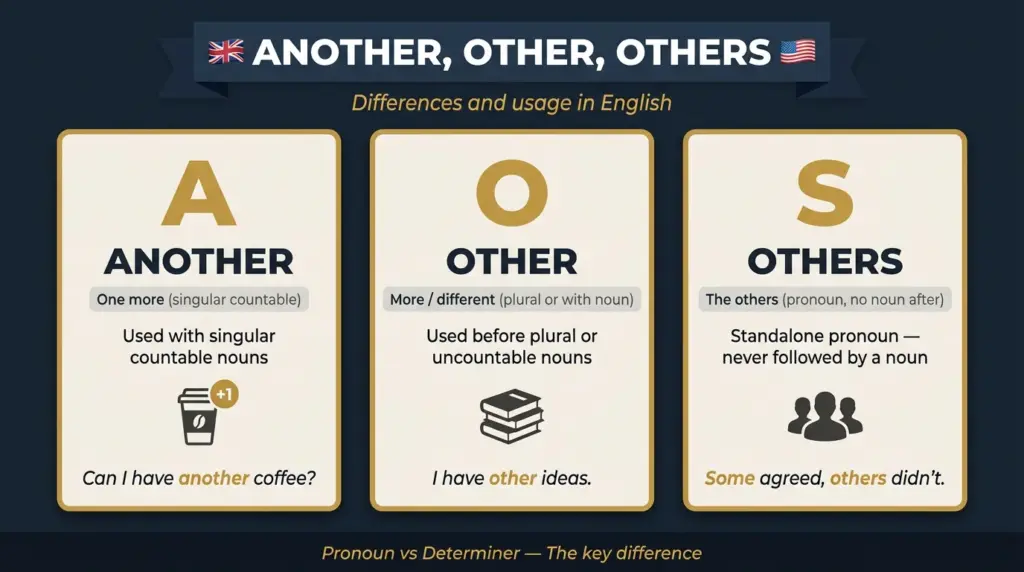
- Another: Means one more or an alternative, used with a singular countable noun.
- Other: Means additional or different ones, used to accompany a plural or uncountable noun.
- Others: Replaces a plural noun, always used alone as a pronoun.
- The other: Refers to the specific remaining element of a defined group.
- Invariability: The word other never takes an s before a noun.
The words another, other, and others all convey the idea of addition or difference in English. Understanding the difference between other others and another depends entirely on the nature of the following word and its grammatical function. Here is how to apply the correct rule for each situation.
The formation and use of Another
The word another is written as a single word. It comes from the fusion of the indefinite article an and the word other. It is used exclusively before a singular noun. This noun must be countable. It expresses two distinct ideas.
The first idea is that of an additional unit. It involves adding an element identical to what already exists. It often means one more.
Example: Would you like another cup of tea?
Meaning: Would you like one more cup of tea?
The second idea is that of an alternative. The proposed element is different from the first one. It means a different one.
Example: I want to buy another car.
Meaning: I want to buy a different car.
It is possible to use another before plural words in a specific case. This case concerns expressions of time, distance, or money accompanied by a number.
Example: We need another three days to finish the project.
Meaning: We need three more days to finish the project.
The use of Other as an adjective
The term other functions as an adjective. It is always placed before a noun. English adjectives are invariable. Therefore, the word other never takes a plural marker when followed by a noun.
It is mainly used with plural nouns. It refers to different or additional elements in a general way.
Example: Other students arrived late.
Meaning: Additional students arrived late.
It also accompanies uncountable nouns. These are concepts, liquids, or materials impossible to count individually.
Example: Do you have other information?
Meaning: Do you have any additional information?
The absence of an s on other before a plural noun is an absolute rule. Adding an s in this configuration makes the sentence incorrect.
The function of Others as a pronoun
The term others with a final s has a very specific function. It is a pronoun. It replaces the structure of other plus a plural noun. Its role is to avoid unnecessary repetitions in a sentence.
This word is always used alone. It is never followed by a noun. It refers to a general group of elements or people.
Example: Some people like summer, others prefer winter.
Meaning: Certain people like summer, while different people prefer winter.
In this example, others replaces the expression other people. The final s marks the plural of the pronoun.
The definite forms The other and The others
The addition of the definite article the brings a notion of precision. It is used to designate one or more specific elements. The speaker and the listener know what is being discussed.
The expression the other is used with a singular noun. It designates the second element of a group of two. It refers to the specific remaining one.
Example: One shoe is clean, the other shoe is dirty.
Meaning: One shoe is clean, the remaining shoe is dirty.
The expression the other is also used with a plural noun. It designates the rest of a specific group.
Example: Where are the other files?
Meaning: Where are the remaining files?
Finally, the others functions as a definite pronoun. It replaces the other followed by a plural noun. It means the remaining ones.
Example: I have read one book. The others are on the table.
Meaning: I have read one book. The remaining books are on the table.
The reciprocal expressions Each other and One another
The terms other and another form very common fixed expressions. They express reciprocity between several subjects. The action is mutual.
The expression each other is traditionally used to designate two people or two entities. It indicates a mutual relationship between them.
Example: Paul and Mary love each other.
Meaning: Paul and Mary love one another mutually.
The expression one another is used to designate more than two people. It conveys the idea of mutual action among a group.
Example: The team members support one another.
Meaning: The team members mutually support each member of the group.
It should be noted that this distinction often fades in modern English. Many English speakers use both expressions interchangeably.
Summary table of uses
| English word | Usage rule | Concrete example |
|---|---|---|
| Another | Before a singular countable noun | Give me another pen. |
| Other | Before a plural or uncountable noun | She needs other shoes. |
| Others | Alone as a plural pronoun | Some agree, others disagree. |
| The other | Before a definite singular or plural noun | Take the other path. |
| The others | Alone to replace The other + plural noun | John is here, where are the others? |
Practical exercise
Test your knowledge by completing the sentences with the correct word:
Question 1: I don’t like this shirt. Do you have _______ one?
Question 2: We have to respect _______ people’s opinions.
Question 3: Some birds fly south for the winter. _______ stay in cold climates.
Question 4: I found one earring, but I cannot find _______.
Question 5: The twins are very close. They tell _______ everything.
Question 6: Only three guests have arrived. Where are _______?
Your score