

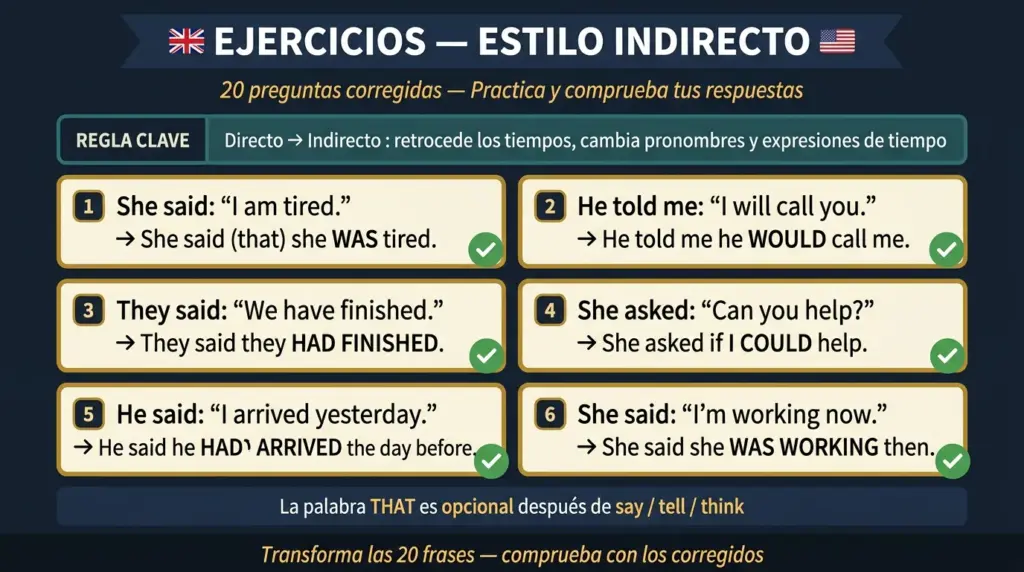
Estos ejercicios estilo indirecto inglés resueltos acompañan la lección completa sobre el reported speech, ideal para estudiantes de la ESO, Bachillerato y preparación de la EBAU o Selectividad. Cada serie aborda un punto gramatical específico: concordancia de tiempos, preguntas, órdenes, pronombres y marcadores temporales.
Serie 1: Concordancia de tiempos (backshift)
1. «I work at a hospital,» she said.
Presente simple (work) → pasado simple (worked). Tell sin complemento de persona es incorrecto.
2. «We are waiting for the bus,» they told me.
Presente continuo (are waiting) → pasado continuo (were waiting).
3. «I have already eaten,» he said.
Present perfect (have eaten) → past perfect (had eaten).
4. «The meeting will start at 3pm,» she announced.
Will → would en el estilo indirecto en pasado.
5. «I could hear the music from my room,» he said.
Could forma parte de los modales que permanecen inalterados en el reported speech. Solo se cambia el pronombre: my → his.
Puntuación serie 1
Serie 2: Preguntas en estilo indirecto
6. «Where do you live?» she asked him.
Pregunta abierta: orden declarativo (sujeto + verbo, sin inversión). Presente simple a pasado simple. Where did he live conserva la inversión, lo cual es un error frecuente.
7. «Have you finished the report?» the manager asked me.
Pregunta cerrada (sí/no): if o whether + orden declarativo. Present perfect → past perfect.
8. «What time does the train leave?» he asked.
Pregunta abierta con what time: orden declarativo. Presente simple (does leave) → pasado simple (left). Sin inversión ni auxiliar does.
9. «Is the shop open on Sundays?» she wondered.
Pregunta cerrada: whether + orden declarativo. Is → was. Sin inversión después de whether.
10. «Why didn’t you call me?» she asked him.
Orden declarativo, sin inversión. Pasado simple negativo (didn’t call) → past perfect (hadn’t called). Los pronombres también cambian: you → he, me → her.
Puntuación serie 2
Serie 3: Órdenes, peticiones y prohibiciones
11. «Please close the window,» she asked me.
Petición: ask + persona + to + infinitivo. No hay concordancia de tiempos para las órdenes y peticiones.
12. «Don’t use your phone in class,» the teacher told the students.
Prohibición: tell + persona + not to + infinitivo. Your → their (cambio de pronombre). La forma to not es posible pero menos estándar.
13. «Call me when you arrive,» my mother said to me.
Tell + persona + to + infinitivo. Said me es incorrecto. En la subordinada temporal, arrive → arrived (concordancia de tiempos), sin would.
14. «Be quiet!» the librarian told the children.
Orden: tell + persona + to + infinitivo. Be es el infinitivo de to be.
15. «Don’t worry, take your time,» he told me.
Dos órdenes coordinadas: not to worry (prohibición) + to take (orden positiva). El to se repite para el segundo infinitivo. Said me es incorrecto.
Puntuación serie 3
Serie 4: Pronombres y marcadores temporales
16. «I’ll come and see you tomorrow,» she said to me.
Will → would. Tomorrow → the following day. You → me. Con complemento de persona (me), se puede utilizar told.
17. «I saw him here yesterday,» she said.
Pasado simple (saw) → past perfect (had seen). Here → there. Yesterday → the day before.
18. «We moved to this house last year,» they said.
Pasado simple → past perfect. This → that. Last year → the previous year (o the year before).
19. «We are leaving now,» my parents said.
Presente continuo → pasado continuo (were leaving). Now → then (o at that moment).
20. «I’ll send the documents next week,» he promised.
Will → would. Next week → the following week. Promise + that + clause sigue las mismas reglas de backshift que say.
Puntuación serie 4
Puntuación global
¿Necesitas repasar las reglas? Consulta la lección completa sobre el estilo indirecto en inglés con todas las tablas de concordancia de tiempos, ejemplos y explicaciones, ideal para preparar la EBAU.