

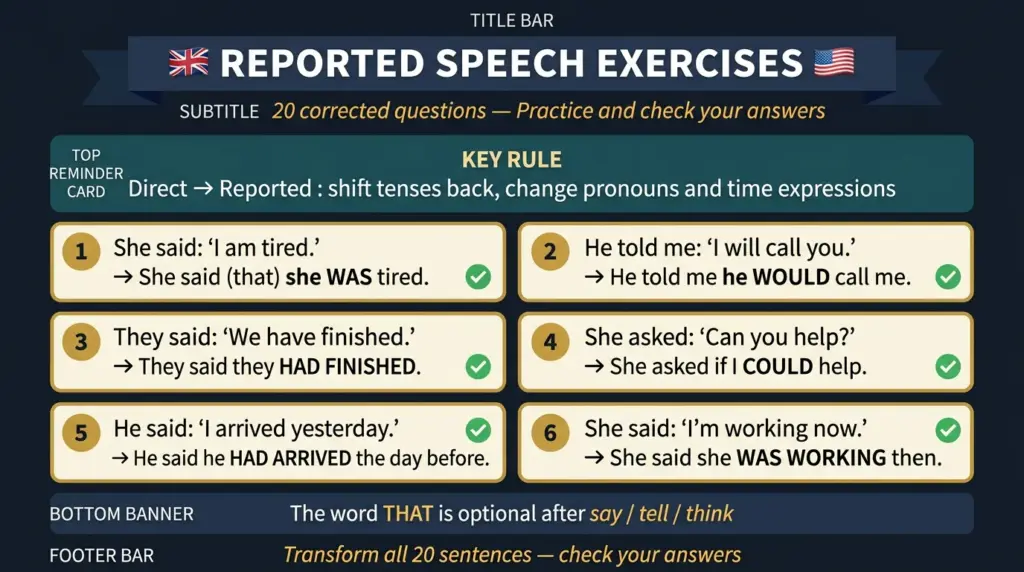
These reported speech exercises with answers accompany the complete lesson on reported speech in English. Each series targets a specific grammatical point: backshift, questions, orders, pronouns, and time markers. Perfect for intermediate and advanced learners.
Series 1: Tense Concordance (backshift)
1. “I work at a hospital,” she said.
Present simple (work) → past simple (worked). Tell without a personal object is incorrect.
2. “We are waiting for the bus,” they told me.
Present continuous (are waiting) → past continuous (were waiting).
3. “I have already eaten,” he said.
Present perfect (have eaten) → past perfect (had eaten).
4. “The meeting will start at 3pm,” she announced.
Will → would in past reported speech.
5. “I could hear the music from my room,” he said.
Could is one of the modals that remain unchanged in reported speech. Only the pronoun changes: my → his.
Series 1 Score
Series 2: Questions in Reported Speech
6. “Where do you live?” she asked him.
Open question: declarative order (subject + verb, without inversion). Present simple to past simple.
7. “Have you finished the report?” the manager asked me.
Closed question (yes/no): if or whether + declarative order. Present perfect → past perfect.
8. “What time does the train leave?” he asked.
Open question with what time: declarative order. Present simple (does leave) → past simple (left). No inversion or auxiliary does.
9. “Is the shop open on Sundays?” she wondered.
Closed question: whether + declarative order. Is → was. No inversion after whether.
10. “Why didn’t you call me?” she asked him.
Declarative order, no inversion. Negative past simple (didn’t call) → past perfect (hadn’t called). Pronouns: you → he, me → her.
Series 2 Score
Series 3: Orders, Requests, and Prohibitions
11. “Please close the window,” she asked me.
Request: ask + person + to + infinitive. No tense backshift for orders and requests.
12. “Don’t use your phone in class,” the teacher told the students.
Prohibition: tell + person + not to + infinitive. Your → their (pronoun change).
13. “Call me when you arrive,” my mother said to me.
Tell + person + to + infinitive. Said me is incorrect. In the time clause, arrive → arrived, without would.
14. “Be quiet!” the librarian told the children.
Order: tell + person + to + infinitive. Be is the infinitive of to be.
15. “Don’t worry, take your time,” he told me.
Two coordinated orders: not to worry (prohibition) + to take (positive order). The to is repeated. Said me is incorrect.
Series 3 Score
Series 4: Pronouns and Time Markers
16. “I’ll come and see you tomorrow,” she said to me.
Will → would. Tomorrow → the following day. You → me. With a personal object, we use told.
17. “I saw him here yesterday,” she said.
Past simple (saw) → past perfect (had seen). Here → there. Yesterday → the day before.
18. “We moved to this house last year,” they said.
Past simple → past perfect. This → that. Last year → the previous year.
19. “We are leaving now,” my parents said.
Present continuous → past continuous (were leaving). Now → then.
20. “I’ll send the documents next week,” he promised.
Will → would. Next week → the following week.
Series 4 Score
Overall Score
Need to review the rules? Check out the complete lesson on reported speech in English with all the tense concordance tables, examples, and explanations.