

En resumen
- Estilo directo: cita palabra por palabra entre comillas: She said, “I am tired.”
- Estilo indirecto (Reported Speech): palabras referidas sin comillas, con concordancia de tiempos: She said (that) she was tired.
- 4 cambios a aplicar: verbo introductorio, concordancia de tiempos (backshift), pronombres, marcadores de tiempo y de lugar
- Say vs tell: say no tiene complemento de persona; tell siempre tiene uno
- Órdenes y peticiones: to + infinitivo en el estilo indirecto (not to para la negación)
El estilo directo refiere las palabras de alguien citándolas palabra por palabra. El estilo indirecto (o Reported Speech) las reformula sin comillas, con modificaciones gramaticales obligatorias. Dominar el estilo directo e indirecto en inglés es fundamental, ya que ambas formas coexisten en todos los contextos: prensa, ficción, conversaciones, correos electrónicos profesionales y exámenes oficiales como los de Cambridge (B1 Preliminary, B2 First) o los de la EOI (Escuela Oficial de Idiomas).
Estilo directo: estructura y puntuación
En el estilo directo, las palabras se reproducen tal como fueron pronunciadas. Se colocan entre comillas y van precedidas o seguidas de un verbo introductorio.
Paul said, “I’m really hungry.”
Paul dijo: “Tengo mucha hambre.”
“Have you seen the report?” she asked.
“¿Has visto el informe?” preguntó ella.
“Don’t open that door,” he warned the children.
“No abráis esa puerta,” les advirtió.
Los verbos introductorios comunes en el estilo directo son say, ask, reply, shout, whisper, warn, tell. Cada uno aporta un matiz sobre el tono o la intención: whisper indica que las palabras fueron susurradas, shout que fueron gritadas.
Pasar al estilo indirecto (Reported Speech): las 4 modificaciones
Transformar una oración del estilo directo al estilo indirecto requiere cuatro tipos de cambios aplicados sistemáticamente.
1. Elegir el verbo introductorio adecuado
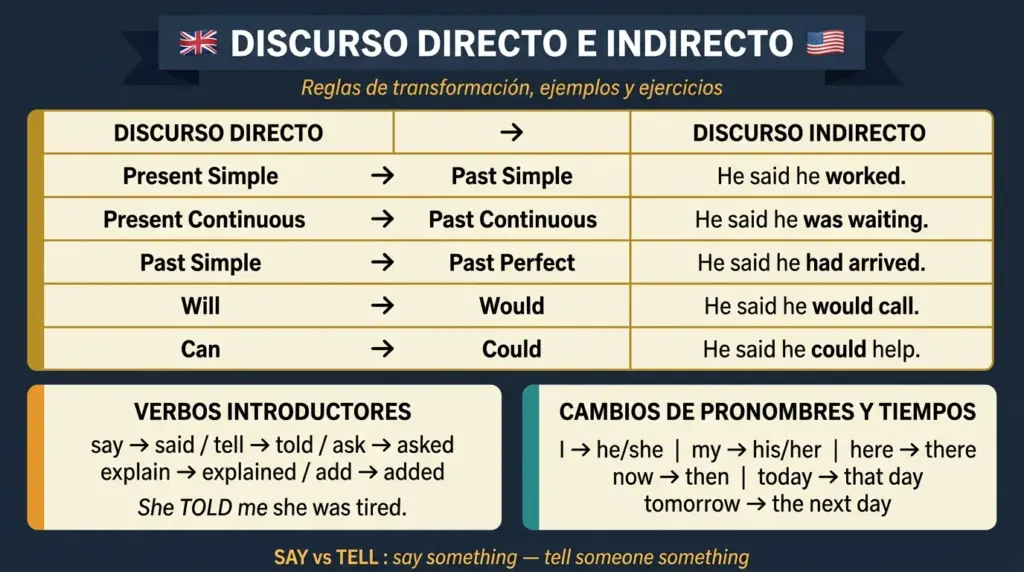
Say y tell son los dos verbos introductorios más comunes, pero no funcionan de la misma manera.
| Verbo | Construcción | Ejemplo |
|---|---|---|
| say | Sin complemento de persona | She said (that) she was tired. |
| tell | Siempre seguido de un pronombre o sustantivo | She told me (that) she was tired. |
| say to | Seguido de to + persona | She said to me that she was tired. |
Error frecuente: She told that she was tired es incorrecto. Tell exige un complemento de persona: She told me / him / us / the team… Sin complemento de persona, se utiliza say.
2. Aplicar la concordancia de tiempos (backshift)
Cuando el verbo introductorio está en pasado (said, told, asked…), los tiempos del estilo directo retroceden un paso hacia el pasado. Esta es la regla del backshift.
| Estilo directo | Estilo indirecto (Reported Speech) |
|---|---|
| Presente simple (am, work) | Pasado simple (was, worked) |
| Presente continuo (is working) | Pasado continuo (was working) |
| Pasado simple (worked) | Past perfect (had worked) |
| Present perfect (has worked) | Past perfect (had worked) |
| Past perfect (had worked) | Past perfect (sin cambios) |
| Futuro con will | Condicional con would |
| Futuro con going to | was/were going to |
| Condicional con would | would (sin cambios) |
“I appreciate your help.” → He said that he appreciated my help.
presente simple → pasado simple
“She has finished the report.” → He said that she had finished the report.
present perfect → past perfect
“I will call you tomorrow.” → She said she would call me the following day.
will → would
Los modales could, should, would, might, must, needn’t, ought to, used to permanecen sin cambios en el estilo indirecto.
No hay backshift cuando el verbo introductorio está en presente simple (he says, she explains): los tiempos del discurso se mantienen idénticos. “I am tired,” she says → She says (that) she is tired.
3. Modificar los pronombres
Los pronombres cambian según quién habla y a quién se refieren las palabras. La regla general: la 1ª persona del estilo directo se convierte en la 3ª persona en el estilo indirecto.
| Estilo directo | Estilo indirecto (ejemplo) |
|---|---|
| “I will contact you tomorrow.” | She said she would contact him the following day. |
| “We have finished the project.” | They said they had finished the project. |
| “My boss is satisfied.” | He said his boss was satisfied. |
4. Cambiar los marcadores de tiempo y de lugar
Las expresiones temporales y espaciales cambian porque se refieren hechos desde un momento diferente al que fueron pronunciados.
| Estilo directo | Estilo indirecto (Reported Speech) |
|---|---|
| now (ahora) | then / at that moment |
| today (hoy) | that day |
| yesterday (ayer) | the day before / the previous day |
| tomorrow (mañana) | the next day / the following day |
| last week (la semana pasada) | the week before / the previous week |
| next year (el año que viene) | the following year |
| here (aquí) | there |
| this (esto) | that |
| these (estos) | those |
| … days ago | … days before |
“I will contact you tomorrow.” → She said she would contact him the following day.
“I saw him yesterday.” → He said he had seen him the day before.
“Come here.” → She told me to come there.
Referir preguntas en el estilo indirecto (Reported Speech)
Las preguntas se transforman de manera diferente según sean abiertas (con una palabra interrogativa) o cerradas (que se responden con sí/no).
Preguntas abiertas (what, where, when, who, how…)
La estructura sigue el orden sujeto + verbo (sin inversión). El signo de interrogación desaparece.
“Where do you live?” → She asked me where I lived.
dónde + orden declarativo, sin inversión
“What are you doing this weekend?” → He asked her what she was doing that weekend.
“How did you get here?” → She asked him how he had got there.
Preguntas cerradas (sí/no)
Se añade if o whether para introducir la pregunta referida. El orden vuelve a ser declarativo (sujeto + verbo).
“Did you enjoy the film?” → He asked her if/whether she had enjoyed the film.
if o whether + orden declarativo, sin inversión
“Are you coming to the meeting?” → She asked me whether I was coming to the meeting.
“Have you finished the report?” → He asked if I had finished the report.
Referir órdenes y peticiones
Para una orden o una petición, no se aplica la concordancia de tiempos. Se utiliza directamente to + infinitivo. Para una prohibición o una petición negativa: not to + infinitivo.
| Tipo | Estilo directo | Estilo indirecto (Reported Speech) |
|---|---|---|
| Orden | “Come here immediately.” | He told me to come there immediately. |
| Petición educada | “Please sit down.” | She asked me to sit down. |
| Prohibición | “Don’t open that door.” | He warned me not to open that door. |
| Petición negativa | “Don’t tell anyone.” | She told me not to tell anyone. |
La estructura who/what/how + infinitivo
Cuando alguien refiere lo que puede o debe hacer, es posible omitir el sujeto y el modal. Se utiliza entonces la palabra interrogativa seguida directamente del infinitivo.
“I don’t know what I should do.” → She doesn’t know what to do.
“How can I get to the station?” → He asked me how to get to the station.
“I’m not sure where I should park.” → She wasn’t sure where to park.
Verbos introductorios con matices
Más allá de say y tell, otros verbos introductorios aportan matices importantes sobre el tipo de palabra referida.
| Verbo | Traducción | Ejemplo en estilo indirecto |
|---|---|---|
| explain | explicar | He explained that the delay was due to traffic. |
| promise | prometer | She promised she would be on time. |
| warn | advertir | He warned me not to be late. |
| suggest | sugerir | She suggested that we leave early. |
| admit | admitir | He admitted that he had made a mistake. |
| deny | negar | She denied having seen him. |
| refuse | rechazar | He refused to answer the question. |
| remind | recordar | She reminded me to call the client. |
Ejercicio práctico
Pon a prueba tus conocimientos sobre el estilo directo e indirecto en inglés:
Pregunta 1: Transforma al estilo indirecto. “I am very tired,” she said.
Pregunta 2: ¿Qué frase es correcta? “I have finished the project,” he said.
Pregunta 3: Refiere la pregunta. “Are you coming to the party?” she asked me.
Pregunta 4: ¿Qué marcador de tiempo es correcto? “I’ll see you tomorrow,” he said.
Pregunta 5: Transforma la orden. “Don’t touch that,” she told the children.
Pregunta 6: Refiere la pregunta abierta. “Where did you park the car?” she asked him.
Pregunta 7: Elige la construcción correcta. “I’ll be here at 9am,” he told me.
Pregunta 8: ¿Qué modal permanece sin cambios en el estilo indirecto? “You should see a doctor,” she said.
Pregunta 9: Transforma con la estructura de infinitivo. “I don’t know what I should buy,” she said.
Pregunta 10: Identifica la frase incorrecta.
Tu puntuación