


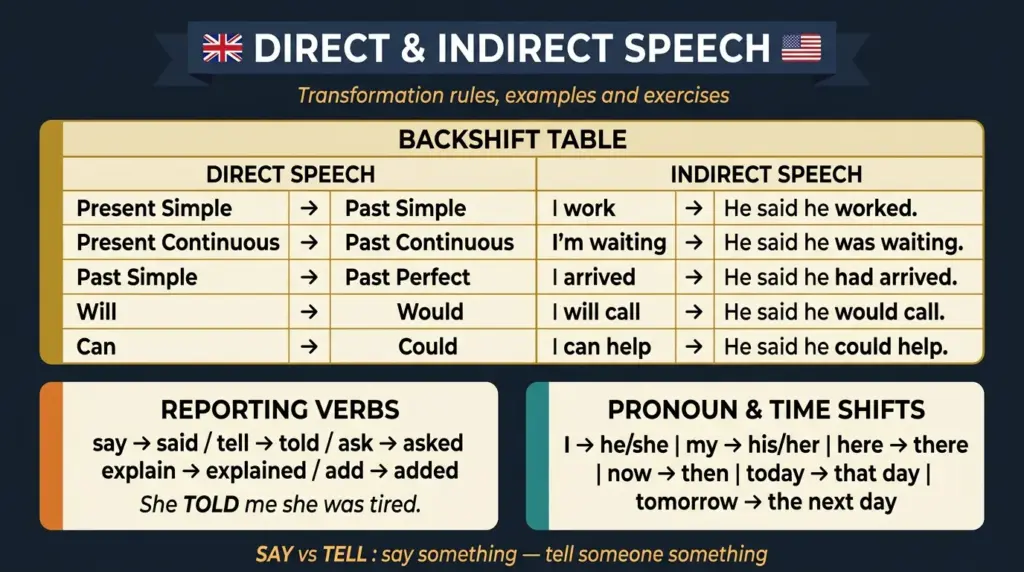
In short
- Direct speech: word-for-word quotation in quotation marks: She said, “I am tired.”
- Reported speech: reported words without quotation marks, with backshifting of tenses: She said (that) she was tired.
- 4 changes to apply: reporting verb, tense backshift, pronouns, time and place markers
- Say vs tell: say does not take a personal object; tell always takes one
- Orders and requests: to + infinitive in reported speech (not to for the negative)
Direct speech reports someone’s words by quoting them word for word. Reported speech reformulates them without quotation marks, requiring mandatory grammatical changes. Both forms coexist in all contexts: the press, fiction, conversations, and professional emails.
Direct speech: structure and punctuation
In direct speech, words are reproduced exactly as they were spoken. They are placed inside quotation marks and preceded or followed by a reporting verb.
Paul said, “I’m really hungry.”
Paul said, “I’m really hungry.”
“Have you seen the report?” she asked.
“Have you seen the report?” she asked.
“Don’t open that door,” he warned the children.
“Don’t open that door,” he warned them.
Common reporting verbs in direct speech include say, ask, reply, shout, whisper, warn, and tell. Each brings a nuance regarding tone or intention: whisper indicates that the words were spoken very quietly, while shout means they were yelled.
Switching to reported speech: the 4 changes
Transforming a sentence from direct speech to reported speech requires four types of changes applied systematically.
1. Choosing the right reporting verb
Say and tell are the two most common reporting verbs, but they do not work in the same way.
| Verb | Construction | Example |
|---|---|---|
| say | Without a personal object | She said (that) she was tired. |
| tell | Always followed by a pronoun or noun | She told me (that) she was tired. |
| say to | Followed by to + person | She said to me that she was tired. |
Common mistake: She told that she was tired is incorrect. Tell requires a personal object: She told me / him / us / the team… Without a personal object, we use say.
2. Applying tense backshift
When the reporting verb is in the past tense (said, told, asked…), the tenses from direct speech shift one step back into the past. This is the rule of backshifting.
| Direct speech | Reported speech |
|---|---|
| Present simple (am, work) | Past simple (was, worked) |
| Present continuous (is working) | Past continuous (was working) |
| Past simple (worked) | Past perfect (had worked) |
| Present perfect (has worked) | Past perfect (had worked) |
| Past perfect (had worked) | Past perfect (unchanged) |
| Future with will | Conditional with would |
| Future with going to | was/were going to |
| Conditional with would | would (unchanged) |
“I appreciate your help.” → He said that he appreciated my help.
present simple → past simple
“She has finished the report.” → He said that she had finished the report.
present perfect → past perfect
“I will call you tomorrow.” → She said she would call me the following day.
will → would
The modals could, should, would, might, must, needn’t, ought to, used to remain unchanged in reported speech.
No backshift when the reporting verb is in the present simple (he says, she explains): the tenses of the speech remain identical. “I am tired,” she says → She says (that) she is tired.
3. Modifying pronouns
Pronouns change depending on who is speaking and to whom the words are reported. The general rule: the 1st person in direct speech becomes the 3rd person in reported speech.
| Direct speech | Reported speech (example) |
|---|---|
| “I will contact you tomorrow.” | She said she would contact him the following day. |
| “We have finished the project.” | They said they had finished the project. |
| “My boss is satisfied.” | He said his boss was satisfied. |
4. Changing time and place markers
Time and place expressions change because facts are reported from a different moment than when they were spoken.
| Direct speech | Reported speech |
|---|---|
| now (now) | then / at that moment |
| today (today) | that day |
| yesterday (yesterday) | the day before / the previous day |
| tomorrow (tomorrow) | the next day / the following day |
| last week (last week) | the week before / the previous week |
| next year (next year) | the following year |
| here (here) | there |
| this (this) | that |
| these (these) | those |
| … days ago | … days before |
“I will contact you tomorrow.” → She said she would contact him the following day.
“I saw him yesterday.” → He said he had seen him the day before.
“Come here.” → She told me to come there.
Reporting questions in reported speech
Questions are transformed differently depending on whether they are open (with an interrogative word) or closed (yes/no questions).
Open questions (what, where, when, who, how…)
The structure follows the subject + verb order (no inversion). The question mark disappears.
“Where do you live?” → She asked me where I lived.
where + declarative order, no inversion
“What are you doing this weekend?” → He asked her what she was doing that weekend.
“How did you get here?” → She asked him how he had got there.
Closed questions (yes/no)
We add if or whether to introduce the reported question. The order becomes declarative again (subject + verb).
“Did you enjoy the film?” → He asked her if/whether she had enjoyed the film.
if or whether + declarative order, no inversion
“Are you coming to the meeting?” → She asked me whether I was coming to the meeting.
“Have you finished the report?” → He asked if I had finished the report.
Reporting orders and requests
For an order or a request, we do not apply tense backshifting. We directly use to + infinitive. For a prohibition or a negative request: not to + infinitive.
| Type | Direct speech | Reported speech |
|---|---|---|
| Order | “Come here immediately.” | He told me to come there immediately. |
| Polite request | “Please sit down.” | She asked me to sit down. |
| Prohibition | “Don’t open that door.” | He warned me not to open that door. |
| Negative request | “Don’t tell anyone.” | She told me not to tell anyone. |
The who/what/how + infinitive structure
When someone reports what they can or must do, it is possible to omit the subject and the modal. We then use the interrogative word followed directly by the infinitive.
“I don’t know what I should do.” → She doesn’t know what to do.
“How can I get to the station?” → He asked me how to get to the station.
“I’m not sure where I should park.” → She wasn’t sure where to park.
Nuanced reporting verbs
Beyond say and tell, other reporting verbs bring important nuances to the type of speech being reported.
| Verb | Translation | Example in reported speech |
|---|---|---|
| explain | to explain | He explained that the delay was due to traffic. |
| promise | to promise | She promised she would be on time. |
| warn | to warn | He warned me not to be late. |
| suggest | to suggest | She suggested that we leave early. |
| admit | to admit | He admitted that he had made a mistake. |
| deny | to deny | She denied having seen him. |
| refuse | to refuse | He refused to answer the question. |
| remind | to remind | She reminded me to call the client. |
Practical exercise
Test your knowledge on direct and reported speech, useful for exams like IELTS or TOEFL:
Question 1: Transform into reported speech. “I am very tired,” she said.
Question 2: Which sentence is correct? “I have finished the project,” he said.
Question 3: Report the question. “Are you coming to the party?” she asked me.
Question 4: Which time marker is correct? “I’ll see you tomorrow,” he said.
Question 5: Transform the order. “Don’t touch that,” she told the children.
Question 6: Report the open question. “Where did you park the car?” she asked him.
Question 7: Choose the correct construction. “I’ll be here at 9am,” he told me.
Question 8: Which modal remains unchanged in reported speech? “You should see a doctor,” she said.
Question 9: Transform with the infinitive structure. “I don’t know what I should buy,” she said.
Question 10: Identify the incorrect sentence.
Your score