

En bref
- Discours direct : citation mot pour mot entre guillemets : She said, « I am tired. »
- Discours indirect : paroles rapportées sans guillemets, avec concordance des temps : She said (that) she was tired.
- 4 changements à appliquer : verbe introducteur, concordance des temps (backshift), pronoms, marqueurs de temps et de lieu
- Say vs tell : say n’a pas de complément de personne ; tell en a toujours un
- Ordres et demandes : to + infinitif au discours indirect (not to pour la négation)
Le discours direct rapporte les paroles de quelqu’un en les citant mot pour mot. Le discours indirect (ou reported speech) les reformule sans guillemets, avec des modifications grammaticales obligatoires. Ces deux formes coexistent dans tous les contextes : presse, fiction, conversations, emails professionnels.
Discours direct : structure et ponctuation
Au discours direct, les paroles sont reproduites telles qu’elles ont été prononcées. Elles sont placées entre guillemets et précédées ou suivies d’un verbe introducteur.
Paul said, « I’m really hungry. »
Paul a dit : « J’ai vraiment faim. »
« Have you seen the report? » she asked.
« Avez-vous vu le rapport ? » a-t-elle demandé.
« Don’t open that door, » he warned the children.
« N’ouvrez pas cette porte, » les avertit-il.
Les verbes introducteurs courants au discours direct sont say, ask, reply, shout, whisper, warn, tell. Chacun apporte une nuance sur le ton ou l’intention : whisper indique que les paroles ont été chuchotées, shout qu’elles ont été criées.
Passer au discours indirect : les 4 modifications
Transformer une phrase du discours direct au discours indirect nécessite quatre types de changements appliqués systématiquement.
1. Choisir le bon verbe introducteur
Say et tell sont les deux verbes introducteurs les plus courants, mais ils ne fonctionnent pas de la même façon.
| Verbe | Construction | Exemple |
|---|---|---|
| say | Sans complément de personne | She said (that) she was tired. |
| tell | Toujours suivi d’un pronom ou nom | She told me (that) she was tired. |
| say to | Suivi de to + personne | She said to me that she was tired. |
Erreur fréquente : She told that she was tired est incorrect. Tell exige un complément de personne : She told me / him / us / the team… Sans complément de personne, on utilise say.
2. Appliquer la concordance des temps (backshift)
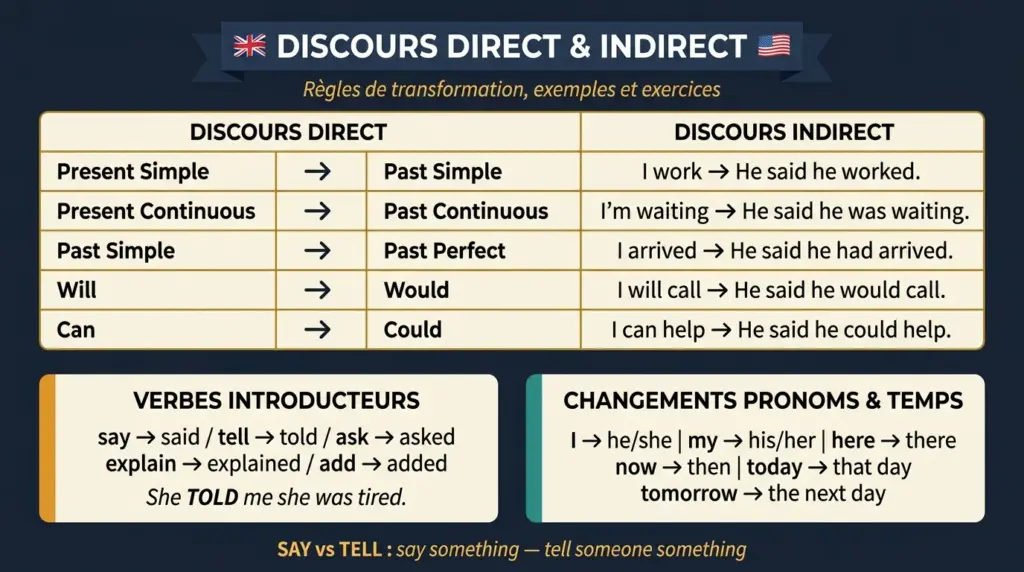
Quand le verbe introducteur est au prétérit (said, told, asked…), les temps du discours direct reculent d’un cran dans le passé. C’est la règle du backshift.
| Discours direct | Discours indirect |
|---|---|
| Présent simple (am, work) | Prétérit simple (was, worked) |
| Présent continu (is working) | Prétérit continu (was working) |
| Prétérit simple (worked) | Past perfect (had worked) |
| Present perfect (has worked) | Past perfect (had worked) |
| Past perfect (had worked) | Past perfect (inchangé) |
| Futur avec will | Conditionnel avec would |
| Futur avec going to | was/were going to |
| Conditionnel avec would | would (inchangé) |
« I appreciate your help. » → He said that he appreciated my help.
présent simple → prétérit simple
« She has finished the report. » → He said that she had finished the report.
present perfect → past perfect
« I will call you tomorrow. » → She said she would call me the following day.
will → would
Les modaux could, should, would, might, must, needn’t, ought to, used to restent inchangés au discours indirect.
Pas de backshift quand le verbe introducteur est au présent simple (he says, she explains) : les temps du discours restent identiques. « I am tired, » she says → She says (that) she is tired.
3. Modifier les pronoms
Les pronoms changent selon qui parle et à qui on rapporte les paroles. La règle générale : la 1re personne du discours direct devient la 3e personne au discours indirect.
| Discours direct | Discours indirect (exemple) |
|---|---|
| « I will contact you tomorrow. » | She said she would contact him the following day. |
| « We have finished the project. » | They said they had finished the project. |
| « My boss is satisfied. » | He said his boss was satisfied. |
4. Changer les marqueurs de temps et de lieu
Les expressions temporelles et spatiales changent car on rapporte des faits depuis un moment différent de celui où ils ont été prononcés.
| Discours direct | Discours indirect |
|---|---|
| now (maintenant) | then / at that moment |
| today (aujourd’hui) | that day |
| yesterday (hier) | the day before / the previous day |
| tomorrow (demain) | the next day / the following day |
| last week (la semaine dernière) | the week before / the previous week |
| next year (l’année prochaine) | the following year |
| here (ici) | there |
| this (ceci) | that |
| these (ceux-ci) | those |
| … days ago | … days before |
« I will contact you tomorrow. » → She said she would contact him the following day.
« I saw him yesterday. » → He said he had seen him the day before.
« Come here. » → She told me to come there.
Rapporter des questions au discours indirect
Les questions se transforment différemment selon qu’elles sont ouvertes (avec un mot interrogatif) ou fermées (répondant par oui/non).
Questions ouvertes (what, where, when, who, how…)
La structure suit l’ordre sujet + verbe (pas d’inversion). Le point d’interrogation disparaît.
« Where do you live? » → She asked me where I lived.
où + ordre déclaratif, pas d’inversion
« What are you doing this weekend? » → He asked her what she was doing that weekend.
« How did you get here? » → She asked him how he had got there.
Questions fermées (oui/non)
On ajoute if ou whether pour introduire la question rapportée. L’ordre redevient déclaratif (sujet + verbe).
« Did you enjoy the film? » → He asked her if/whether she had enjoyed the film.
if ou whether + ordre déclaratif, pas d’inversion
« Are you coming to the meeting? » → She asked me whether I was coming to the meeting.
« Have you finished the report? » → He asked if I had finished the report.
Rapporter des ordres et des demandes
Pour un ordre ou une demande, on n’applique pas la concordance des temps. On utilise directement to + infinitif. Pour une interdiction ou une demande négative : not to + infinitif.
| Type | Discours direct | Discours indirect |
|---|---|---|
| Ordre | « Come here immediately. » | He told me to come there immediately. |
| Demande polie | « Please sit down. » | She asked me to sit down. |
| Interdiction | « Don’t open that door. » | He warned me not to open that door. |
| Demande négative | « Don’t tell anyone. » | She told me not to tell anyone. |
La tournure who/what/how + infinitif
Quand quelqu’un rapporte ce qu’il peut ou doit faire, il est possible d’omettre le sujet et le modal. On utilise alors le mot interrogatif suivi directement de l’infinitif.
« I don’t know what I should do. » → She doesn’t know what to do.
« How can I get to the station? » → He asked me how to get to the station.
« I’m not sure where I should park. » → She wasn’t sure where to park.
Verbes introducteurs nuancés
Au-delà de say et tell, d’autres verbes introducteurs apportent des nuances importantes sur le type de parole rapportée.
| Verbe | Traduction | Exemple au discours indirect |
|---|---|---|
| explain | expliquer | He explained that the delay was due to traffic. |
| promise | promettre | She promised she would be on time. |
| warn | avertir | He warned me not to be late. |
| suggest | suggérer | She suggested that we leave early. |
| admit | admettre | He admitted that he had made a mistake. |
| deny | nier | She denied having seen him. |
| refuse | refuser | He refused to answer the question. |
| remind | rappeler | She reminded me to call the client. |
Exercice pratique
Testez vos connaissances sur le discours direct et indirect :
Question 1 : Transformez au discours indirect. « I am very tired, » she said.
Question 2 : Quelle phrase est correcte ? « I have finished the project, » he said.
Question 3 : Rapportez la question. « Are you coming to the party? » she asked me.
Question 4 : Quel marqueur de temps est correct ? « I’ll see you tomorrow, » he said.
Question 5 : Transformez l’ordre. « Don’t touch that, » she told the children.
Question 6 : Rapportez la question ouverte. « Where did you park the car? » she asked him.
Question 7 : Choisissez la bonne construction. « I’ll be here at 9am, » he told me.
Question 8 : Quel modal reste inchangé au discours indirect ? « You should see a doctor, » she said.
Question 9 : Transformez avec la tournure infinitive. « I don’t know what I should buy, » she said.
Question 10 : Identifiez la phrase incorrecte.
Votre score