


Here’s my list of 10 Great English Words and Expressions coined by British writers (Shakespeare is omnipresent as expected). These are presented in order of difficulty to help you improve your English, whether you’re a beginner or a more advanced learner.
But without further ado (without any more delay), let’s cut to the chase (get straight to the point)!
Beginner Level
1) “Break the ice”
William Shakespeare coined the phrase “break the ice” in his 1594 play “The Taming of the Shrew”. In the original context, it referred to making a daring start to a difficult enterprise—clearing the path for Petruchio to woo the fiery Katherine. The character Tranio encourages Petruchio to step up to the challenge with this advice:
“And if you break the ice and do this feat”
Over time, it evolved into the modern idiom meaning to alleviate social awkwardness. To “break the ice” means to make people feel relaxed and comfortable in a social situation. It is one of the easiest and most useful English expressions for beginners. Teachers, managers, and friends often use it when meeting new people.
The expression comes from the idea of ships breaking ice to open a path through frozen water. Learning this phrase helps English learners sound natural in conversations, meetings, classrooms, and interviews.
2) “Heart of gold”
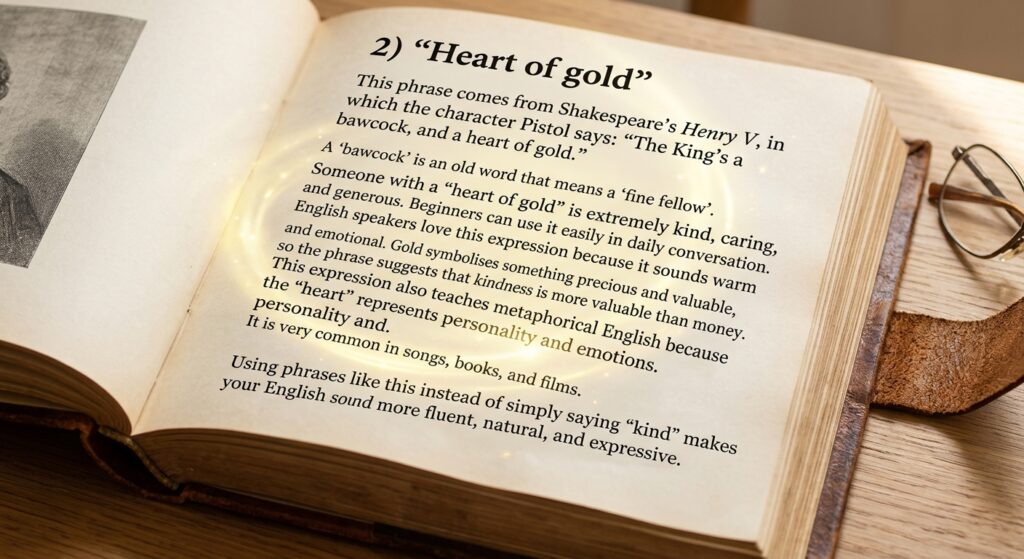
This phrase comes from Shakespeare’s Henry V, in which the character Pistol says:
“The King’s a bawcock, and a heart of gold.”
A ‘bawcock’ is an old word that means a ‘fine fellow’. Someone with a “heart of gold” is extremely kind, caring, and generous. Beginners can use it easily in daily conversation. English speakers love this expression because it sounds warm and emotional. Gold symbolises something precious and valuable, so the phrase suggests that kindness is more valuable than money.
This expression also teaches metaphorical English because the “heart” represents personality and emotions. It is very common in songs, books, and films. Using phrases like this instead of simply saying “kind” makes your English sound more fluent, natural, and expressive.
3) “Green-eyed monster”
This is a famous metaphor for jealousy. It was coined by William Shakespeare in his tragedy Othello in which the villainous Iago uses it to manipulate Othello, maliciously warning him about the dangers of jealousy while simultaneously fuelling his suspicion.
It is more colourful and expressive than simply saying “jealous.” The phrase compares jealousy to a dangerous creature that can control emotions and damage relationships.
Learning expressions like this improves both vocabulary and cultural understanding because Shakespeare strongly influenced modern English. Indeed an astonishing number of expressions from his plays are still used naturally in English all around the world today.
Intermediate Level
4) “Big Brother”
“Big Brother” describes a powerful authority that watches and controls people too closely. The expression comes from George Orwell’s novel “Nineteen Eighty-Four”. Beginners can understand it simply as “someone always watching”, while intermediate learners can use it in discussions about privacy and surveillance.
This expression appears frequently in newspapers, documentaries, and political debates. Understanding terms like “Big Brother” helps learners follow conversations about technology, governments, social media, and personal freedom in English-speaking countries.
5) “Pandemonium”
“Pandemonium” means complete chaos, confusion, and noise. Milton invented the word in “Paradise Lost” as the capital city of Hell.
This word is excellent for intermediate learners because it sounds dramatic and vivid. Journalists, writers, and speakers often use it to create strong descriptions. Instead of saying simple words like “chaos,” you can choose expressive vocabulary like “pandemonium.”
By learning literary words you improve reading comprehension and communicate more creatively in formal writing, storytelling, and public speaking.
6) “Brave new world”

This phrase, popularised by both William Shakespeare and Aldous Huxley, describes a surprising or radically changed society, especially because of technology or social change.
Shakespeare coined it in “The Tempest”, and later Aldous Huxley used it as the title of his 1932 novel. The expression often suggests both excitement and danger. You hear it frequently in discussions about science, politics, and the future.
Understanding this phrase will help you follow sophisticated conversations in media, academic writing, and documentaries about modern society and technological progress.
Advanced Level
7) “Serendipity”
Coined by Horace Walpole, “Serendipity” means finding something wonderful by accident. This elegant word sounds positive, intelligent, and expressive.
Walpole created it after reading a fairy tale called “The Three Princes of Serendip”. The word is useful in storytelling, personal essays, travel writing, and conversations about lucky coincidences.
Advanced learners especially benefit from words like this because they add sophistication and emotional depth to spoken and written English.
8) “Doublethink”

Coined by George Orwell in his novel “Nineteen Eighty-Four”, “Doublethink” means accepting two contradictory ideas at the same time.
It’s valuable for advanced learners because it appears in political discussions, journalism, and media criticism. It improves analytical English and helps learners discuss complex ideas clearly.
Orwellian vocabulary has become extremely important in modern communication, especially in conversations about misinformation, propaganda, and social control.
9) “Utopia”
Coined by Thomas More in his 1516 book of the same name, Utopia is derived from the Greek for “no place” (‘ou topos’). It refers to an imaginary and perfect world, an ideally organised state where everything functions well.
This word is important in literature, philosophy, and politics. Advanced learners often encounter it in essays, academic discussions, and debates about society. The opposite word is “dystopia,” which describes a terrible society.
Understanding “utopia” helps learners express complex ideas about equality, justice, and human ambition.
10) “Pandora’s box”
Popularised in English literature by many British writers, “Pandora’s box” describes an action that creates many unexpected problems. The expression comes from Greek mythology but became deeply embedded in English literature through British writers and scholars.
Advanced English speakers use it in politics, business, law, and journalism. The phrase is powerful because it expresses complicated consequences in only two words.
Mastering expressions like this makes spoken and written English sound sophisticated and culturally informed. It also helps learners understand advanced newspapers, television discussions, academic writing, and formal debates in English-speaking environments.
There goes my list of 10 Great English Words and Expressions coined by British writers (mostly Shakespeare). I hope they will help you broaden your vocabulary and sound more sophisticated when discussing professional or personal topics with native English speakers.
Another excellent way of improving or perfecting your English is to have tailored one-on-one lessons online with cultured native-English teachers such as the ones you will find at Break Into English.
That’s all for now, and my best wishes go out to you in your journey to master the English language!

This article was written by Break Into English’s blog contributor Adam Jacot de Boinod. Adam has worked for the BBC and is the author of “The Meaning of Tingo and Other Extraordinary Words from around the World”, published by Penguin Books.