



Learn the most essential Nature Vocabulary in English
“That is just gorgeous!”
“This doesn’t even look real!”
Have you ever heard someone say any of these things, or have you yourself said something similar, while observing nature?
The beauty of nature is something that can truly inspire us…sometimes when we least expect it.
Have you ever been driving home after a long day at work when you looked out the window and were greeted by the glorious colors of a sunset? How did it make you feel? Did you tell any of your friends or family about it? Or, have you ever been walking through the “concrete jungle” (aka a big city) to be surprised by a delicate little yellow flower growing on the side of the street? Did you stop and take a picture? Maybe you even sent that picture to a fellow plant lover.
Nature doesn’t just delight us… it connects us with each other. So knowing how to talk about the very thing we love – nature – is an important part of learning how to speak English.
Imagine you’re on a hike with a friend who only speaks English. How could you describe the things you see on this hike and the feelings they evoke? How might your friend describe what they see?
Before we continue this imaginary hike…let’s “stop and smell the roses” by taking a look at some common vocabulary we could use to describe nature and then we’ll see how it can fit into our story.
Common nouns to describe nature in English
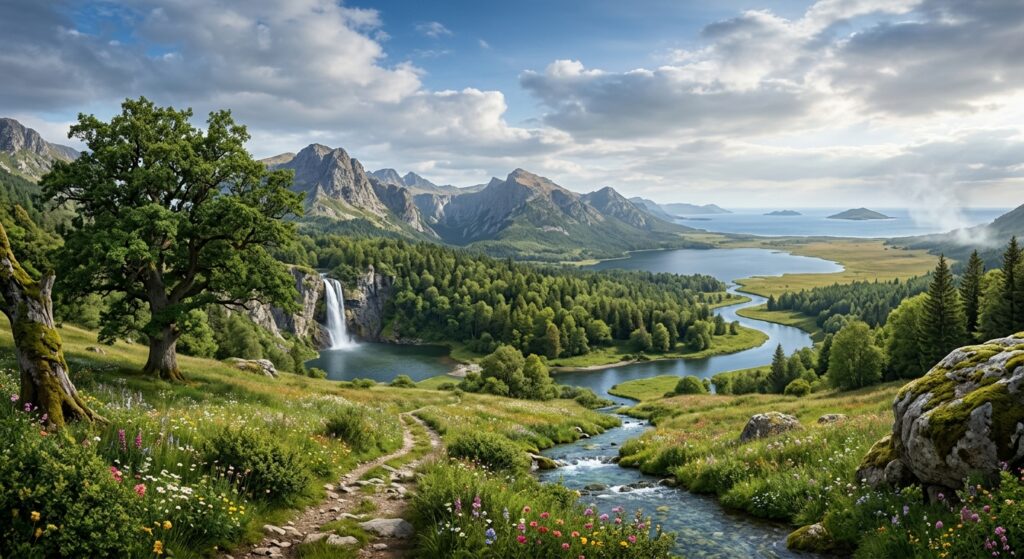
-
- Flower: Colorful seed-making part of a plant
-
- Petals: The soft, individual parts of a flower that surround the center
-
- Mountain: Large natural rise of the Earth’s surface
-
- Forest: Large area of land covered mostly by trees
-
- River: Large natural stream of freshwater
-
- Rock: Mass of mineral matter that makes up the Earth’s crust.
-
- Clouds: Visible mass of tiny water drops floating in the air.
-
- Sky: The area above earth where we see the sun, moon, stars
-
- Valley: The low area of land between hills or mountains
-
- Sunset: When the sun goes down at night
-
- Sunrise: When the sun comes up in the morning
-
- Sunbeams: A ray of sunlight
-
- Rainbow: The arc of colors that appears in the sky often after it rains
-
- Jungle: A tropical forest with many plants and animals
-
- Evergreens: A plant or tree that keeps green leaves or needles all year long
-
- Ocean: The large body of salt water covering most of the earth’s surface
-
- Beach: A sandy or rocky area beside a lake, sea, or ocean
-
- Waves: Water that moves across the surface of a lake or ocean
-
- Insects or Bugs: Small six-legged animals (like ants, butterflies, and beetles)
-
- Wildlife: Animals living freely in nature
Common adjectives to describe nature and the feelings it evokes in English
-
- Vast: Something that covers a very large area (so large it seems almost limitless)
-
- Enormous: Extremely large in size
-
- Awe-inspiring: Something that is so amazing/beautiful/impressive that you feel almost like you can’t speak because of how awesome it is
-
- Raging: Something that is moving with great force and power
-
- Fluffy: Something that looks soft and full (like how cotton looks)
-
- Emotional: When you are filled with a lot of emotions
-
- Moved: When you are touched by something
-
- Pensive: When you are thinking deeply or reflecting on something
-
- Peaceful: Calm and quiet- making you feel relaxed
-
- Colorful: Full of colors
-
- Incredible: So amazing it’s hard to believe
-
- Breathtaking: Something so beautiful or impressive it makes you stop breathing for a moment
-
- Stunning: Extremely beautiful in a way that immediately attracts attention
-
- Unforgettable: Something so beautiful or impressive that you will never forget it
How to Put all this Nature Vocabulary Into Context

Phew! That was a lot of words! Let’s see how we can use some of them by putting ourselves back into our imaginary hike:
As you hike up the enormous mountain you pause for a moment to take it all in. “I love the smell of evergreens in the forest,” your friend says. “Me too! It’s so peaceful here,” you add. After taking a few moments to take in the fresh air you continue up the mountain. You wonder what you’ll find on the other side.
You soon realize, though, that there’s plenty to see on the journey there. Right on the path in front of you is the most incredible bug you’ve ever seen. It’s white and fluffy. You call out for your friend to come look but she’s nowhere to be found. You walk around the corner and find your friend sitting on a large rock looking quite pensive.
“What are you thinking about?” You ask your friend. She points behind you. When you turn, you see a deer a little distance away about to cross a raging river. “Wow,” you whisper to your friend, “I love getting to see wildlife like this…”
You sit down beside her to watch the deer. With the river raging you start to wonder if the deer will be able to cross. It cautiously puts one leg in and before you know it, it’s swimming across the river.
The current starts to carry the deer downstream. You and your friend stare in silence, wondering whether the deer will make it. After a long struggle it manages to swim onto a nearby rock and trudges out of the water. Your friend lets out a big sigh, as you both had been holding your breath in anticipation.
“Wow!” she exclaims, “that was incredible!”
“That was unforgettable!” you reply. “I’m feeling a bit emotional. I didn’t know if the deer was going to survive. But that was awe-inspiring.”
Your friend nods in agreement. You both sit for a while longer and then decide to proceed along the trail. Just a little ways up you start to smell something delightful. You recognize that scent– it’s coming from your favorite flower.
You look to your right to see a field of lavender. The smell is so calming. And you’re not the only one who likes it– you start to notice several colorful butterflies fluttering around the lavender. You take out your camera to try to capture some of them in flight. You smile to yourself and continue on the path.
OK- let’s pause our story here. We used some of the words, but not all of them. I want to challenge you to continue the story from here. Try to include as many of the vocabulary words from this article as you can.
To help you with continuing the story, here are some questions to get the creative juices flowing:
-
- As you go further up the mountain what else do you see along the way?
-
- What is the view you’re climbing to the top of the mountain to see? Is it a valley, an ocean, more mountains?
-
- What time of day is it when you reach the top of the mountain? Do you see the sunset? If so, what does it look like and how does it make you feel?
So the next time you go on a hike, look up and see a beautiful cloud, or see the waves crashing at a beach…don’t just take a picture; connect with someone on a deeper level by telling them about how moved you are by the nature that surrounds you!

This article was written by Gabrielle, one of the online English teachers at Break Into English.