

En resumen
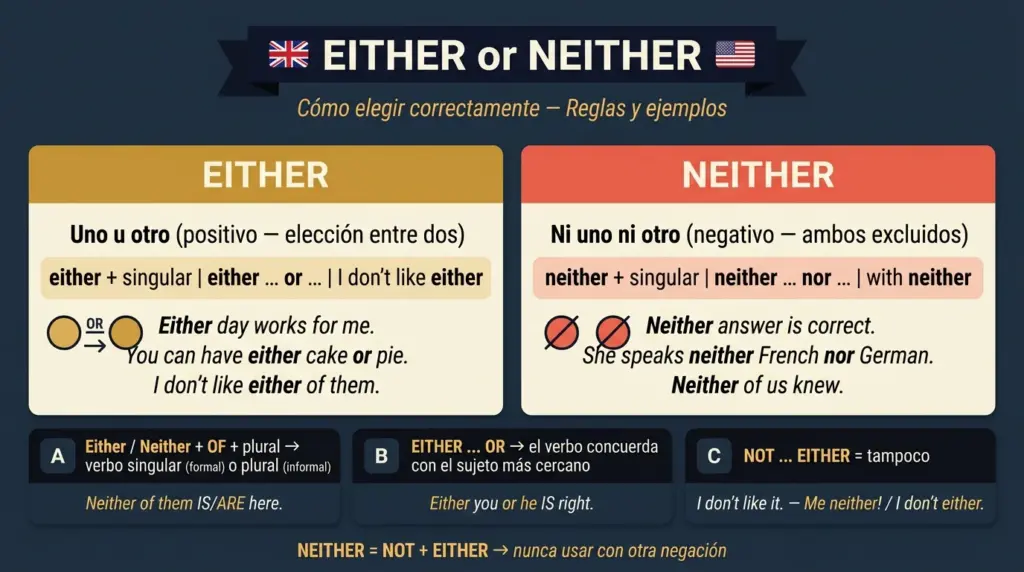
- Either… or: «o… o» — se usa en frases afirmativas para expresar dos opciones.
- Neither… nor: «ni… ni» — se usa en frases negativas para excluir las dos opciones.
- Tampoco: Neither do I (respuesta corta) o I don’t either (verbo ya negativo).
- Regla de concordancia: Neither solo siempre se conjuga en singular.
- 4 funciones: Either y neither son adverbios, determinantes, pronombres y conjunciones.
Either y neither son dos palabras muy frecuentes en inglés, pero su lógica suele confundir a los hispanohablantes. Funcionan en pares: either… or para las opciones posibles, neither… nor para las dos opciones excluidas. Para decir «yo tampoco», las dos pueden intervenir según la estructura de la frase.
Either… or: «o… o»
La estructura either… or se usa en frases afirmativas. Presenta dos opciones posibles o expresa una consecuencia condicional: si no se elige una de las opciones, la otra se impone.
| Inglés | Español |
|---|---|
| I can serve you either a beer or a glass of wine. | Puedo servirte o una cerveza o una copa de vino. |
| Either you tidy your room, or I’ll turn off the WiFi. | O recoges tu habitación, o cortaré el Wi-Fi. |
| I will either go jogging or to the gym. | O saldré a correr o iré al gimnasio. |
| Either mum or dad will come to pick you up. | O mamá o papá vendrá a recogerte. |
| You can call me either at home or at the office. | Puedes llamarme o en casa o en la oficina. |
| If it rains, we’ll either go to the cinema or to a museum. | Si llueve, iremos o al cine o a un museo. |
El verbo concuerda con el sujeto más cercano cuando dos sujetos están unidos por either… or:
| Inglés | Concordancia del verbo |
|---|---|
| Either Paul or his friends are coming. | Concordancia con his friends (plural, sujeto más cercano) |
| Either his friends or Paul is coming. | Concordancia con Paul (singular, sujeto más cercano) |
Neither… nor: «ni… ni»
La estructura neither… nor se usa en frases negativas para excluir dos opciones simultáneamente. El verbo permanece en forma afirmativa en inglés: la negación la portan neither y nor ellos mismos.
| Inglés | Español |
|---|---|
| He speaks neither Spanish nor Italian. | No habla ni español ni italiano. |
| I like neither him nor his sister. | No me gusta ni él ni su hermana. |
| It’s neither Paul nor Mike who made the mistake. | No ha sido ni Paul ni Mike quien cometió el error. |
| I will neither call you nor send you a message before midnight. | No te llamaré ni te enviaré un mensaje antes de medianoche. |
| The boy had neither the time nor the patience to help. | El chico no tenía ni el tiempo ni la paciencia para ayudar. |
| Neither the blue one nor the red is available in size 4. | Ni el azul ni el rojo está disponible en la talla 4. |
El verbo inglés siempre va en forma afirmativa con neither… nor. Añadir not crearía una doble negación incorrecta en inglés estándar.
Decir «tampoco» en inglés: either vs neither
Para decir «yo tampoco» o «él tampoco», son posibles dos estructuras según si la frase ya contiene un verbo negativo o no.
Caso 1: respuesta corta con inversión (Neither + auxiliar + sujeto)
| Frase de partida | Respuesta corta | Traducción |
|---|---|---|
| I don’t like horror films. | Neither do I. | Yo tampoco. |
| She can’t swim. | Neither can I. | Yo tampoco. |
| We haven’t been to Japan. | Neither have we. | Nosotros tampoco. |
| He didn’t come. | Neither did she. | Ella tampoco. |
El auxiliar retoma siempre el de la frase original.
Caso 2: frase larga con verbo ya negativo — se usa either al final de la frase
| Inglés | Español |
|---|---|
| I don’t like horror films either. | Yo tampoco me gustan las películas de terror. |
| We haven’t been to New Zealand either. | Nosotros tampoco hemos estado en Nueva Zelanda. |
| She doesn’t like spinach. No, I don’t like it either. | A ella no le gustan las espinacas. A mí tampoco. |
Cuando la frase ya contiene un verbo negativo (don’t, can’t, haven’t…), se usa either al final. Usar neither crearía una doble negación.
| Estructura | Ejemplo | Regla |
|---|---|---|
| Neither + auxiliar + sujeto | Neither do I. | Respuesta corta, inversión obligatoria |
| Sujeto + verbo negativo + either | I don’t like it either. | Frase larga, verbo ya negativo |
| Me neither | Me neither. | Registro muy familiar, solo oral |
Either y neither como determinantes
Delante de un sustantivo singular, either y neither funcionan como determinantes. Either significa entonces «cada» o «uno y otro». Neither significa «ninguno de los dos».
| Inglés | Español | Sentido |
|---|---|---|
| The house has a door at either end. | La casa tiene una puerta en cada extremo. | Either = cada lado |
| There were flowers on either side of the path. | Había flores a ambos lados del camino. | Either = ambos lados |
| Neither journalist could finish their article. | Ninguno de los dos periodistas pudo terminar su artículo. | Neither = ninguno de los dos |
| Neither Isabelle nor Regina is happy. | Ni Isabelle ni Regina está contenta. | Neither = ni una ni otra |
Importante: neither como determinante se construye con un verbo en singular, aunque se mencionen dos personas.
Either y neither como pronombres (+ of)
Seguidos de of, either y neither se convierten en pronombres. Designan un elemento de entre varios ya mencionados. El verbo permanece en singular.
| Inglés | Español |
|---|---|
| Does either of these roads go to Rome? | ¿Alguna de estas carreteras lleva a Roma? |
| Do either of the boys have maths this afternoon? | ¿Tiene alguno de los chicos matemáticas esta tarde? |
| Either of these bags is fine for me. | Cualquiera de estos bolsos me va bien. |
| Neither of my parents went to university. | Ninguno de mis padres fue a la universidad. |
| Neither of my arms is strong enough to lift this suitcase. | Ninguno de mis brazos es suficientemente fuerte para levantar esta maleta. |
| I like neither of these two books. | No me gusta ninguno de estos dos libros. |
Neither of se emplea únicamente para dos elementos. Para tres elementos o más, se usa none of en su lugar.
| Situación | Forma correcta | Ejemplo |
|---|---|---|
| Dos libros | neither of | I like neither of his two books. |
| Tres libros o más | none of | I like none of his books. |
Either solo al final de la frase: «uno u otro»
Either puede usarse solo, al final de la frase, para expresar indiferencia entre dos opciones ya propuestas. Significa entonces «uno u otro» o «en ambos casos».
| Inglés | Español |
|---|---|
| Do you fancy an Italian or a French restaurant? I’d be happy with either. | ¿Te apetece un restaurante italiano o francés? Cualquiera de los dos me viene bien. |
| Take whichever you like. Either is fine. | Coge el que quieras. Cualquiera está bien. |
| You can leave today or tomorrow. Either works for me. | Puedes irte hoy o mañana. Cualquiera de los dos me va bien. |
Expresiones idiomáticas con either y neither
| Expresión | Traducción | Ejemplo |
|---|---|---|
| Either way | En cualquier caso | You can stay or go. Either way, I’ll be happy. (Puedes quedarte o irte. En cualquier caso, estaré contento.) |
| In neither case | En ninguno de los dos casos | In neither case is the result acceptable. (En ninguno de los dos casos el resultado es aceptable.) |
| That’s neither here nor there | Eso no viene al caso | Whether you agree or not is neither here nor there. (Estés de acuerdo o no, eso no viene al caso.) |
| On either side | A ambos lados | People were standing on either side of the road. (La gente estaba de pie a ambos lados de la carretera.) |
Resumen: either vs neither
| Función | Either | Neither |
|---|---|---|
| Conjunción | either… or = o… o (afirmativo) | neither… nor = ni… ni (negativo) |
| Tampoco (respuesta corta) | I don’t like it either. | Neither do I. |
| Determinante | either side = cada lado | neither option = ninguna de las dos opciones |
| Pronombre + of | either of them = uno de ellos | neither of them = ninguno de ellos |
| Concordancia del verbo | Singular | Singular |
| Número de elementos | Siempre dos | Siempre dos (si no: none) |
Ejercicio práctico
Pon a prueba tus conocimientos sobre el uso de either, or, neither y nor en inglés:
Pregunta 1: Completa: «He speaks ___ Spanish ___ Italian.» (No habla ni español ni italiano.)
Pregunta 2: «I don’t like horror films.» ¿Cómo responder «yo tampoco» con una respuesta corta?
Pregunta 3: ¿Qué frase usa correctamente either… or para proponer dos opciones?
Pregunta 4: ¿Cuál de estas frases es correcta?
Pregunta 5: ¿Qué significa either way?
Pregunta 6: Completa: «She can’t drive. I can’t drive ___.»