

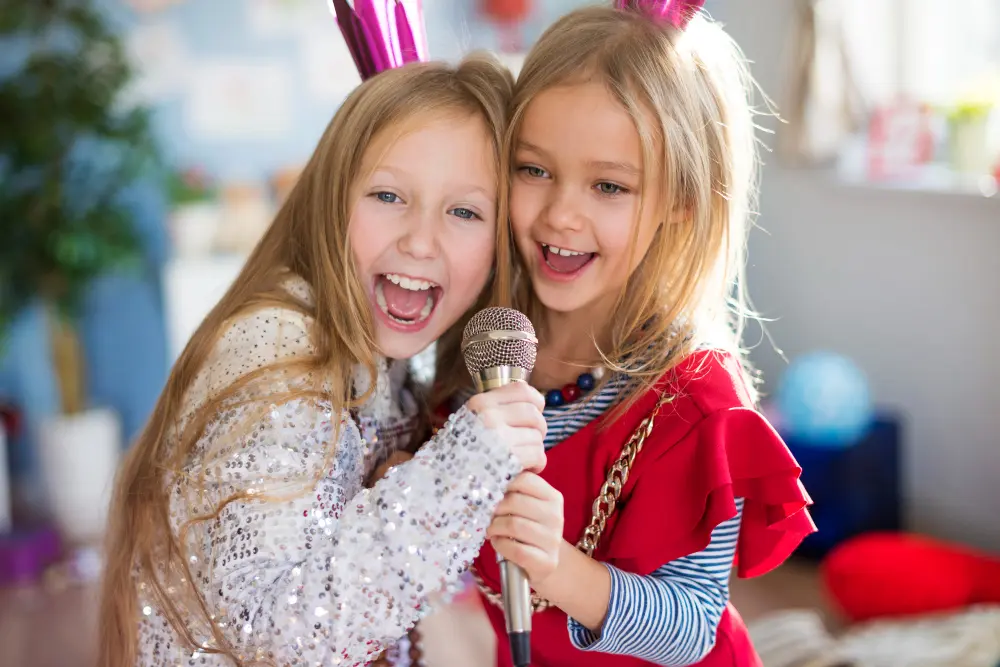
Songs are among the most powerful tools for children’s English learning. Unlike traditional methods, they leverage the brain’s natural connections between music and language. Melodic repetition embeds vocabulary into memory, while rhythm aids English pronunciation and intonation.
Children naturally retain lyrics without conscious effort, they hum first, understand later. This playful approach eliminates the fear of mistakes and encourages spontaneous speaking. Moreover, gestures often accompanying nursery rhymes reinforce memory through kinesthetic learning.
Songs fit perfectly into a holistic approach to learning English through play, alongside other fun activities that keep children motivated.
This selection brings together the most effective English songs for children aged 2 to 12. These rhymes naturally help acquire vocabulary, pronunciation, and basic structures.
Songs for First Words (2–4 years)
Baby Shark – Pinkfong
This English song for children works due to its excessive repetition of “Doo, doo, doo, doo, doo.” Toddlers memorize the melody even before understanding the words “daddy,” “mommy,” “baby shark.” Result: they naturally absorb the musicality of English.
Hello Song
An essential first song. It teaches “Hello, how are you?” with a simple melody that children remember after 2–3 listens. This song immediately creates a positive atmosphere at the start of learning.
What’s Your Name Song
Follows perfectly after the Hello Song. Children learn to say “My name is…” effortlessly. The repetitive structure helps even the shyest to participate.
Counting Songs (3–6 years)
Five Little Monkeys
This English song for children teaches numbers by telling a story. Children remember “five, four, three, two, one” more easily than a simple recitation. The narrative aspect keeps their attention throughout.
One Potato, Two Potatoes
Perfect for starting with numbers. Its simplicity allows 3-year-olds to follow easily. This song is recommended before Five Little Monkeys for logical progression.
Ten Green Bottles
A more advanced version to work from 10 to 0. Visualizing the falling bottles helps understand the concept of subtraction while learning English.
Body Vocabulary Songs (2–7 years)
Head, Shoulders, Knees and Toes
THE must-know English song for children. Impossible to teach without children moving. This coordination between gesture and speech firmly anchors body vocabulary. Bounce Patrol version recommended for its progressive rhythm.
One Little Finger
Perfectly complements the previous one. Children point to each mentioned body part—the physical action reinforces memory. Effective from age 2.
If You’re Happy and You Know It
Double learning: body parts AND actions. “Clap your hands, stomp your feet” becomes automatic after a few sessions. The Sesame Street version adds a stimulating visual aspect.
Animal Songs (2–8 years)
Old MacDonald Had a Farm
Multi-level English song for children. Young ones remember animal names, older ones understand the structure “Old MacDonald had a farm, E-I-E-I-O.” Universal animal sounds facilitate understanding.
Mary Had a Little Lamb
Simple story and gentle melody. Introduces basic vocabulary (“little,” “lamb,” “school”) in a narrative context that children intuitively understand.
Incy Wincy Spider
English equivalent of our “Araignée Gypsy.” French-speaking children immediately make the connection, facilitating the learning of weather vocabulary (“rain,” “sun”).
Universal Classic Songs (2–10 years)
Twinkle Twinkle Little Star
Melody known worldwide. Children focus solely on the English lyrics without musical learning effort. Super Simple Songs version particularly clear for pronunciation.
Yankee Doodle Went To Town
Introduces an American cultural aspect. Suitable for children aged 4 and up who are starting to take an interest in cultural differences.
Bingo’s Bath Song – CoComelon
This English song for children covers everyday life with vocabulary about bathing and hygiene. The CoComelon animation holds the attention of 2–5 year olds while they learn “wash,” “clean,” “soap.” Perfect to turn bath time into English learning time.
Disney Movie Songs (4–12 years)
Let It Go – Frozen
This English song for children works because they already know the story. They naturally associate the English lyrics with the character’s emotions. Richer vocabulary, best suited for ages 6 and up.
Under the Sea – The Little Mermaid
Catchy rhythm that keeps attention. Teaches sea-themed vocabulary while working on fluency. Kids sing along without realizing they’re learning.
Hakuna Matata – The Lion King
A phrase that became universal. Children understand the “no worries” concept through the context of the film. Excellent for introducing idiomatic expressions.
Modern Songs (6–14 years)
Happy – Pharrell Williams
Emotion-related vocabulary in a modern musical context. Pre-teens connect more easily with this than with traditional nursery rhymes. Helps work on pronunciation with a rhythm they enjoy.
Can’t Stop the Feeling – Justin Timberlake
From the Trolls movie, it combines modern style and a child-friendly universe. Great for keeping 8–12-year-olds interested as they begin to move on from nursery songs.
Practical Resources
Reliable YouTube channels:
- Super Simple Songs: content created by educators, subtitles available
- CoComelon: high-quality animation that keeps attention
- Sesame Street: proven educational approach for over 50 years
Recommended apps:
- YouTube Kids for a safe environment
- Super Simple Songs apps for offline use
Complementary resources:
- Cartoons for children: a visual alternative that perfectly complements song-based learning
Tips for Practical Use
Frequency: 10–15 minutes daily yields better results than occasional long sessions.
Repetition: The same English song for children should be listened to at least 5 times to be mastered. That’s normal and necessary.
Gestures: Always accompany with movements. Kinesthetic learning works particularly well for languages.
Progression: Start with 2–3 songs max. Add a new one only when the previous ones are well learned.
Environment: Use these songs in the car, during bath time, or while preparing meals. Informal learning is often the most effective.
Each song in this selection was chosen for its proven educational effectiveness. They work because they respect the child’s natural development while creating lasting language habits.