
Here is my list of the top ten comedy shows that are not only fun but also great for improving your English. It will help especially with conversational English, idioms and cultural references. My list is in increasing order of difficulty, from the easiest to the more advanced shows in terms of language, slang and speed.
Beginner Level
1. Shaun the Sheep
This stop-motion animated comedy is a children’s television series. It’s about a clever sheep called Shaun who constantly causes mischief. He lives with his flock at Mossy Bottom Farm, a small farm in Northern England and he is named Shaun as a pun on the word “shorn” after he was accidentally subjected to Wallace’s automated sheep shearing machine. Linguistically there’s no real dialogue, merely sounds and physical comedy. But it’s excellent for absolute beginners in that it teaches visual storytelling and British humour without needing much English at all.
2. Peppa Pig
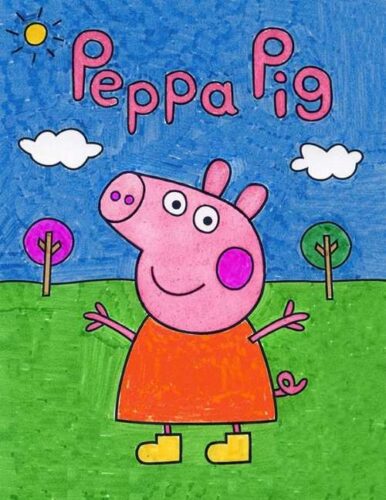
This children’s cartoon, which first aired in 2004, is about a young pig named Peppa who lives with her mummy and daddy and her little brother George. Her adventures are fun, sometimes involve a few tears, but always end happily. She goes on small adventures and learns simple life lessons. It has simple, everyday vocabulary and grammar. The slow-speaking voices deliver clear British accents and so it’s perfect for young children learning English: the sentences are short and grammatically simple and it often repeats key phrases (e.g., “I’m Peppa Pig!” or “This is my little brother George”).
Intermediate Level
3. Friends
This is an American sitcom about six young friends living in New York City and how they navigate their relationships, their careers and their everyday life. Being at Beginner to Intermediate level for learners, it’s told in clear American English. There is useful and clear dialogue and even the odd iconic phrase. It should all be very relatable to learners. The characters use real, conversational language and learners of English can discover how people speak in informal, everyday situations such as at home, work, cafes, dating, and with friends.
4. The IT Crowd
This involves three staff members. There’s a clueless boss, a nerdy genius and a socially awkward techie. The location is set in a corporate IT department. They tend to deal typically with hilarious work-life problems. Here, there is a good mixture of both formal and informal English. It is also great for learning the different technology and workplace lingo. Not to mention lots of sarcasm thrown in.
5. Outnumbered
This semi-improvised sitcom is all about a middle-class British family raising three precocious children. From a learning perspective, it’s excellent to watch for the family conversations that feel authentic and spontaneous: just as in real life. It provides realistic, everyday language in a fun and relatable way. It’s also great for learning informal, everyday British English (with idioms and cultural references) as well as for listening to how children talk with their semi-improvised talk.
6. Derry Girls

This comedy series is all five teens growing up in 1990s Northern Ireland during the Troubles. It is full of heart, of rebellion and of hilarious chaos. The slang is brilliant as is the teen talk and the local culture. But it really is quite a challenge and it is all delivered in strong Northern Irish accents which will doubtless prove more than a small jump in difficulty!
7. Friday Night Dinner
In this series, which is a sitcom, two adult brothers return home every Friday. They then have an awkwardly funny and chaotic dinner with their eccentric parents. The casual family slang and rather repetitive structure make it that bit easier to follow despite the rather fast speech. You hear natural family dialogue that is funny, chaotic, emotional and very human.
Advanced Level
8. The Inbetweeners
This comedy series is all about coming-of-age. So four rather awkward teenagers try (and usually fail) to be cool in their secondary school. It’s an excellent way for learning British teen slang, insults as well as school-related vocabulary. It’s very different from textbook English: it’s much more casual and modern with examples like ‘fit’ for attractive and ‘banter’ for joking conversation. The characters speak with Southern British (Estuary) accents. It may prove quite a challenge with both its crude humour as well its regional slang.
9. Fleabag

This is a brilliant, sharp and dark comedy about a troubled woman navigating life, love, grief, and guilt in London. Not to mention lots of fourth-wall breaks. A good reason for learners to watch this is to try and appreciate the advanced level of British humour with its sarcasm and dry wit, with its rapid dialogue and its emotional subtext. This belongs to the category for high-level learners.
10. Blackadder
This collection of comedy series is all about a highly sarcastic man named Edmund Blackadder and his dim-witted servant Baldrick. They attempt to navigate different historical periods in Britain. Each season is set in a different era. The main cast has, as its stars, Rowan Atkinson (Blackadder), Tony Robinson (Baldrick), Hugh Laurie (in various roles) and Stephen Fry (General Melchett). One of the many reasons to watch is to notice and savour the clever and rich historical and satirical language. Written by Richard Curtis and Ben Elton, it is best for advanced learners due both to the period vocabulary and also the sophisticated wordplay.
I hope you’ve enjoyed this list of comedy shows that will allow you to have fun while learning English. Learning a new language needs to be an enjoyable process and finding activities that entertain you and keep your motivational level high are essential to an efficient learning experience. Another good way of remaining motivated and reaching your goal of speaking fluent English is taking online English lessons with a professional native tutor such as those offered by Break Into English.

This article was written by BIE’s blog contributor Adam Jacot de Boinod.