

In short
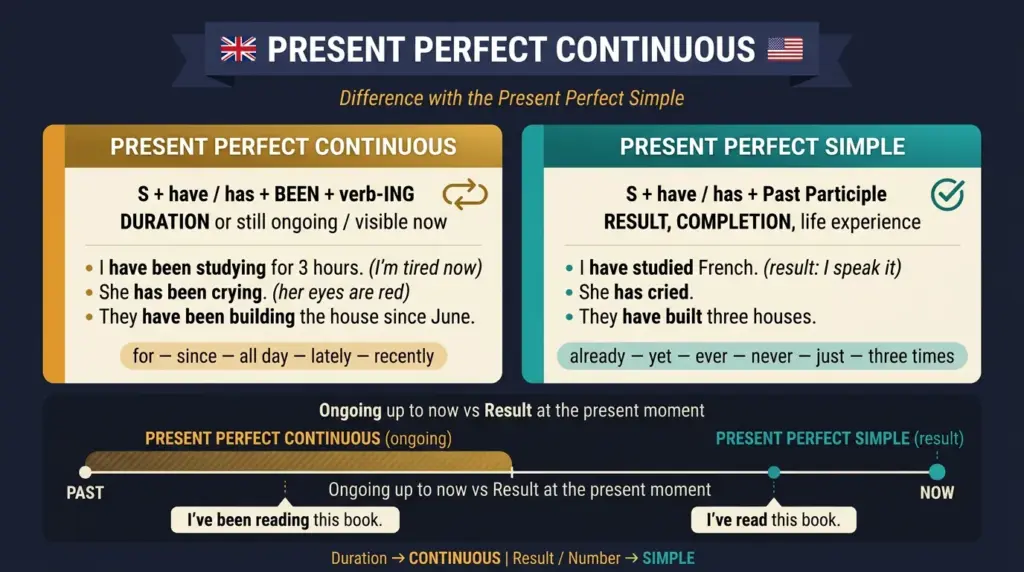
- The main difference: The continuous emphasizes the duration of an action, while the simple emphasizes its result.
- Unfinished action: We use the continuous for an activity still in progress at the present moment.
- Finished action: We use the simple when the work is completed and produces an immediate effect.
- Stative verbs: Verbs like love or know are used only in the present perfect simple.
- Keywords: The continuous is often associated with all day or lately, the simple with already or just.
In English, linking a past action to the present moment requires a specific choice. Understanding present perfect vs present perfect continuous depends on a single question: are we looking at the time spent doing the action or the final result achieved?
Forming the present perfect continuous
The present perfect continuous requires the use of three distinct elements. You must combine the verb have in the present tense, the past participle been, and the main verb ending in ing. This structure remains fixed for all action verbs. The only variation concerns the auxiliary have. It takes the form has in the third person singular. Here is how to build affirmative and negative sentences.
| Form | Structure | Example |
|---|---|---|
| Affirmative | Subject + have/has + been + verb-ing | They have been playing tennis. |
| Negative | Subject + haven’t/hasn’t + been + verb-ing | She hasn’t been sleeping well. |
| Interrogative | Have/Has + subject + been + verb-ing? | Have you been waiting long? |
Adding ing to the main verb indicates the continuous progress of the action. The word been marks the anchor in the past. The word have or has links this action to the present. This complex combination gives full meaning to this verb tense.
Forming the present perfect simple
The present perfect simple has a shorter structure. It uses only two verbal elements. We find the auxiliary have in the present tense and the past participle of the main verb. Regular verbs end in ed. Irregular verbs require learning by heart. Here is a reminder of this construction.
| Form | Structure | Example |
|---|---|---|
| Affirmative | Subject + have/has + past participle | I have finished my homework. |
| Negative | Subject + haven’t/hasn’t + past participle | He hasn’t arrived yet. |
| Interrogative | Have/Has + subject + past participle? | Have they eaten their dinner? |
The simple form gets straight to the point. It indicates a clear action. The past participle freezes the action in its state of completion. The auxiliary have connects it to the current moment.
Ongoing action versus completed action
The main distinction lies in the state of completion of the activity. The present perfect continuous describes an action started in the past and still ongoing. The activity does not stop at the moment of speaking. The speaker is in the middle of the process.
Let us take a clear example. I have been reading this book means that the reading continues. The book is not finished. The reader intends to pick it up again later. The focus is on the activity of reading itself.
Conversely, the present perfect simple announces the end of the process. The action is completed. The result matters for the present. The activity itself is no longer important. Only its accomplishment matters.
Take the sentence I have read this book. The reading is finished. The book is closed. The reader now knows the story. The final result modifies the present situation.
Focus on duration versus quantity
Another major difference concerns the measurement of the action. The present perfect continuous answers the question how long. The attention is entirely focused on the duration of the activity. We look at the time elapsed between the beginning of the action and now.
Here is a striking example. She has been writing emails all morning. We emphasize the person’s occupation. The entire morning was dedicated to this task. The number of emails sent has no importance in this context.
The present perfect simple answers the question how many. It is interested in the volume produced. The exact duration disappears in favor of the number or quantity achieved.
Let us look at this other example. She has written five emails this morning. The speaker gives a numerical assessment. The exact number is known. The task is divided into completed units.
Visible effects of a recent action
The present perfect continuous has a very specific use. It is used to describe an action that has just finished with visible physical consequences. The action took place over a certain duration. It has just stopped. The traces of this activity can still be seen.
For example, a person arrives with dirty clothes. We will say He has been repairing his car. The repair has just been completed. The dirt on the clothes represents the visible proof of the past activity.
Another example concerns the weather. The sidewalk is wet. The sky is gray. We will say It has been raining. The rain has stopped. The soaked ground shows the direct effect of this long precipitation.
In these specific cases, we do not use the present perfect simple. Saying It has rained gives simple factual information. It does not highlight the immediate consequence on the current environment.
Stative verbs: the great exception
Some verbs completely refuse the continuous form. They are called stative verbs. They describe a thought, an emotion, a perception, or a possession. These verbs do not express a physical action. They describe a fixed situation.
The most common verbs in this category are know, like, love, understand, belong, and need. These verbs must always be used in the present perfect simple. This rule applies even to emphasize the duration of the situation.
For example, we will always say I have known him for ten years. The sentence I have been knowing him is completely wrong. The verb to know does not represent an evolving process.
Similarly, for the verb to own, we will say She has owned this house since 2010. We will never say She has been owning. Possession is a constant state. It does not require continuous effort.
Indicator words for each tense
The choice of tense is often accompanied by specific words. These little linking words naturally guide you to the right structure. Words indicating a long period call for the continuous. Words indicating immediacy call for the simple.
The present perfect continuous is very often used with the expressions all day, all morning, or lately. These terms reinforce the idea of an uninterrupted process. The expression how long also triggers this form in questions.
The present perfect simple naturally associates with already, just, yet, ever, and never. These adverbs point to a single event. They validate or invalidate an accomplishment. The expression how many times almost always announces the simple tense.
The case of dual-meaning verbs: work and live
A few verbs blur the lines. The verbs work, live, and study can be used with both tenses. The meaning of the sentence remains exactly the same. The choice depends on the preference of the person speaking.
The sentence I have lived in London for five years is perfectly correct. The sentence I have been living in London for five years is just as correct. Both announce a current place of residence started in the past.
The continuous form sometimes gives a slight feeling of temporality. It can suggest a temporary situation. The simple form sounds more permanent. But this nuance remains minimal in everyday conversation.
Practical exercise
Test your knowledge by choosing the correct verb tense for each sentence:
Question 1: Choose the correct sentence to express a reading still in progress.
Question 2: Which sentence correctly expresses that you called someone three times?
Question 3: Which sentence is grammatically correct with the verb know?
Question 4: Why choose the continuous form in the sentence You look tired. Have you been running?
Question 5: Complete the sentence: They _____ my car. It looks brand new!
Question 6: Which of these words generally accompanies the present perfect simple?
Your score