Conjugation
Conjugation of the verb “to be” in English in all tenses
In brief Infinitive: to be, an irregular verb and the most frequent in English. Present: three distinct forms: am (I), is (he/she/it), are (you/we/they). Past

About Break Into English
Break Into English is an online language academy specialising in one-to-one English lessons with native teachers. Our method is based on active conversation and personalised content tailored to your goals.
We believe the fastest way to real fluency is speaking from day one with a native teacher who adapts to you, not the other way around.
Our individual online English courses
All our online English courses are taught by native English speakers who have been internally trained to apply the Break Into English method.
Personalised lessons are delivered online and you can choose the video conferencing platform that suits you best: Zoom, Google Meet, Teams, etc.


In brief Infinitive: to be, an irregular verb and the most frequent in English. Present: three distinct forms: am (I), is (he/she/it), are (you/we/they). Past
In brief Formation: regular verbs + -ed (invariable across persons); irregular verbs must be learnt by heart. Negative: didn’t + base form, without -ed or
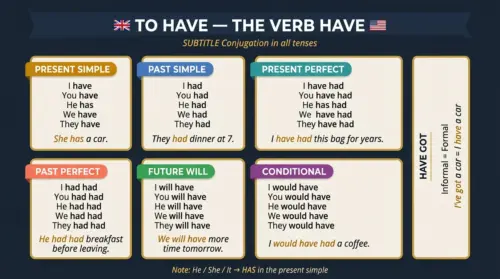
In short Present: The verb takes the form have or has in the third person singular. Past: The single form had is used for all
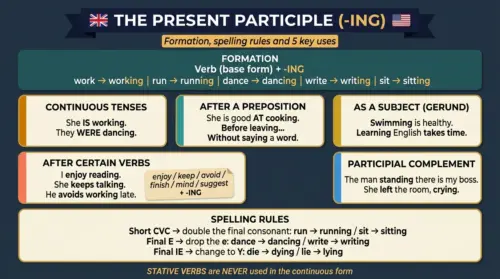
In short Formation: verb stem + -ing (work → working). A few spelling rules: dropping the silent -e, doubling the final consonant, -ie → -y.
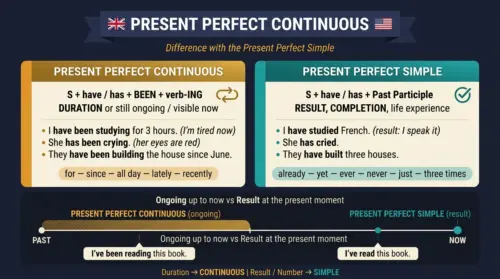
In short The main difference: The continuous emphasizes the duration of an action, while the simple emphasizes its result. Unfinished action: We use the continuous
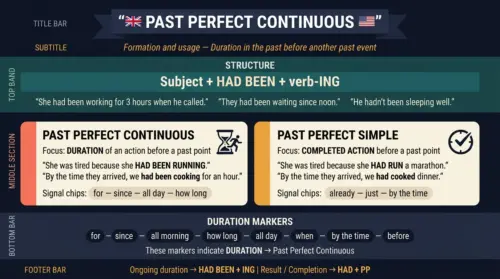
In short Long past action: expresses an action that lasted before another defined moment in the past. Fixed structure: always used with the subject, followed
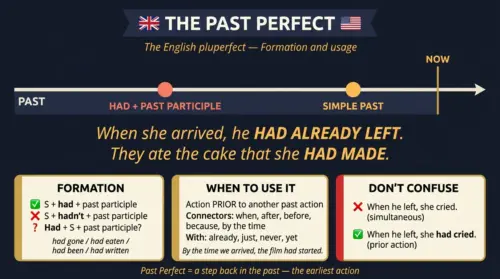
In short The main role: To express a past action that happened before another past action on a timeline. The basic formula: Subject + auxiliary
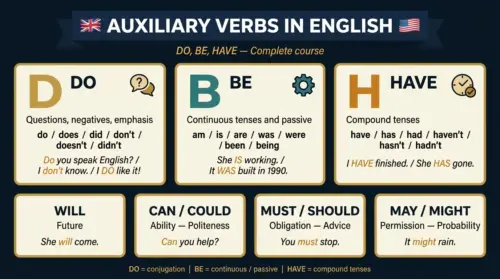
In short Main role: An auxiliary verb, often called a helping verb, assists another verb to indicate the tense or form of the sentence. Be: