

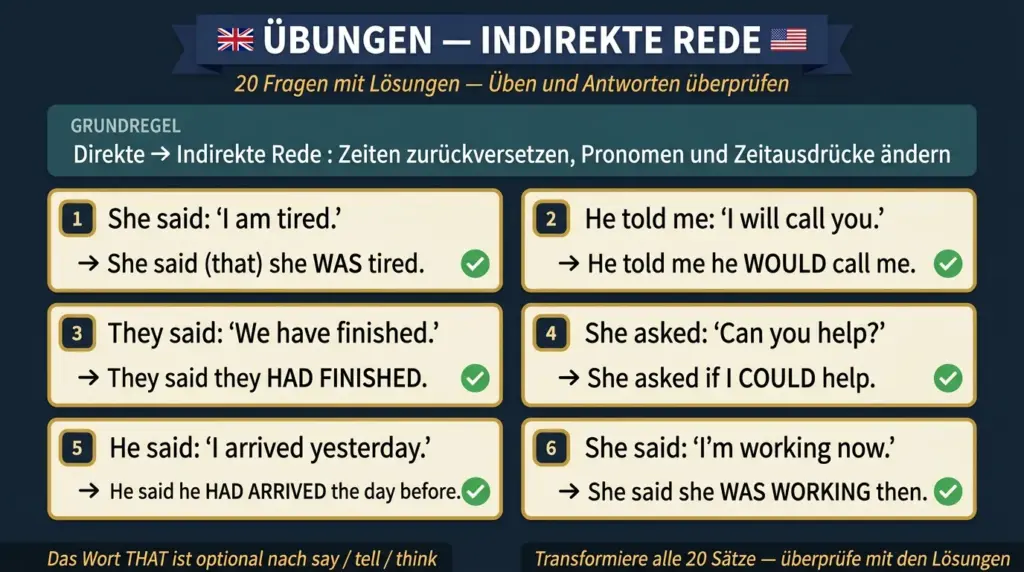
Diese Übungen begleiten die vollständige Lektion über die direkte und indirekte Rede im Englischen. Jede Serie zielt auf einen bestimmten grammatikalischen Punkt ab: Zeitenfolge, Fragen, Befehle, Pronomen, Zeitangaben.
Serie 1: Zeitenfolge (backshift)
1. „I work at a hospital,“ she said.
Simple Present (work) → Simple Past (worked). Tell ohne Personenobjekt ist inkorrekt.
2. „We are waiting for the bus,“ they told me.
Present Continuous (are waiting) → Past Continuous (were waiting).
3. „I have already eaten,“ he said.
Present Perfect (have eaten) → Past Perfect (had eaten).
4. „The meeting will start at 3pm,“ she announced.
Will → would in der indirekten Rede der Vergangenheit.
5. „I could hear the music from my room,“ he said.
Could gehört zu den Modalverben, die in der indirekten Rede unverändert bleiben. Nur das Pronomen wird geändert: my → his.
Ergebnis Serie 1
Serie 2: Fragen in der indirekten Rede
6. „Where do you live?“ she asked him.
Offene Frage: Aussagesatzstellung (Subjekt + Verb, ohne Inversion). Simple Present zu Simple Past. Where did he live behält die Inversion bei, was ein häufiger Fehler ist.
7. „Have you finished the report?“ the manager asked me.
Geschlossene Frage (Ja/Nein): if oder whether + Aussagesatzstellung. Present Perfect → Past Perfect.
8. „What time does the train leave?“ he asked.
Offene Frage mit what time: Aussagesatzstellung. Simple Present (does leave) → Simple Past (left). Keine Inversion und kein Hilfsverb does.
9. „Is the shop open on Sundays?“ she wondered.
Geschlossene Frage: whether + Aussagesatzstellung. Is → was. Keine Inversion nach whether.
10. „Why didn’t you call me?“ she asked him.
Aussagesatzstellung, keine Inversion. Vergangene Verneinung (didn’t call) → Past Perfect (hadn’t called). Die Pronomen ändern sich ebenfalls: you → he, me → her.
Ergebnis Serie 2
Serie 3: Befehle, Bitten und Verbote
11. „Please close the window,“ she asked me.
Bitte: ask + Person + to + Infinitiv. Keine Zeitenfolge bei Befehlen und Bitten.
12. „Don’t use your phone in class,“ the teacher told the students.
Verbot: tell + Person + not to + Infinitiv. Your → their (Änderung des Pronomens). Die Form to not ist möglich, aber weniger gebräuchlich.
13. „Call me when you arrive,“ my mother said to me.
Tell + Person + to + Infinitiv. Said me ist inkorrekt. Im temporalen Nebensatz: arrive → arrived (Zeitenfolge), ohne would.
14. „Be quiet!“ the librarian told the children.
Befehl: tell + Person + to + Infinitiv. Be ist der Infinitiv von to be.
15. „Don’t worry, take your time,“ he told me.
Zwei koordinierte Befehle: not to worry (Verbot) + to take (positiver Befehl). Das to wird für den zweiten Infinitiv wiederholt. Said me ist inkorrekt.
Ergebnis Serie 3
Serie 4: Pronomen und Zeitangaben
16. „I’ll come and see you tomorrow,“ she said to me.
Will → would. Tomorrow → the following day. You → me. Mit Personenobjekt (me) kann told verwendet werden.
17. „I saw him here yesterday,“ she said.
Simple Past (saw) → Past Perfect (had seen). Here → there. Yesterday → the day before.
18. „We moved to this house last year,“ they said.
Simple Past → Past Perfect. This → that. Last year → the previous year (oder the year before).
19. „We are leaving now,“ my parents said.
Present Continuous → Past Continuous (were leaving). Now → then (oder at that moment).
20. „I’ll send the documents next week,“ he promised.
Will → would. Next week → the following week. Promise + that + Nebensatz folgt denselben Backshift-Regeln wie say.
Ergebnis Serie 4
Gesamtergebnis
Müssen Sie die Regeln wiederholen? Lesen Sie die vollständige Lektion über die direkte und indirekte Rede im Englischen mit allen Tabellen zur Zeitenfolge, Beispielen und Erklärungen.