

In short
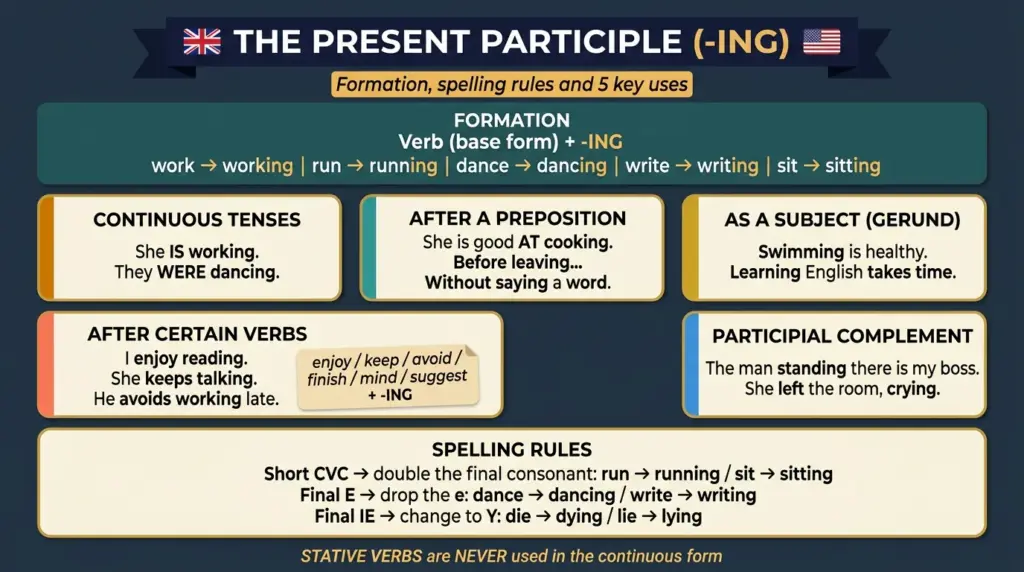
- Formation: verb stem + -ing (work → working). A few spelling rules: dropping the silent -e, doubling the final consonant, -ie → -y.
- Continuous tenses: auxiliary be + present participle (She is working / He was singing).
- Adjectives: the present participle describes what causes an effect (boring = causes boredom); the past participle describes the one who feels it (bored = feeling boredom).
- Present participle vs gerund: same -ing form, but the gerund functions as a noun (Swimming is good for you).
- Perfect participle: having + past participle, for an action completed before another (Having finished her work, she left).
The English present participle is the -ing form of verbs. It is a non-conjugated verb form that does not vary according to the subject. Its uses go far beyond continuous tenses: adjective, participial clause, simultaneous action, cause, perfect participle.
Forming the present participle
The basic rule is simple: verb stem (infinitive without to) + -ing. Several spelling rules apply depending on the ending of the verb.
| Rule | Example | Result |
|---|---|---|
| General case: stem + -ing | work, talk, read | working, talking, reading |
| Stem ending in silent -e: drop the -e | make, use, write | making, using, writing |
| Exception: stem ending in -ee, -oe, -ye: no dropping | agree, see, dye | agreeing, seeing, dyeing |
| Stressed short vowel + final consonant: double the consonant | run, sit, swim, begin | running, sitting, swimming, beginning |
| Exception: final -w, -x, -y: no doubling | fix, snow, play | fixing, snowing, playing |
| Stem ending in -ie: -ie becomes -y | tie, lie, die | tying, lying, dying |
| British English: doubling of final -l | travel, cancel | travelling, cancelling |
American vs British English: in American English, an unstressed final -l is not doubled. We write traveling (US) and travelling (UK). Both forms are correct.
The present participle in continuous tenses
The most frequent use of the present participle is the formation of continuous tenses. The structure is always: conjugated auxiliary be + present participle of the main verb.
| Tense | Structure | Example | Meaning |
|---|---|---|---|
| Present continuous | am/is/are + -ing | She is reading. | She is in the middle of reading. |
| Past continuous | was/were + -ing | He was sleeping. | He was asleep at that moment. |
| Present perfect continuous | have/has been + -ing | They have been waiting. | They have been waiting for a while. |
| Past perfect continuous | had been + -ing | She had been crying. | She had been crying for some time. |
| Future continuous | will be + -ing | We will be travelling. | We will be in the middle of travelling. |
| Conditional continuous | would be + -ing | I would be working. | I would be in the middle of working. |
Although this form is called the “present participle”, it appears in all continuous tenses, from past to future. The name is therefore somewhat misleading.
The present participle as an adjective: -ing vs -ed
The present participle can function as an adjective. It describes what causes an effect or feeling. The -ed form (adjectival past participle) describes the person who experiences that effect.
| -ing adjective | Meaning (cause) | -ed adjective | Meaning (feeling) |
|---|---|---|---|
| boring | causes boredom | bored | feeling bored |
| interesting | causes interest | interested | feeling interested |
| exciting | causes excitement | excited | feeling excited |
| tiring | causes tiredness | tired | feeling tired |
| surprising | causes surprise | surprised | feeling surprised |
| confusing | causes confusion | confused | feeling confused |
| frightening | causes fright | frightened | feeling frightened |
The film was boring. (The film causes boredom.)
She was bored. (She feels boredom.)
That’s an interesting idea.
He seemed interested in the project.
Present participle or gerund?
The present participle and the gerund share the same -ing form, but their grammatical role differs.
| Form | Role | Example | Meaning |
|---|---|---|---|
| Present participle | Forms a verb tense or functions as adjective/adverb | She is reading a book. | She is in the middle of reading a book. |
| Gerund | Functions as a noun (subject, object, complement) | Reading is my favourite hobby. | The activity of reading is my favourite hobby. |
| Gerund | After a preposition | She left without saying goodbye. | She left without saying goodbye. |
| Gerund | After certain verbs (enjoy, avoid, consider…) | He enjoys cooking. | He likes cooking. |
To tell them apart: if the -ing form can be replaced by a noun, it is a gerund. If it is part of a verb tense with be, it is the present participle.
Perception and motion verbs
Perception verbs (see, hear, watch, feel, smell, notice…)
These verbs take either the bare infinitive or the present participle. The meaning changes.
I saw him cross the road. — I watched the whole action from start to finish.
I saw him crossing the road. — I saw him in the middle of crossing.
She heard someone singing. — She heard the singing in progress.
I could smell something burning! — The burning was ongoing.
Motion and position verbs
The verbs go and come combine with a present participle to describe the activity taking place during the movement.
She goes running every morning.
I went shopping yesterday.
She came running towards me.
Simultaneous actions and constructions with spend, waste, catch, find
The present participle can describe two actions happening at the same time with the same subject. It can also express a causal or temporal relationship.
She sat at her desk, typing an email.
Feeling hungry, he went to the kitchen. — Because he was hungry, he went to the kitchen.
Not knowing the answer, she stayed quiet. — As she didn’t know the answer, she stayed quiet.
The spend/waste + duration + present participle structure expresses time or money devoted to an activity. With catch and find, the structure is verb + object + present participle.
She spends two hours a day commuting.
Don’t waste time arguing.
I caught him reading my messages. — I surprised him in the act of reading my messages.
She found him sitting alone in the dark. — She discovered him sitting alone (neutral).
The participial clause
A participial clause is a subordinate clause whose verb is in the present participle form. It has no subject of its own: it shares the subject of the main clause. This construction is mainly reserved for formal writing, to lighten complex sentences.
Feeling nervous, she approached the microphone.
= As she was feeling nervous, she approached the microphone.
The runners focusing on the same goal inspired everyone.
= The runners who were focusing on the same goal inspired everyone.
Watch out for the dangling participle: the grammatical subject of the participial clause must match the subject of the main clause. Walking down the street, a bus hit him is incorrect: it was he, not the bus, who was walking.
The perfect participle
The perfect participle is formed with having + past participle (having done, having said, having left). It indicates that a first action is completed before a second one begins. Its use is reserved for formal written English.
She had trained for months. She felt ready for the race.
→ Having trained for months, she felt ready for the race.
→ Having signed the contract, he left the meeting.
Practice exercise
Test your knowledge of the English present participle:
Question 1: What is the correct present participle form of swim?
Question 2: “The film was boring.” Which sentence is the correct translation of “Elle s’ennuyait” (She was bored)?
Question 3: Which sentence correctly uses the present participle with a perception verb?
Question 4: “She loves swimming in the sea.” What is the role of swimming here?
Question 5: Turn into a participial clause: “As she didn’t know the answer, she stayed quiet.”
Question 6: Fill in the blank: “She ___ all morning preparing for the interview.”
Question 7: Which sentence correctly uses the perfect participle?
Question 8: What is the correct spelling of the present participle of lie (to be lying down)?