| English |
French |
Context of use |
| Balance sheet |
Bilan comptable |
Annual summary document |
| Income statement / P&L |
Compte de résultat |
Profit and loss over a financial year |
| Assets |
Actifs |
What the company owns |
| Liabilities |
Passifs |
What the company owes |
| Equity |
Capitaux propres |
Net worth = assets minus liabilities |
| Cash flow |
Flux de trésorerie |
Inflows and outflows of cash |
| Revenue / Turnover |
Chiffre d’affaires |
Total sales over the period |
| Net income |
Résultat net |
Profit after deduction of all expenses |
| Audit |
Audit / Révision |
Independent review of accounts |
| Depreciation |
Amortissement (corporel) |
Gradual loss of value of an asset |
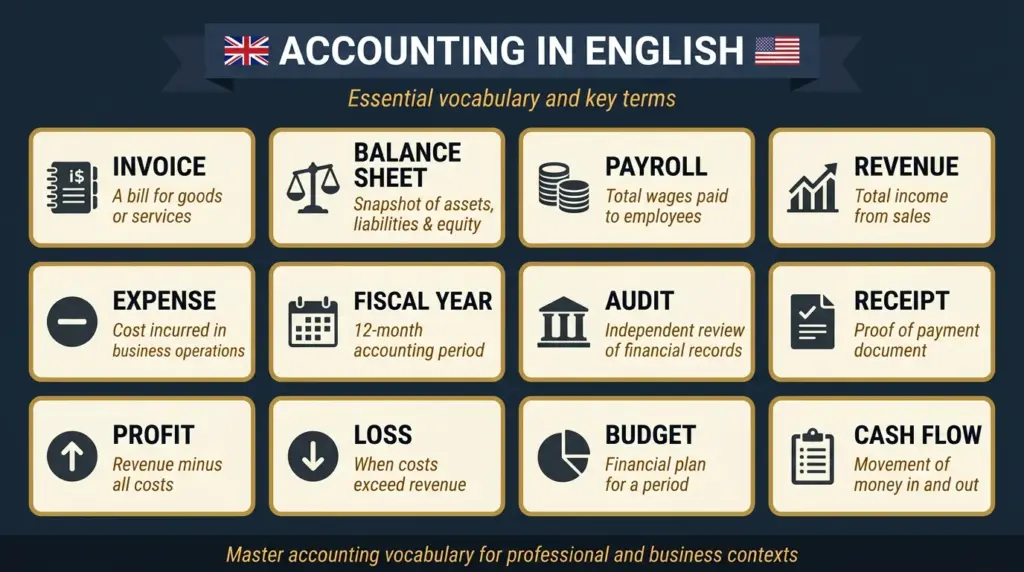
Mastering French accounting vocabulary requires understanding the precise terms used in both local firms and multinationals. This glossary covers the essential terms for the balance sheet, income statement, financial KPIs, and the daily professional life of an accountant. When adapting to a French-speaking environment, it is crucial to highlight the differences between Anglo-Saxon accounting standards (such as US GAAP or international IFRS) and the French General Accounting Plan (Plan Comptable Général, or PCG). Furthermore, professionals must contextualize specific French administrative and tax entities, such as URSSAF for social security contributions or the Ordre des Experts-Comptables for certified public accountants, which do not have direct equivalents in the US or UK systems. Clear distinctions between British and American accounting terminology are also provided where relevant.
The basics of accounting in French
Fundamental terms to understand and use accounting in a French context.
| English |
French |
Note |
| Accounting |
Comptabilité |
Generic term |
| Accountant |
Comptable |
The professional |
| Account |
Compte |
Recording unit |
| Ledger |
Grand livre |
Groups all accounts |
| Journal |
Journal / Livre de compte |
Chronological record |
| Journal entry |
Écriture comptable |
Transaction entered in the journal |
| Trial balance |
Balance générale |
Verifies debit/credit equality |
| Debit |
Débit |
Left side of the account |
| Credit |
Crédit |
Right side of the account |
| Financial statements |
États financiers |
Set of accounting documents |
| Fiscal year / Financial year |
Exercice fiscal / comptable |
12-month period |
| Cut-off |
Date d’arrêt des comptes |
Closing date |
| Disclosure |
Publication / Divulgation |
Publication of results |
| Audit |
Audit |
External review of accounts |
| Variance |
Écart |
Difference between budget and actual |
| Budget |
Budget |
Forecast of income/expenses |
| Forecast |
Prévision |
Future estimation of results |
| Consolidation |
Consolidation |
Grouping of group accounts |
| Suspense account |
Compte d’attente |
Temporary account pending allocation |
| Accruals |
Provisions / Charges à payer |
Expenses recorded but not yet paid |
The balance sheet in French (bilan comptable)
The balance sheet is called bilan comptable in French. It presents the financial situation of a company at a given date, distinguishing assets, liabilities, and equity.
| English |
French |
Position on the balance sheet |
| Balance sheet |
Bilan comptable |
Complete document |
| Assets |
Actifs |
Left side / assets |
| Fixed assets / Non-current assets |
Immobilisations / Actifs non courants |
Fixed assets |
| Tangible assets |
Immobilisations corporelles |
Physical goods (machines, buildings) |
| Intangible assets |
Immobilisations incorporelles |
Patents, goodwill |
| Current assets |
Actifs courants |
Circulating assets |
| Inventories |
Stocks |
Goods, raw materials |
| Accounts receivable |
Créances clients |
Amounts owed by customers |
| Cash |
Liquidités / Trésorerie |
Immediate availability |
| Short-term investments |
Placements à court terme |
Marketable securities, investment securities |
| Liabilities |
Passifs |
Right side / liabilities |
| Current liabilities / Short-term debts |
Dettes à court terme |
Maturity < 1 year |
| Long-term liabilities / Long-term debts |
Dettes à long terme |
Maturity > 1 year |
| Accounts payable |
Dettes fournisseurs |
Amounts owed to suppliers |
| Accrued liabilities |
Charges à payer |
Provisioned debts |
| Borrowings / Loans |
Emprunts |
External financing |
| Equity / Stockholder’s equity |
Capitaux propres |
Company’s own resources |
| Capital stock / Nominal capital |
Capital social |
Contributions from partners |
| Retained earnings |
Réserves / Résultats reportés |
Undistributed profits |
| Net asset value (NAV) |
Valeur nette comptable |
Net assets = assets minus liabilities |
To remember: The balance sheet formula is always Assets = Liabilities + Equity. In French: Actif = Passif + Capitaux propres. This is the fundamental rule of accounting equilibrium.
The income statement in French (compte de résultat)
The income statement or profit and loss statement (P&L) is called compte de résultat in French. It measures the company’s performance over a given period.
| English |
French |
Note |
| Income statement / P&L |
Compte de résultat |
Profit and loss |
| Revenue / Net sales / Turnover |
Chiffre d’affaires net |
Total sales |
| Cost of goods sold (COGS) |
Coût des marchandises vendues |
Direct production cost |
| Gross profit / Gross margin |
Marge brute |
Revenue minus COGS |
| Operating expenses |
Charges d’exploitation |
Rent, salaries, overheads… |
| Selling expenses |
Frais de ventes |
Commissions, advertising… |
| Overhead |
Frais généraux |
Expenses not directly linked to production |
| Operating income / EBIT |
Résultat d’exploitation |
Before interest and taxes |
| EBITDA |
Résultat avant intérêts, impôts, dépréciations et amortissements |
Operational performance indicator |
| Income before tax |
Résultat avant impôts |
Before corporate tax |
| Tax |
Impôt |
Corporate income tax |
| Net income / Net profit |
Résultat net / Bénéfice net |
After taxes |
| Loss |
Perte |
Negative result |
| Gain / Profit |
Bénéfice / Gain |
Positive result |
| Non-operating activities |
Activités hors exploitation |
Financial interest, disposals… |
| Depreciation |
Amortissement (immobilisations corporelles) |
Annual loss of value |
| Amortization |
Amortissement (immobilisations incorporelles) |
Patents, software… |
| Dividend |
Dividende |
Share of profits distributed to shareholders |
| Profit sharing |
Participation aux bénéfices |
Distribution to employees |
| Unearned revenues |
Produits perçus d’avance |
Payments received before service |
Assets and liabilities: detailed vocabulary
| English |
French |
Context |
| Fixed expenses |
Coûts fixes |
Expenses independent of activity volume |
| Variable costs |
Coûts variables |
Vary with production |
| Direct labor cost |
Coût de main-d’œuvre directe |
Labor directly linked to the product |
| Indirect charges |
Charges indirectes |
Cannot be allocated directly |
| Cost of raw material |
Coût des matières premières |
Supplies |
| Capital expenditure (CapEx) |
Dépenses d’investissement |
Purchases of fixed assets |
| Working capital |
Fonds de roulement |
Current assets minus short-term debts |
| Allowance |
Provision |
E.g., allowance for doubtful accounts is provision pour créances douteuses |
| Bond |
Obligation |
Debt security issued by a company |
| Share / Stock |
Action |
Share of the share capital |
| Shareholder / Stockholder |
Actionnaire |
Shareholder |
| Investments / Equity investments |
Titres de participation |
Shares in other companies |
| Solvency |
Solvabilité |
Ability to meet its debts |
| Liquidity |
Liquidité |
Ability to mobilize funds quickly |
| Debt / Liability |
Dette |
Repayment obligation |
| Loan |
Prêt / Emprunt |
Amount made available by a bank |
| Lease |
Bail |
Long-term lease contract |
| Factoring |
Affacturage |
Transfer of receivables to a factor |
| Royalty |
Redevance |
Payment for the use of a right |
| Grant |
Subvention |
Public financial aid |
| Guarantee |
Cautionnement |
Commitment to pay for a third party |
| Deposit |
Dépôt |
Sum paid as a guarantee or in a bank |
| Patents |
Brevets |
Exclusive right to exploit an invention |
| Trademark |
Marque |
Distinctive sign of a company |
| Bills receivable |
Effets à recevoir |
Receivables in the form of commercial paper |
| Bills payable |
Effets à payer |
Debts in the form of commercial paper |
| Discount |
Remise / Rabais / Escompte |
Reduction on invoice or bill |
Cash flows in French (tableau des flux de trésorerie)
| English |
French |
Note |
| Cash flow statement / Statement of cash flows |
Tableau des flux de trésorerie |
Third mandatory financial statement |
| Cash flow from operations |
Flux de trésorerie d’exploitation |
Generated by the main activity |
| Cash flow from investing |
Flux de trésorerie d’investissement |
Purchases/sales of assets |
| Cash flow from financing |
Flux de trésorerie de financement |
Borrowings, dividends, capital |
| Free cash flow |
Flux de trésorerie libre |
Cash available after CapEx |
| Operating activities |
Activités d’exploitation |
Normal business cycle |
| Net change in cash |
Variation nette de trésorerie |
Difference at the beginning and end of the period |
| Opening balance |
Solde d’ouverture |
Cash at the beginning of the period |
| Closing balance |
Solde de clôture |
Cash at the end of the period |
Financial KPIs and ratios in French
Financial performance indicators are essential for analyzing a company’s health.
| English |
Abbreviation |
French |
| Earnings Before Interest and Taxes |
EBIT |
Résultat avant intérêts et impôts |
| Earnings Before Interest, Taxes, Depreciation and Amortization |
EBITDA |
Résultat avant intérêts, impôts, dépréciation et amortissement |
| Net Profit Margin |
N/A |
Marge nette |
| Return on Equity |
ROE |
Rendement des capitaux propres |
| Return on Assets |
ROA |
Rendement des actifs |
| Return on Investment |
ROI |
Retour sur investissement |
| Debt to Equity Ratio |
D/E |
Ratio dette / capitaux propres |
| Current Ratio |
N/A |
Ratio de liquidité générale |
| Quick Ratio |
N/A |
Ratio de liquidité immédiate |
| Inventory Turnover |
N/A |
Rotation des stocks |
| Days Sales Outstanding |
DSO |
Délai de règlement clients |
| Days Payable Outstanding |
DPO |
Délai de paiement fournisseurs |
| Earnings Per Share |
EPS |
Bénéfice par action |
| Price to Earnings Ratio |
P/E |
Ratio cours / bénéfice |
| Net Present Value |
NPV / VAN |
Valeur actuelle nette |
| Internal Rate of Return |
IRR / TRI |
Taux interne de rendement |
| Break-even Point |
N/A |
Seuil de rentabilité / point mort |
| Gross Margin |
N/A |
Marge brute |
| Working Capital Ratio |
N/A |
Ratio de fonds de roulement |
| Asset Turnover Ratio |
N/A |
Ratio de rotation des actifs |
| Dividend Yield |
N/A |
Rendement du dividende |
| Market Capitalization |
N/A |
Capitalisation boursière |
| Book Value Per Share |
N/A |
Valeur comptable par action |
| Capital Expenditure |
CapEx |
Dépenses d’investissement |
| Operating Expense Ratio |
OER |
Ratio des charges d’exploitation |
Accounting verbs in French
These verbs are used daily in accounting documents, emails, and reports.
- To book : Comptabiliser, for example to book an entry = passer une écriture
- To record : Enregistrer, synonymous with to book, more generic
- To journalize : Journaliser, to record a transaction in the journal
- To audit : Auditer, to independently review the accounts
- To balance : Équilibrer, to verify debit/credit equality
- To depreciate : Amortir (immobilisations corporelles), for example the asset is depreciated over 5 years
- To amortize : Amortir (immobilisations incorporelles), patents, software
- To reconcile : Rapprocher, for example to reconcile bank accounts = lettrer les comptes bancaires
- To allocate : Allouer / Affecter, to distribute a cost to analytical centers
- To charge : Imputer, for example to charge expenses to an account
- To invoice : Facturer, to issue an invoice
- To disburse : Débourser, to make a payment
- To collect : Percevoir, to receive a due payment
- To forecast : Prévoir, to establish budget forecasts
- To assess : Évaluer, to estimate the value of an asset or a risk
- To value / to evaluate : Valoriser / Évaluer, for example to value inventory = valoriser les stocks
- To verify : Vérifier, to check the compliance of a transaction
- To review : Réviser / Examiner, to proofread and check documents
- To report : Rapporter / Déclarer, for example to report financial results
- To liquidate : Liquider, to sell assets or close a company
- To leverage : Utiliser l’effet de levier, to use debt to finance growth
- To negotiate : Négocier, payment terms, deadlines, rates
- To invest : Investir, to place funds in assets
- To analyze : Analyser, to interpret financial data
- To streamline : Rationaliser, to simplify and optimize an accounting process
Accounting stakeholders in French
| English |
French |
Role |
| Accountant |
Comptable |
Keeps and checks the accounts |
| Auditor |
Auditeur / Commissaire aux comptes |
Independently verifies the financial statements |
| CFO (Chief Financial Officer) |
Directeur financier |
Responsible for financial strategy |
| Shareholder / Stockholder |
Actionnaire |
Holder of capital shares |
| Stakeholder |
Partie prenante |
Anyone concerned by the company |
| Supplier |
Fournisseur |
Upstream business partner |
| Affiliate / Subsidiary |
Filiale |
Company controlled by another |
| Corporation |
Société par actions |
Anglo-Saxon legal form (US Corporation / UK Limited Company) |
| Sole trader |
Entrepreneur individuel |
Works alone, without a partner (US Sole Proprietor / UK Sole Trader) |
| Partnership |
Partenariat / Société de personnes |
Two or more partners |
Business operations and structures in French
| English |
French |
Context |
| Merger |
Fusion |
Grouping of two entities into one |
| Acquisition |
Acquisition / Rachat |
Taking control of a company |
| Foreign operation |
Opération en monnaie étrangère |
Transaction outside the national monetary zone |
| Outsourcing |
Externalisation |
Entrusting an activity to an external provider |
| Offshoring |
Délocalisation |
Transfer of activity abroad |
| Diversification |
Diversification |
Expansion into new markets |
| Portfolio management |
Gestion de portefeuille |
Management of a set of investments |
| Valuation |
Valorisation |
Estimation of the value of a company or an asset |
| Quotation |
Cours / Cotation |
Price of a share on a stock market |
| Franchise |
Franchise |
Economic distribution model |
Accounting vocabulary for emails and professional documents
These terms frequently appear in professional accounting correspondence in English.
- Dear Sir / Madam : Formule d’appel formelle, for an unknown recipient
- Sincerely / Kind regards : Formule de fin d’email, Sincerely is more formal (US), Kind regards is more common (UK)
- Attached / Enclosed : En pièce jointe, for example please find attached the balance sheet
- Invoice : Facture, payment request document
- Bill : Facture, common use, slightly less formal than invoice
- Purchase order (PO) : Bon de commande, official purchase request document
- Credit note : Avoir, total or partial cancellation of an invoice
- Statement of account : Relevé de compte, summary of transactions
- Payment terms : Conditions de paiement, for example net 30 = paiement sous 30 jours
- Overdue : En retard, for example overdue invoice = facture impayée à échéance
- Outstanding : En attente / Non réglé, for example outstanding balance = solde impayé
- Remittance : Règlement / Avis de paiement, document accompanying a bank transfer
- Write-off : Annulation / Passage en perte, permanently unrecoverable debt
- Payroll : Paie / Masse salariale, payroll management
- Headcount : Effectif, number of employees in a company
Vocabulary for financial charts and trends
These terms are used to comment on charts or trends in financial reports.
- To increase / To rise / To grow : Augmenter / Monter / Croître, for example revenues increased by 12%
- To soar / To skyrocket : S’envoler / Monter en flèche, sudden sharp rise
- To decrease / To drop / To fall : Diminuer / Chuter / Baisser, for example costs fell sharply in Q3
- To plummet : Chuter brutalement, very fast and sharp drop
- To remain stable / To plateau : Rester stable, stagnation of results
- Upward trend : Tendance à la hausse, generally positive evolution
- Downward trend : Tendance à la baisse, generally negative evolution
- Year-on-year (YoY) : D’une année sur l’autre, annual comparison
- Quarter-on-quarter (QoQ) : D’un trimestre sur l’autre, quarterly comparison
- Year-to-date (YTD) : Depuis le début de l’exercice, cumulative for the current year
- Figures / Data : Chiffres / Données, numerical elements of a report
- Breakdown : Ventilation / Décomposition, for example a breakdown of costs by category
- Variance : Écart, difference between budget and actual
- Target : Objectif, expected result over a period
- Benchmark : Référence / Point de comparaison, industry standard
International accounting and standards
| English |
French |
Context |
| IFRS (International Financial Reporting Standards) |
Normes internationales d’information financière |
Mandatory for listed companies in Europe |
| GAAP (Generally Accepted Accounting Principles) |
Principes comptables généralement admis |
American standards |
| Fair value |
Juste valeur |
Market value of an asset |
| Historical cost |
Coût historique |
Original acquisition value |
| Going concern |
Continuité d’exploitation |
Assumption of continued business |
| Accrual basis |
Comptabilité d’engagement |
Recording on the transaction date |
| Cash basis |
Comptabilité de caisse |
Recording on the payment date |
| Materiality |
Importance significative / Matérialité |
Materiality threshold in auditing |
| Prudence principle |
Principe de prudence |
Do not anticipate gains, provision for risks |
| Consistency principle |
Principe de permanence des méthodes |
Apply the same methods from one financial year to the next |