

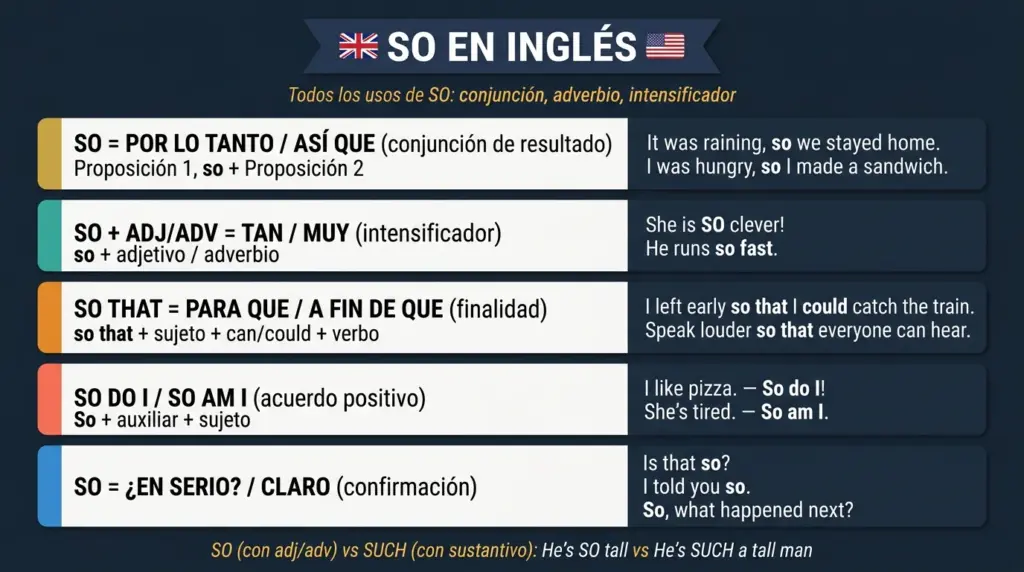
- Varios roles: So es adverbio, conjunción y marcador del discurso según el contexto.
- Grado: Delante de un adjetivo o un adverbio, so significa «tan» o «tanto».
- So vs such: Such se usa delante de un grupo nominal (adjetivo + sustantivo); so delante de un adjetivo solo.
- Conjunción: So introduce una consecuencia («por eso»); so that introduce una finalidad («para que»).
- Similitud: So do I / so am I significa «yo también» — con inversión sujeto/auxiliar.
- En el lenguaje oral: So sirve de marcador del discurso para resumir, introducir o cambiar de tema.
En inglés, so es una de las palabras más frecuentes y versátiles. Adverbio de intensidad, conjunción de consecuencia, marcador del discurso o herramienta para evitar una repetición: su significado cambia cada vez según lo que lo rodea. Esta lección repasa todos sus usos, del más sencillo al más sutil.
1. So para expresar grado: «tan», «tanto»
So modifica el grado de un adjetivo o un adverbio. Es su uso más frecuente.
| Inglés | Español |
|---|---|
| He is so nice. | Es tan amable. |
| Why is Becky so cheerful? | ¿Por qué está Becky tan alegre? |
| She is so beautiful. | Ella es tan guapa. |
| The movie was so boring. | La película era tan aburrida. |
| She explained the concept so clearly. | Explicó el concepto tan claramente. |
| I’m sorry I’m arriving so late. | Lo siento por llegar tan tarde. |
| This park is so peaceful. | Este parque es tan tranquilo. |
| It’s so rainy today. | Llueve tanto hoy. |
La estructura so + adjetivo/adverbio + that expresa una consecuencia directa:
| Inglés | Español |
|---|---|
| She’s so curious that she always asks questions. | Es tan curiosa que siempre hace preguntas. |
| It was so cold that we couldn’t go outside. | Hacía tanto frío que no podíamos salir. |
| She was so thirsty that she couldn’t even speak. | Tenía tanta sed que no podía ni hablar. |
| He ran so fast that nobody could catch him. | Corrió tan rápido que nadie podía alcanzarlo. |
| The bag was so heavy that she had to put it down. | La bolsa era tan pesada que tuvo que dejarla en el suelo. |
2. So much, so many, so little, so few
So se combina con cuantificadores para expresar una cantidad grande o pequeña.
| Expresión | Uso | Ejemplo | Traducción |
|---|---|---|---|
| so much | Sustantivo incontable | There is so much chocolate. | Hay tanto chocolate. |
| so many | Sustantivo contable | There were so many books. | Había tantos libros. |
| so little | Pequeña cantidad (incontable) | You’ve drunk so little. | Has bebido tan poco. |
| so few | Pequeño número (contable) | There are so few stars tonight. | Hay tan pocas estrellas esta noche. |
| so much more | Delante de un comparativo | My job is so much more stressful than yours. | Mi trabajo es mucho más estresante que el tuyo. |
| so much better | Delante de un comparativo | I feel so much better today. | Me siento mucho mejor hoy. |
Delante de un comparativo, se dice siempre so much better — nunca so better.
3. So como conjunción de consecuencia: «por eso», «así que»
So une dos proposiciones: la primera es la causa, la segunda es la consecuencia.
| Inglés | Español |
|---|---|
| She didn’t study for the exam, so she was totally unprepared. | No estudió para el examen, así que no estaba nada preparada. |
| He didn’t finish his homework, so he got a bad grade. | No terminó los deberes, así que sacó una mala nota. |
| I was sick yesterday, so I couldn’t work. | Ayer estaba enfermo, así que no pude trabajar. |
| The fruits were on sale, so I bought three kilos of apples. | La fruta estaba de oferta, así que compré tres kilos de manzanas. |
| It was raining, so we stayed inside. | Llovía, así que nos quedamos dentro. |
| She missed the bus, so she took a taxi. | Perdió el autobús, así que cogió un taxi. |
4. So that y so as to para expresar finalidad
So that no expresa una consecuencia — expresa una intención, una finalidad.
| Inglés | Español | Estructura |
|---|---|---|
| He trained every day so that he could run the marathon. | Entrenó todos los días para poder correr el maratón. | so that + sujeto + modal |
| She woke up early so that she wouldn’t miss the train. | Se levantó temprano para no perder el tren. | so that + sujeto + modal |
| He whispered so that nobody would hear him. | Susurró para que nadie lo oyera. | so that + sujeto + modal |
| She saved money so that she could travel next year. | Ahorró dinero para poder viajar el año que viene. | so that + sujeto + modal |
| I wake up early so as to start my day productively. | Me levanto temprano con el fin de empezar el día de manera productiva. | so as to + infinitivo |
| She left early so as to avoid the traffic. | Salió temprano con el fin de evitar el tráfico. | so as to + infinitivo |
La diferencia entre so y so that de un vistazo:
| Estructura | Significado | Ejemplo |
|---|---|---|
| proposición, so proposición | Consecuencia (así que) | She was late, so she missed the bus. |
| proposición so that proposición | Finalidad (para que / a fin de que) | She left early so that she wouldn’t miss the bus. |
5. So para evitar una repetición
En un registro más formal, so sustituye a un adjetivo o una proposición ya mencionada para aligerar la frase.
| Inglés | Español |
|---|---|
| The climate was unstable in that area and it remains so. | El clima era inestable en esa región y sigue siéndolo. |
| He’s very motivated. He’s been so since the start. | Está muy motivado. Lo ha estado desde el principio. |
| My old school was noisy; my new school less so. | Mi antigua escuela era ruidosa; mi nueva escuela, menos. |
| The movie was exciting, and the sequel more so. | La película era emocionante, y la secuela aún más. |
Con ciertos verbos (think, believe, hear, say, read, expect, suppose), so sustituye a toda una proposición en una respuesta corta:
| Intercambio | Traducción |
|---|---|
| A: Is Laura moving this year? B: I believe so. | A: ¿Laura se muda este año? B: Eso creo. |
| A: Tom won the race. B: So I read. | A: Tom ganó la carrera. B: Eso es lo que leí. |
| A: Will it be tough? B: I think so. | A: ¿Será difícil? B: Creo que sí. |
| A: Is she coming tonight? B: I expect so. | A: ¿Viene esta noche? B: Supongo que sí. |
| A: They said it was free. B: So I heard. | A: Dijeron que era gratis. B: Eso es lo que escuché. |
6. So am I, so do I: «yo también»
So seguido de un auxiliar y un sujeto expresa una similitud. La estructura es siempre: so + auxiliar + sujeto.
| Auxiliar utilizado | Ejemplo | Traducción |
|---|---|---|
| be | Karen is an excellent cook and so is her brother. | Karen es una cocinera excelente, y su hermano también. |
| do / does | She loves coffee and so does her brother. | Ella adora el café, y su hermano también. |
| did | I went to the party and so did Tom. | Fui a la fiesta, y Tom también. |
| have | I’ve been to Japan and so has she. | He estado en Japón, y ella también. |
| can | I can swim and so can my sister. | Sé nadar, y mi hermana también. |
| will | I will come and so will Marc. | Vendré, y Marc también. |
En una respuesta exclamativa oral, so confirma algo con sorpresa — sin invertir el sujeto y el auxiliar:
| Intercambio | Traducción |
|---|---|
| A: It’s almost midnight. B: Oh, so it is! | A: Es casi medianoche. B: ¡Es verdad! |
| A: I can solve this in five minutes. B: So you can! | A: Puedo resolver esto en cinco minutos. B: ¡Parece que sí! |
| A: It’s snowing outside! B: So it is! | A: ¡Está nevando! B: ¡Es verdad! |
7. So como marcador del discurso
So aparece muy a menudo al inicio de una frase en el lenguaje oral. Sirve para fluidificar la conversación, resumir, introducir o cambiar de tema.
| Inglés | Español | Función |
|---|---|---|
| So, to sum up, the pros outweigh the cons. | Así que, para resumir, las ventajas superan a los inconvenientes. | Resumir |
| So, what will you do instead? | Entonces, ¿qué vas a hacer en su lugar? | Cambiar de tema |
| So, where were we? | Entonces, ¿por dónde íbamos? | Retomar el hilo |
| So, here’s the thing… | Bueno, el caso es que… | Introducir una explicación |
| So, shall we get started? | Entonces, ¿empezamos? | Lanzar una acción |
| So, as I was saying… | Así que, como decía… | Retomar después de una interrupción |
| So, that’s it for today. | Bueno, eso es todo por hoy. | Cerrar una reunión, una clase |
8. So vs such: la regla de un vistazo
Es la confusión más frecuente. La regla es sencilla: si va seguido de un sustantivo, se usa such. Si el adjetivo está solo, se usa so.
| Situación | Palabra correcta | Ejemplo correcto | Error a evitar |
|---|---|---|---|
| Adjetivo solo (sin sustantivo) | so | He is so kind. | He is such kind. ✗ |
| Adjetivo + sustantivo | such | He is such a kind man. | He is so a kind man. ✗ |
| Adjetivo solo | so | The story was so interesting. | The story was such interesting. ✗ |
| Adjetivo + sustantivo | such | He told us such an interesting story. | He told us so an interesting story. ✗ |
| Adjetivo solo | so | She is so beautiful. | She is such beautiful. ✗ |
| Adjetivo + sustantivo | such | She has such a beautiful face. | She has so a beautiful face. ✗ |
9. Otros usos frecuentes de so
So far — hasta ahora:
So far, everything is going well with the new project. — Hasta ahora, todo va bien con el nuevo proyecto.
So far, I’ve read three books this month. — Hasta ahora, he leído tres libros este mes.
How’s it going so far? — ¿Cómo va todo hasta ahora?
Is that so? — sorpresa o escepticismo:
A: I saw your ex at the supermarket. B: Oh, is that so? — ¿Ah, de verdad?
So para indicar un tamaño o una manera (registro oral, con gesto):
The fish I caught was about so big! — ¡El pez que pesqué era así de grande!
So para enfatizar (registro coloquial):
That joke is so your style of humor. — Ese chiste es tan típico de tu sentido del humor.
She is so not ready for this. — Ella definitivamente no está lista para esto.
10. So: naturaleza gramatical completa
| Categoría | Significado | Ejemplo | Traducción |
|---|---|---|---|
| Adverbio de grado | Tan / Tanto | She is so tired. | Está tan cansada. |
| Adverbio de manera | Así / De esta manera | Do it so. | Hazlo así. |
| Conjunción de coordinación | Así que / Por eso | It rained, so we stayed in. | Llovió, así que nos quedamos. |
| Adverbio de sustitución | Lo mismo / Que sí | I think so. | Creo que sí. |
| Marcador del discurso | Entonces / Bueno / Así que | So, shall we begin? | Entonces, ¿empezamos? |
11. Expresiones idiomáticas con so
| Expresión | Traducción | Ejemplo |
|---|---|---|
| so far | Hasta ahora | So far, everything is going well. |
| so what! | ¡Y qué! | You got a better grade. So what! |
| so be it | Que así sea | If you decide to leave, so be it. |
| so long as | Siempre que / Con tal de que | You can go so long as you’re back by midnight. |
| if so | Si es así / En ese caso | Do you have allergies? If so, tell the chef. |
| I think so | Creo que sí | Will he come? I think so. |
| I hope so | Espero que sí | Will it be sunny tomorrow? I hope so. |
| I’m afraid so | Me temo que sí | Did we miss the train? I’m afraid so. |
| I suppose so | Supongo que sí | Is it too late? I suppose so. |
| is that so? | ¿De verdad? ¿En serio? | I saw your ex. Oh, is that so? |
| so to speak | Por así decirlo | He’s the brain of the operation, so to speak. |
| even so | Aun así / A pesar de todo | It was risky. Even so, they tried. |
| and so on / and so forth | Etcétera / Y así sucesivamente | I bought apples, oranges, bananas, and so on. |
| not so long ago | No hace tanto tiempo | Not so long ago, he was a student here. |
| so much for that! | ¡Adiós a eso! / ¡Tanto para nada! | The picnic is canceled. So much for that! |
| all the more so | Tanto más | The task is hard, all the more so without tools. |
| every so often | De vez en cuando | Every so often, I visit the countryside. |
| how so? | ¿Cómo así? / ¿En qué sentido? | It’s complicated. How so? |
| so as to | A fin de / Para | She left early so as to avoid the traffic. |
| quite so | Exactamente / Efectivamente | It was a mistake. Quite so. |
| or so | Más o menos / Aproximadamente | I’ll be there in an hour or so. |
| so it seems | Al parecer / Eso parece | She’s moving abroad. So it seems. |
| not so much | No tanto / No mucho | Do you like jazz? Not so much. |
| so much so that | Hasta tal punto que | He was tired, so much so that he fell asleep standing. |
| only so much | Solo hasta cierto punto | There is only so much I can do. |
12. Resumen: todos los usos de so en una tabla
| Uso | Traducción | Estructura | Ejemplo |
|---|---|---|---|
| Grado | Tan / Tanto | so + adjetivo/adverbio | She is so tired. |
| Consecuencia (so…that) | Tan… que | so + adj + that | It was so cold that we stayed in. |
| Cantidad | Tanto / Tantos | so much / so many | There are so many options. |
| Consecuencia (conjunción) | Así que / Por eso | frase, so frase | It rained, so we stayed in. |
| Finalidad | Para que / A fin de que | so that + sujeto + modal | She left early so that she’d be on time. |
| Sustitución | Que sí / Lo mismo | verbo + so | I think so. / I believe so. |
| Similitud | Yo también / Él también | so + aux + sujeto | So do I. / So does he. |
| Confirmación | Es verdad / Efectivamente | so + sujeto + aux | Oh, so it is! |
| Marcador del discurso | Entonces / Bueno / Así que | so, + frase | So, shall we begin? |
| Énfasis (coloquial) | Definitivamente / Totalmente | so + not/adj | That is so not fair. |
Ejercicio práctico
Pon a prueba tus conocimientos sobre los diferentes usos de so en inglés:
Pregunta 1: Completa: «He told us ___ an interesting story about his trip!»
Pregunta 2: ¿Qué frase expresa una finalidad y no una consecuencia?
Pregunta 3: ¿Qué significa «So far, everything is going well»?
Pregunta 4: ¿Cuál de estas frases usa correctamente so para expresar «yo también»?
Pregunta 5: ¿Qué significa «I’m afraid so» en respuesta a una pregunta?
Pregunta 6: Delante de un comparativo, ¿qué forma es correcta?