

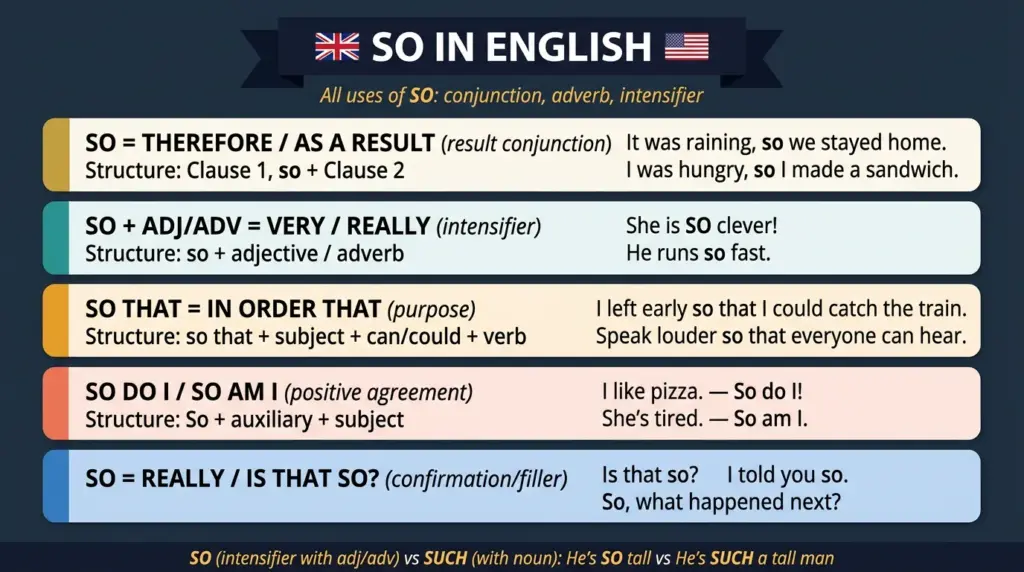
- Multiple roles: So acts as an adverb, a conjunction, and a discourse marker depending on context.
- Degree: Before an adjective or adverb, so means “very” or “such”.
- So vs such: Such is used before a noun phrase (adjective + noun); so before an adjective alone.
- Conjunction: So introduces a consequence (“therefore”); so that introduces a purpose (“in order that”).
- Agreement: So do I / so am I means “me too” — with subject/auxiliary inversion.
- Spoken English: So acts as a discourse marker to summarise, introduce, or change topic.
In English, so is one of the most frequent and versatile words. Adverb of degree, conjunction of consequence, discourse marker, or tool to avoid repetition: its meaning shifts every time depending on what surrounds it. This lesson covers all its uses, from the simplest to the most subtle.
1. So to express degree: “very”, “really”
So modifies the degree of an adjective or adverb. This is its most common use.
| English | Meaning |
|---|---|
| He is so nice. | He is really nice. |
| Why is Becky so cheerful? | Why is Becky so cheerful? |
| She is so beautiful. | She is very beautiful. |
| The movie was so boring. | The movie was really boring. |
| She explained the concept so clearly. | She explained it in such a clear way. |
| I’m sorry I’m arriving so late. | I apologise for arriving this late. |
| This park is so peaceful. | This park is really peaceful. |
| It’s so rainy today. | It’s really rainy today. |
The structure so + adjective/adverb + that expresses a direct consequence:
| English | Meaning |
|---|---|
| She’s so curious that she always asks questions. | Her curiosity leads her to always ask questions. |
| It was so cold that we couldn’t go outside. | The cold prevented us from going out. |
| She was so thirsty that she couldn’t even speak. | Her thirst stopped her from speaking. |
| He ran so fast that nobody could catch him. | His speed made him impossible to catch. |
| The bag was so heavy that she had to put it down. | The weight of the bag forced her to put it down. |
2. So much, so many, so little, so few
So combines with quantifiers to express a large or small quantity.
| Expression | Use | Example |
|---|---|---|
| so much | Uncountable noun | There is so much chocolate. |
| so many | Countable noun | There were so many books. |
| so little | Small quantity (uncountable) | You’ve drunk so little. |
| so few | Small number (countable) | There are so few stars tonight. |
| so much more | Before a comparative | My job is so much more stressful than yours. |
| so much better | Before a comparative | I feel so much better today. |
Before a comparative, always say so much better — never so better.
3. So as a conjunction of consequence: “so”, “therefore”
So links two clauses: the first is the cause, the second is the consequence.
| English | Meaning |
|---|---|
| She didn’t study for the exam, so she was totally unprepared. | Not studying led to her being unprepared. |
| He didn’t finish his homework, so he got a bad grade. | The unfinished homework caused a bad grade. |
| I was sick yesterday, so I couldn’t work. | Being sick prevented me from working. |
| The fruits were on sale, so I bought three kilos of apples. | The sale prompted the purchase. |
| It was raining, so we stayed inside. | The rain caused us to stay in. |
| She missed the bus, so she took a taxi. | Missing the bus led to taking a taxi. |
4. So that and so as to to express purpose
So that does not express a consequence — it expresses an intention or purpose.
| English | Meaning | Structure |
|---|---|---|
| He trained every day so that he could run the marathon. | His aim was to run the marathon. | so that + subject + modal |
| She woke up early so that she wouldn’t miss the train. | Her goal was not to miss the train. | so that + subject + modal |
| He whispered so that nobody would hear him. | He wanted nobody to hear him. | so that + subject + modal |
| She saved money so that she could travel next year. | Travelling next year was her goal. | so that + subject + modal |
| I wake up early so as to start my day productively. | A productive start is the purpose. | so as to + infinitive |
| She left early so as to avoid the traffic. | Avoiding traffic was her intention. | so as to + infinitive |
The difference between so and so that at a glance:
| Structure | Meaning | Example |
|---|---|---|
| clause, so clause | Consequence (therefore) | She was late, so she missed the bus. |
| clause so that clause | Purpose (in order that) | She left early so that she wouldn’t miss the bus. |
5. So to avoid repetition
In a more formal register, so replaces an adjective or clause already mentioned, to lighten the sentence.
| English | Meaning |
|---|---|
| The climate was unstable in that area and it remains so. | It is still unstable. |
| He’s very motivated. He’s been so since the start. | He has been motivated from the beginning. |
| My old school was noisy; my new school less so. | My new school is less noisy. |
| The movie was exciting, and the sequel more so. | The sequel was even more exciting. |
With certain verbs (think, believe, hear, say, read, expect, suppose), so replaces a whole clause in a short answer:
| Exchange | Meaning |
|---|---|
| A: Is Laura moving this year? B: I believe so. | I believe she is. |
| A: Tom won the race. B: So I read. | That’s what I read. |
| A: Will it be tough? B: I think so. | I think it will be. |
| A: Is she coming tonight? B: I expect so. | I expect she is. |
| A: They said it was free. B: So I heard. | That’s what I heard. |
6. So am I, so do I: “me too”
So followed by an auxiliary and a subject expresses agreement. The structure is always: so + auxiliary + subject.
| Auxiliary used | Example | Meaning |
|---|---|---|
| be | Karen is an excellent cook and so is her brother. | Her brother is too. |
| do / does | She loves coffee and so does her brother. | Her brother loves it too. |
| did | I went to the party and so did Tom. | Tom went too. |
| have | I’ve been to Japan and so has she. | She has been too. |
| can | I can swim and so can my sister. | My sister can too. |
| will | I will come and so will Marc. | Marc will come too. |
In an exclamatory spoken response, so confirms something with surprise — without inverting subject and auxiliary:
| Exchange | Meaning |
|---|---|
| A: It’s almost midnight. B: Oh, so it is! | You’re right, it is! |
| A: I can solve this in five minutes. B: So you can! | Apparently you can! |
| A: It’s snowing outside! B: So it is! | So it is, yes! |
7. So as a discourse marker
So appears very often at the start of a sentence in spoken English. It is used to keep the conversation flowing, to summarise, to introduce, or to change topic. This use is universal in spoken English.
| English | Function |
|---|---|
| So, to sum up, the pros outweigh the cons. | Summarising |
| So, what will you do instead? | Changing topic |
| So, where were we? | Picking up a thread |
| So, here’s the thing… | Introducing an explanation |
| So, shall we get started? | Launching an action |
| So, as I was saying… | Resuming after an interruption |
| So, that’s it for today. | Closing a meeting or lesson |
8. So vs such: the rule at a glance
This is the most frequent confusion. The rule is simple: if a noun follows, use such. If the adjective stands alone, use so.
| Situation | Correct word | Correct example | Error to avoid |
|---|---|---|---|
| Adjective alone (no noun) | so | He is so kind. | He is such kind. ✗ |
| Adjective + noun | such | He is such a kind man. | He is so a kind man. ✗ |
| Adjective alone | so | The story was so interesting. | The story was such interesting. ✗ |
| Adjective + noun | such | He told us such an interesting story. | He told us so an interesting story. ✗ |
| Adjective alone | so | She is so beautiful. | She is such beautiful. ✗ |
| Adjective + noun | such | She has such a beautiful face. | She has so a beautiful face. ✗ |
9. Other common uses of so
So far — until now:
So far, everything is going well with the new project.
So far, I’ve read three books this month.
How’s it going so far?
Is that so? — surprise or scepticism:
A: I saw your ex at the supermarket. B: Oh, is that so?
A: They say he’s the best. B: Is that so?
So to indicate a size or manner (spoken, often with a gesture):
The fish I caught was about so big!
Press the button — so.
So for emphasis (informal, common among younger speakers):
That joke is so your style of humor.
That is so the last thing I needed!
She is so not ready for this.
10. So: full grammatical breakdown
| Category | Meaning | Example |
|---|---|---|
| Adverb of degree | Very / Really | She is so tired. |
| Adverb of manner | In this way / Thus | Do it so. |
| Coordinating conjunction | Therefore / So | It rained, so we stayed in. |
| Substitute adverb | The same / That | I think so. |
| Discourse marker | So / Well / Right | So, shall we begin? |
| Adjective (formal) | In proper order | Everything was finally so. |
11. Idiomatic expressions with so
| Expression | Meaning | Example |
|---|---|---|
| so far | Until now | So far, everything is going well. |
| so what! | Who cares! | You got a better grade. So what! |
| so be it | Let it be so | If you decide to leave, so be it. |
| so long as | As long as / Provided that | You can go so long as you’re back by midnight. |
| if so | If that is the case | Do you have allergies? If so, tell the chef. |
| I think so | I think that’s the case | Will he come? I think so. |
| I hope so | I hope that’s the case | Will it be sunny tomorrow? I hope so. |
| I’m afraid so | Unfortunately yes | Did we miss the train? I’m afraid so. |
| I suppose so | I suppose that’s the case | Is it too late? I suppose so. |
| is that so? | Really? Is that true? | I saw your ex. Oh, is that so? |
| so to speak | As it were / In a manner of speaking | He’s the brain of the operation, so to speak. |
| even so | Nevertheless / Even then | It was risky. Even so, they tried. |
| and so on / and so forth | And so on / Etc. | I bought apples, oranges, bananas, and so on. |
| not so long ago | Not very long ago | Not so long ago, he was a student here. |
| so much for that! | That’s the end of that! | The picnic is canceled. So much for that! |
| all the more so | Even more so | The task is hard, all the more so without tools. |
| every so often | From time to time | Every so often, I visit the countryside. |
| how so? | How do you mean? | It’s complicated. How so? |
| so as to | In order to | She left early so as to avoid the traffic. |
| quite so | Absolutely / Quite right | It was a mistake. Quite so. |
| or so | Approximately | I’ll be there in an hour or so. |
| so it seems | Apparently / It would seem so | She’s moving abroad. So it seems. |
| not so much | Not really / Not particularly | Do you like jazz? Not so much. |
| so much so that | To such an extent that | He was tired, so much so that he fell asleep standing. |
| only so much | Only to a certain degree | There is only so much I can do. |
12. Summary: all uses of so in one table
| Use | Meaning | Structure | Example |
|---|---|---|---|
| Degree | Very / Really | so + adj/adverb | She is so tired. |
| Consequence (so…that) | So… that | so + adj + that | It was so cold that we stayed in. |
| Quantity | So much / so many | so much / so many | There are so many options. |
| Consequence (conjunction) | Therefore / So | clause, so clause | It rained, so we stayed in. |
| Purpose | In order that / So that | so that + subject + modal | She left early so that she’d be on time. |
| Substitution | So / The same | verb + so | I think so. / I believe so. |
| Agreement | Me too / So does he | so + aux + subject | So do I. / So does he. |
| Confirmation | Indeed / You’re right | so + subject + aux | Oh, so it is! |
| Discourse marker | So / Well / Right | so, + clause | So, shall we begin? |
| Emphasis (informal) | Really / Totally | so + not/adj | That is so not fair. |
Practice exercise
Test your knowledge of the different uses of so in English:
Question 1: Fill in the blank: “He told us ___ an interesting story about his trip!”
Question 2: Which sentence expresses a purpose rather than a consequence?
Question 3: What does “So far, everything is going well” mean?
Question 4: Which sentence correctly uses so to express “me too”?
Question 5: What does “I’m afraid so” mean in response to a question?
Question 6: Before a comparative, which form is correct?