

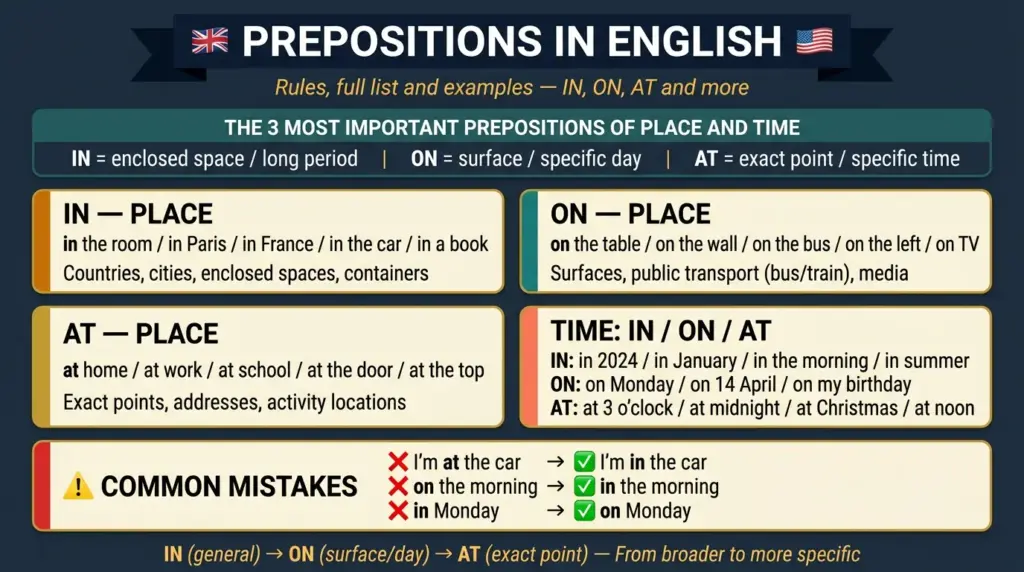
- In / On / At (place): in for an enclosed space, on for a surface, at for a precise point
- In / On / At (time): in for longer periods, on for days and dates, at for times and precise moments
- Since / For: since indicates a starting point (from when), for indicates a duration (how long)
- Verbs + preposition: combinations are fixed and not logical: listen to, look for, wait for… they are learned by heart
- Preposition at the end: in informal English, the preposition can come after the verb, as in Who are you waiting for?
English prepositions cause particular difficulties for learners: one preposition in another language often corresponds to several different English prepositions depending on context — and vice versa. In, on and at can all translate the same way in other languages, yet each serves a distinct purpose in English.
What is a preposition in English?
A preposition is a short, invariable word that connects a noun, pronoun or noun phrase to the rest of the sentence. It specifies a relationship of place, time, direction, cause or belonging.
| Type | Common prepositions | Example |
|---|---|---|
| Place | in, on, at, above, below, behind, between, near, next to, in front of | The keys are on the table. |
| Time | in, on, at, before, after, during, since, for, by, until | She arrives at 9am. |
| Direction | to, into, towards, from, out of, through, across | He walked into the room. |
| Cause / Purpose | because of, thanks to, for, due to | She stayed home because of the rain. |
| Belonging | of | The title of the book. |
| Agent / Means | by, with | The painting was done by hand. |
In English, the preposition normally comes before its complement. However, informal English accepts — and often prefers — placing the preposition at the end of the sentence, especially in questions and relative clauses.
Who are you waiting for?
That’s the colleague I told you about.
This is the house I grew up in.
Formal style places the preposition before the question word or relative pronoun: For whom are you waiting? / This is the house in which I grew up. These constructions are grammatically correct but sound unnatural in everyday speech.
In, On, At: prepositions of place
These three prepositions share overlapping translations in other languages, which makes them easy to confuse. Spatial logic is the key.
| Preposition | Use | Examples |
|---|---|---|
| In | Enclosed or bounded space (city, country, room, box) | in the kitchen, in Paris, in France, in a box |
| On | Horizontal or vertical surface, transport (bus, train, plane) | on the table, on the wall, on the bus, on the phone |
| At | Precise point, address, functional location | at the door, at 5 Main Street, at school, at work, at home |
Transport exception: use in (not on) for a car or taxi: She’s in the car. For all other shared transport (bus, train, plane, underground), use on.
Some common cases worth memorising:
| Expression | Meaning | Note |
|---|---|---|
| at the top / bottom | at the top / bottom | precise point on a scale |
| in the corner (of a room) | in the corner (of a room) | enclosed space |
| on the corner (of a street) | on the corner (of a street) | surface, meeting point |
| at the corner | at the corner (exact point) | exact position |
| in the newspaper | in the newspaper | enclosed space (pages) |
| on TV / on the radio | on TV / on the radio | broadcast channel |
In, On, At: prepositions of time
The same logic applies to time: in for longer periods, on for specific days and dates, at for times and precise moments.
| Preposition | Use | Examples |
|---|---|---|
| In | Months, years, seasons, centuries, parts of the day (except at night) | in March, in 2010, in summer, in the morning, in the 20th century |
| On | Days of the week, specific dates, holidays (with article) | on Monday, on 14 July, on Christmas Day, on my birthday |
| At | Specific times, precise moments, festive periods (without article) | at 6pm, at noon, at midnight, at Christmas, at Easter |
Common exceptions: at night (not in the night, except for a specific night). At the weekend (British English) vs on the weekend (American English). No preposition before last, next, this, every: I saw her last Monday / every Friday.
Since, For, During, By, Until
These prepositions express duration or position in time and are frequently confused.
| Preposition | Use | Example |
|---|---|---|
| Since | Starting point (with present perfect or past perfect) | I’ve lived here since 2018. |
| For | Total duration | I’ve lived here for six years. |
| During | Within a named period | He fell asleep during the film. |
| By | At the latest, deadline | Send the report by Friday. |
| Until / Till | Up to a precise moment (continuity) | The shop is open until 8pm. |
She has worked here since January. (precise starting point)
She has worked here for three months. (duration)
Finish this by Monday. (at the latest on Monday)
Wait here until I come back. (up to the moment I return)
To, Into, Towards, From: prepositions of direction
Prepositions of direction express a movement or trajectory. They differ from prepositions of place, which indicate a static position.
| Preposition | Meaning | Example |
|---|---|---|
| to | Towards a destination (with a movement verb) | She went to the office. |
| into | Movement inward (entering) | He walked into the building. |
| towards | In the direction of (without necessarily reaching it) | She looked towards the window. |
| from | Starting point | The train from London arrives at noon. |
| out of | Movement outward | She walked out of the room. |
| through | Through, from one side to the other | They drove through the tunnel. |
| across | From one side to the other (over a surface) | She swam across the river. |
Go home without a preposition: unlike many other languages, English does not use a preposition before home with a movement verb. I’m going home is correct — never I’m going to home.
Verbs followed by a preposition
In English, many verbs form fixed combinations with a preposition. These pairings cannot be deduced logically and are learned phrase by phrase. Here are the most common groups.
Look + preposition
| Expression | Meaning | Example |
|---|---|---|
| look at | to look at something | Look at that painting. |
| look for | to search for | I’m looking for my keys. |
| look after | to take care of | She looks after her neighbour’s cat. |
| look into | to examine, to investigate | We will look into the matter. |
| look forward to | to anticipate with pleasure | I’m looking forward to the weekend. |
Other common verbs + preposition
| Expression | Meaning | Example |
|---|---|---|
| listen to | to listen to | She’s listening to a podcast. |
| wait for | to wait for | We’ve been waiting for the bus. |
| ask for | to request | He asked for advice. |
| talk to / with | to speak to / with | I need to talk to the manager. |
| arrive at / in | to arrive at (precise location) / in (city, country) | She arrived at the airport. / They arrived in Tokyo. |
| depend on | to depend on | It depends on the weather. |
| agree with / on | to agree with / on | I agree with you. / We agreed on a plan. |
| apologise for | to apologise for | She apologised for being late. |
| consist of | to consist of | The team consists of ten people. |
| belong to | to belong to | This bag belongs to my sister. |
Adjectives followed by a preposition
Some English adjectives are always constructed with a specific preposition. These combinations often differ from other languages.
| Expression | Meaning | Example |
|---|---|---|
| good at | skilled in | She’s good at maths. |
| bad at | weak in | I’m bad at spelling. |
| interested in | interested in | He’s interested in history. |
| afraid of | afraid of | She’s afraid of spiders. |
| proud of | proud of | They’re proud of their team. |
| responsible for | responsible for | He’s responsible for the project. |
| different from | different from | This model is different from the previous one. |
| similar to | similar to | The new version is similar to the old one. |
| married to | married to | She’s married to a doctor. |
| full of | full of | The room was full of people. |
Common mistake: different from is standard in both British and American English. Different than is used in some American English contexts; different to in informal British English. Different of is always incorrect.
Practice exercise
Test your knowledge of English prepositions:
Question 1: She has been working at this company ___ 2019.
Question 2: We met ___ a Tuesday ___ June.
Question 3: Please submit your application ___ Friday.
Question 4: She walked ___ the room without saying a word.
Question 5: I’m not very good ___ cooking, but I enjoy it.
Question 6: He arrived ___ the airport two hours early.
Question 7: Can you look ___ my cat while I’m away?
Question 8: This design is very different ___ what we had before.