

- Nature: modal auxiliaries, invariable for all persons, followed by an infinitive without to
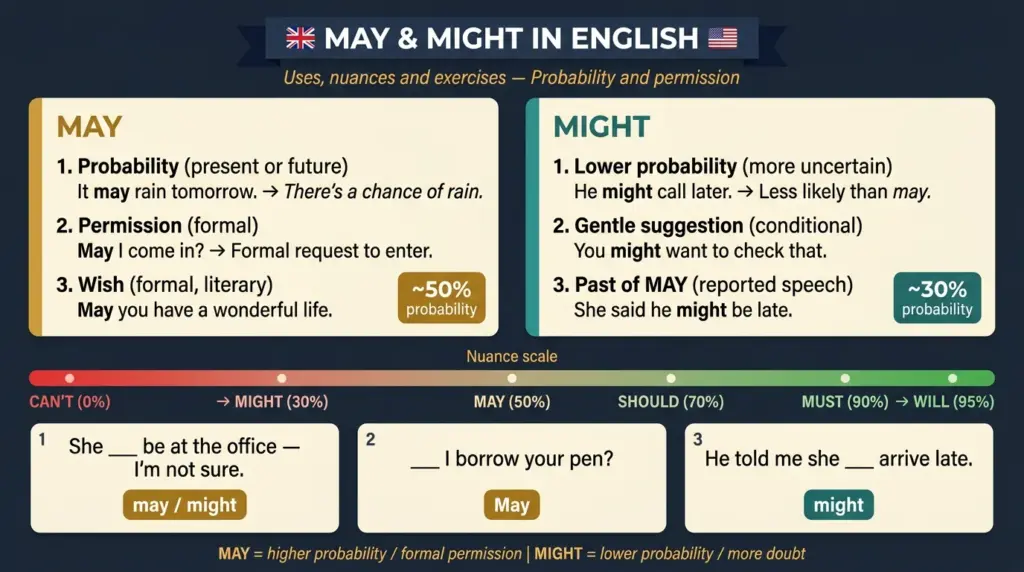
- May: expresses a possibility considered likely (around 50–60%) or gives/asks for formal permission
- Might: expresses a weaker or more uncertain possibility (around 30–40%); the only modal used for a possibility in the past
- Past: may have + past participle and might have + past participle for hypotheses about the past
- Negation: may not = categorical prohibition; might not = simple possibility of not doing something
May and might can both be translated as “perhaps” or “to be able to”, which makes them easy to confuse. The difference lies in the degree of certainty expressed and the intended use: possibility, permission or a past hypothesis.
The basic rules of modal auxiliaries
May and might belong to the family of modal auxiliaries, along with can, could, must, should and would. These auxiliaries follow three common rules:
| Rule | Correct example | Incorrect example |
|---|---|---|
| Invariable: no -s in the 3rd person | She may come. | She mays come. |
| Followed by an infinitive without to | He might leave. | He might to leave. |
| Negative: not is added directly after | You may not enter. | You don’t may enter. |
Might is historically the past tense of may, but in contemporary English both forms coexist in the present with different nuances of probability.
Expressing possibility: may vs might
This is the most frequent use of the two modals. May expresses a possibility considered relatively likely. Might expresses a more uncertain, more hypothetical possibility.
| Modal | Degree of probability | Example | Meaning |
|---|---|---|---|
| may | ~50–60% | It may rain tomorrow. | It will perhaps rain tomorrow. (the sky is overcast) |
| might | ~30–40% | It might rain tomorrow. | It could rain tomorrow. (nothing is certain) |
The sky is very dark. It may rain soon. (high probability)
I haven’t decided yet. I might go to the gym tonight. (weak possibility)
In many everyday situations, may and might are interchangeable without radically changing the meaning. The difference becomes more noticeable when the context specifies the degree of certainty.
Asking for and giving permission with may
To politely ask for permission to do something, may is the reference modal. Might I…? can be used in the same sense, but with an even higher degree of politeness. In everyday practice, this interrogative form of might is rare and tends to sound ceremonious.
May I borrow your pen? (polite request, standard)
May I ask you a question?
You may leave the room now. (permission granted)
| Form | Example | Meaning |
|---|---|---|
| Polite request | May I borrow your book? | Am I allowed to borrow your book? |
| Even more polite request | Might I ask you a question? | Would you permit me to ask you a question? (very ceremonious) |
| Permission granted | You may use my laptop. | You are allowed to use my laptop. |
| Categorical prohibition | You may not smoke here. | Smoking here is strictly forbidden. |
| Permission granted (classroom) | Students may leave at noon. | Students are allowed to leave at noon. |
May not expresses a firm prohibition, close to must not. It is not a simple possibility of not doing something: it is a refusal or a rule.
Negation: may not vs might not
| Form | Meaning | Example |
|---|---|---|
| may not | Prohibition (it is not permitted) | You may not take pictures in this museum. |
| might not / mightn’t | Possibility of not doing (perhaps not) | She might not come to the party. |
You may not use your phone during the exam. (strict prohibition)
He might not be at home right now. (uncertain possibility)
Hypotheses about the past: may have and might have
| Structure | Example | Meaning |
|---|---|---|
| may have + PP | She may have missed her train. | It is possible that she missed her train. |
| might have + PP | He might have forgotten the meeting. | He may have forgotten the meeting. (less likely) |
| may not have + PP | They may not have received the email. | It is possible that they did not receive the email. |
| might not have + PP | She might not have seen your message. | She may not have seen your message. |
The door is unlocked. Someone may have forgotten to close it.
He didn’t answer. He might have been asleep when you called. (uncertain hypothesis)
You cannot use may alone (without have) to talk about the past. She may left early is incorrect. The correct form is She may have left early.
Might in reported speech
| Direct speech | Reported speech |
|---|---|
| “It may rain later,” she said. | She said it might rain later. |
| “I may be late,” he warned. | He warned that he might be late. |
| “We may cancel the trip,” they announced. | They announced they might cancel the trip. |
May and might to express concession
This restaurant may not be the biggest in town, but the food is excellent.
She might not be the fastest runner, but her technique is flawless.
Maybe, may be and might be: beware of confusion
| Form | Example | Meaning |
|---|---|---|
| maybe (adverb) | Maybe she will call later. | Perhaps she will call later. |
| may be (modal + verb) | She may be at the office now. | She is perhaps at the office now. |
| might be (modal + verb) | It might be a mistake. | It could be a mistake. |
The test: if you can replace it with perhaps at the start of a sentence, it is maybe (one word). If it is a conjugated verb in the sentence, it is may be or might be (two words).
Practice exercise
Test your knowledge of may and might:
Question 1: The sky is very cloudy. Which sentence expresses the highest probability of rain?
Question 2: Fill in: “_____ I use your phone? Mine is dead.”
Question 3: Which sentence expresses a categorical prohibition?
Question 4: She didn’t reply to your message yesterday. Which sentence is a hypothesis about the past?
Question 5: In reported speech, what does “I may be late,” he said become?
Question 6: Which sentence uses maybe (adverb) correctly?
Question 7: Which sentence is the most formal and ceremonious way to ask permission to ask someone a question?