


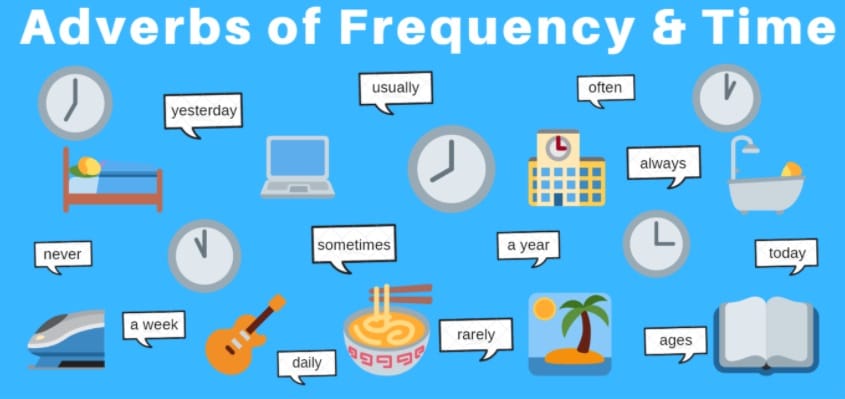
Let’s look at adverbs of frequency and time, how to form them, where to position them in a sentence and some examples in some famous songs. Have a look at our article about other types of adverbs.
Adverbs of frequency describe how often actions happen
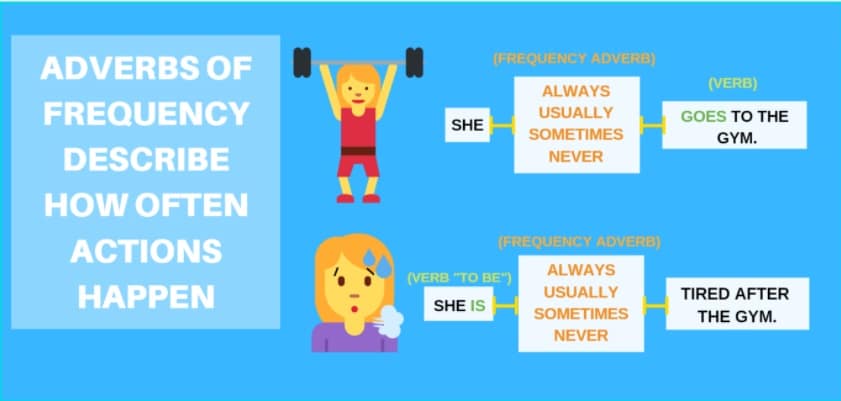
Some adverbs can tell us how often we do certain actions. Usually, we place them before the main verb, except for when the main verb is “to be,” the adverb will always come after it.
For Example:
(normal position)
- She never goes to the gym. = 0% frequency
- He sometimes goes to the gym. = 50% frequency
- They usually go to the gym. = 80~90% frequency
- She always goes to the gym. = 100% frequency
(with verb “to be”)
- She is never tired after the gym. = 0% frequency
- He is sometimes tired after the gym. = 50% frequency
- We are usually tired after the gym. = 80~90% frequency
- They are always tired after the gym. = 100% frequency
Some frequency adverbs can also be used at the beginning/end of sentences
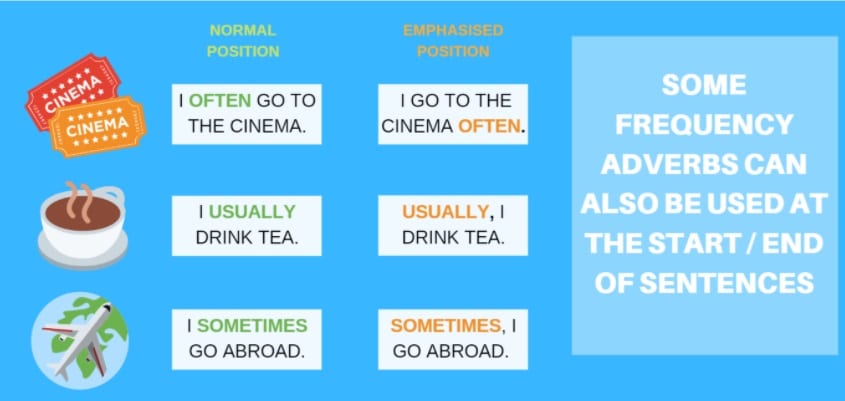
Additionally, we can also use certain adverbs that talk about frequency at the very start or very end of a sentence. When they are in these positions, it makes the meaning of the adverb much stronger or emphasized.
For example:
Normal position Emphasised position
- Sometimes I sometimes go abroad. Sometimes, I go abroad/I go abroad sometimes.
- Usually I usually drink tea. Usually, I drink tea / I drink tea usually.
- Often I often go to the cinema. I go to the cinema often.
Other frequency adverbs describe the period/number of times actions are done
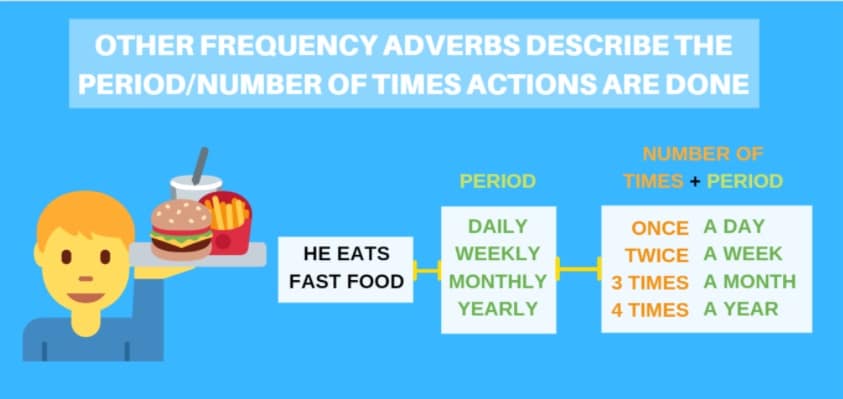
Another way to talk about frequency is to use adverbs that tell us the number of times or period in which we do things. These adverbs usually go at the end of the sentence.
For example:
PERIODS Number of times
- He eats fast food daily. He eats fast food 3 times a day.
- I go to the gym weekly. I go to the gym once / twice / three times etc. a week.
- This magazine comes out monthly. I buy this magazine once a month.
- That event happens yearly. That event happens once a year.
Adverbs of time can tell us when things happen
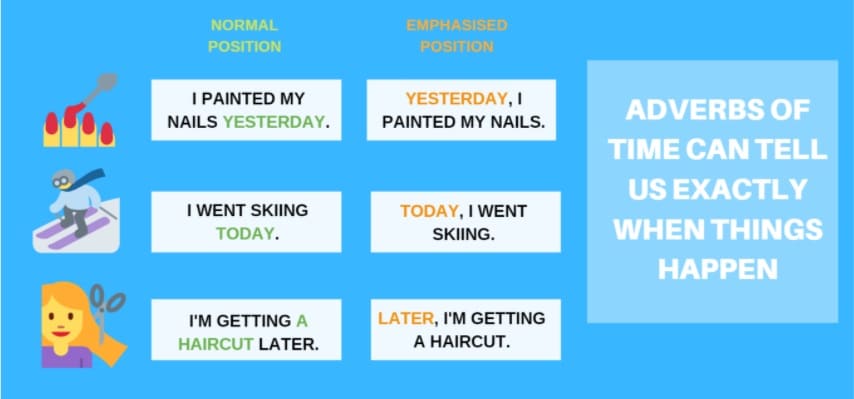
Adverbs that tell us exactly when actions happen usually go at the end of the sentence, but we can place them at the start of the sentence if the “when” part of the sentence is more important.
For example:
Normal position:
- He painted my nails yesterday.
- You went skiing today.
- I am getting a haircut later.
- They need to go to work now.
- I saw that film last/ this year/ month / week.
Emphasized position:
- Yesterday, He painted my nails.
- Today, you went skiing.
- Later, I am getting a haircut.
- Now, they need to go to work now.
- Last/ This year/ month/week, I saw that film.
Here are some more examples of adverbs of frequency in context:
- I always eat breakfast before starting my day.
- John frequently goes to the gym to work out.
- She rarely misses a day of work.
- They occasionally go out to dinner on weekends.
- We usually take a walk after dinner.
- He hardly ever complains about his job.
- Mary often travels to different countries for work.
- They never forget to call their parents on their birthdays.
- I sometimes forget where I put my keys.
- She always arrives on time for her appointments.
Here are 20 more unusual examples:
- He invariably drinks his coffee black.
- They sporadically take a day off just to relax.
- She unfailingly reads at least one book a week.
- He habitually runs late to meetings.
- They persistently argue about politics.
- She frequently daydreams about traveling the world.
- He intermittently forgets to turn off the stove.
- They consistently win every game they play.
- She occasionally dyes her hair a new color.
- He routinely listens to classical music before bed.
- They uncommonly eat sushi for breakfast.
- She typically wears mismatched socks.
- He occasionally sneezes three times in a row.
- They almost never take the same route home.
- She frequently wears hats with unusual designs.
- He regularly talks to himself while cooking.
- They seldom go to the movies on weekdays.
- She hardly ever eats dessert after dinner.
- He periodically cleans his car with a toothbrush.
- They always sit in the same spot at their favorite restaurant.
Interested in improving your English?
Sign up for a 30-minute trial lesson
What follows is more in depth explanation of Adverbs of Frequency
Adverbs of frequency are a crucial part of the English language that help us to convey how often something happens. They provide us with a way to express the frequency of an action, event, or state. These adverbs can be placed before the main verb or after the auxiliary verb, depending on the sentence structure.
They can be broadly divided into two categories: definite and indefinite. Definite adverbs of frequency specify a precise frequency, while indefinite adverbs of frequency indicate an approximate frequency.
Definite adverbs include words such as “always,” “usually,” “often,” “sometimes,” “rarely,” and “never.” These adverbs indicate the frequency of an action, event, or state with a high degree of certainty. For example, “I always wake up at 6 am,” or “She never eats meat.”
Indefinite adverbs of frequency include words such as “frequently,” “regularly,” “occasionally,” and “seldom.” These adverbs indicate a less precise frequency of an action, event, or state. For example, “I frequently go to the gym,” or “She seldom drinks alcohol.”
Adverbs of frequency are important because they allow us to express how often something happens. This information is essential for effective communication, especially when discussing habits or routines. Adverbs of frequency also help to create more nuanced meaning and add emphasis to our statements.
When using adverbs of frequency, it is essential to pay attention to their placement in the sentence. Generally, adverbs of frequency are placed before the main verb in a sentence. For example, “I always eat breakfast before work.” However, if the sentence contains an auxiliary verb, such as “do,” “be,” or “have,” the adverb of frequency should be placed after the auxiliary verb. For example, “She has always been interested in science.”
It is also important to note that the position of the adverb of frequency can affect the meaning of the sentence. For example, “I only eat vegetables” and “I eat only vegetables” have different meanings. In the first sentence, “only” modifies “eat,” indicating that the speaker does not eat anything else besides vegetables. In the second sentence, “only” modifies “vegetables,” indicating that the speaker eats nothing else besides vegetables.
Tips to use adverbs of frequency
Adverbs of frequency are essential for expressing how often an action occurs. To use them effectively, Break Into English will give you several recommendations.
Using adverbs of frequency in questions
In English, when forming questions with adverbs of frequency, the placement of the adverb depends on the structure of the sentence and on the verbs that you are using.
Adverbs of frequency such as ‘always’, ‘usually’, ‘often’, ‘sometimes’, ‘rarely’, and ‘never’ are positioned between the subject and the main verb in interrogative sentences. For example, in the question “Do you often travel for work?”, ‘often’ is placed after the subject ‘you’ and before the main verb ‘travel’.
However, when the verb ‘to be’ is used, the adverb follows the verb. Consider the question “Is he always late?”. In this example, ‘always’ comes after the verb ‘is’ and before the adjective ‘late’.
Common mistakes with adverbs of frequency
Frequency adverbs such as “always”, “usually”, “often”, “sometimes”, “rarely” and “never” help you communicate effectively in English. However, some of our students may encounter challenges in their usage, which lead to common mistakes.
One of these errors involves the misplacement of these adverbs within a sentence. For regular verbs, adverbs of frequency should precede the main verb. For example, “She often studies at the library.”
When using the verb “to be,” the adverb should follow it, as in “He is always punctual.” Incorrect placement, such as “She studies often at the library” or “He always is punctual,” disrupt the sentence’s natural flow and can lead to misunderstandings.
Another common mistake is using adverbs of frequency with inappropriate time expressions or tenses. For instance, saying “I always went shopping yesterday” is incorrect because “always” suggests a habitual action, conflicting with the specific past time reference “yesterday”. The correct construction would be “I went shopping yesterday”.
Additionally, negative adverbs like “never” or “rarely” should not be used in negative sentences, as this results in a double negative. For example, “I don’t never miss class” is incorrect. The correct form is “I never miss class”.
Cultural differences in expressing frequency
Cultural specificities significantly influence how individuals express frequency in their speech, reflecting the values and the communication styles of each English-speaking country.
In high-context cultures, such as in Japan and China, communication often relies on implicit understanding. Individuals from these cultures may use adverbs of frequency less explicitly, assuming that the listener can understand the meaning from the context and the examples that they have given. This cultural specificity aligns with the attitude of high-context societies, where maintaining harmony and empathy are the priority.
However, low-context cultures such as the United States and Germany favor explicit and direct communication. Speakers are more likely to use specific adverbs of frequency to express themselves and avoid ambiguity. This style reflects the values of low-context societies, where personal opinions and clarity are put first.
Understanding cultural differences is crucial in communicating when you are travelling, as well as when you are working in an international company. It helps avoid misunderstandings and fosters effective interactions by acknowledging the communication style of each culture.
Learning adverbs of frequency
Learning adverbs of frequency is essential when you are looking forward to moving abroad, traveling or even communicating with your international clients. They help you communicate your ideas with clarity.
Interactive activities for practicing adverbs of frequency
Our native teachers are engaging their students in several types of interactive activities during a lesson. It’s an effective strategy for teaching adverbs of frequency, as it encourages active participation and reinforces learning through practice.
One of these activities is called “Find Someone Who”, where students receive a worksheet listing various activities paired with frequency adverbs, such as “watches TV often” or “drinks coffee sometimes”. Students need to ask their teacher questions such as “How often do you watch TV?”. This exercise can be made during a one-on-one lesson, whether we are using Zoom, Google Meet or Teams. It helps students understand the use of adverbs of frequency in everyday contexts.
At Break Into English, we adapt interactive activities to the needs and interest of our students, as we a-only deliver one-on-one online classes. We can also focus on industry-specific vocabulary for our students who want to learn English or develop their language skills in order to use them at work.
Engaging in role-playing scenarios with you English teacher
Engaging in role-playing scenarios with your teacher offers a dynamic approach by simulating real-life situations during the lessons. This method immerses you in authentic contexts and allows you to practice English in a supportive environment. At Break Into English, we work with certified native teachers, which helps you get familiar with a specific accent. For example, you can choose to learn with a teacher from the United States, from Australia or any other English-speaking country.
By playing various roles, students can enhance their fluency and adapt in all circumstances. These kinds of activities make learning more interactive and will help you learn English easier.
Role-playing scenarios foster soft skills such as negotiation, empathy and problem-solving. As students play different scenarios, they learn to understand various perspectives and respond appropriately.
This learning approach also boosts confidence, as students become more comfortable in conversations.
Assessing mastery of adverbs of frequency
Assessing your use of adverbs of frequency is crucial for evaluating your proficiency in English. Our teachers may use methods such as:
- quizzes
- board games
- surveys
- other interactive activities
These methods allow them to check your progress in time and adapt your learning plan. You will also receive regular and constructive feedback.
Why shall you use adverbs of frequency in daily conversations ?
In conclusion, adverbs of frequency are an essential part of the English language. They help us to express how often something happens and create more nuanced meaning and emphasis in our statements. When using them, it is crucial to pay attention to their placement in the sentence and the effect that this has on the meaning of the sentence. By using these tools effectively, we can communicate more clearly and effectively in English.
Overall, adverbs of frequency help us describe how often we do actions, which can be useful when talking about our routines, free time, work and studies in more detail. We usually place them in front of the main verb except for phrases that use “to be” where it always goes after. Most can also be used at the very start or end of a sentence to make them more emphasised. This same rule also applies to time adverbs that are usually at the end of the sentence but can go at the beginning as well. Adverbs of frequency and time are all around us, especially in music. Listen to the songs below and see if you can hear the frequency and time adverbs being used.