Grammar content
Make or Do in English: rules, collocations and examples
In short Make is used for creation, production, and results: something new exists after the action. Do is used for tasks, duties, activities, and work:

About Break Into English
Break Into English is an online language academy specialising in one-to-one English lessons with native teachers. Our method is based on active conversation and personalised content tailored to your goals.
We believe the fastest way to real fluency is speaking from day one with a native teacher who adapts to you, not the other way around.
Our individual online English courses
All our online English courses are taught by native English speakers who have been internally trained to apply the Break Into English method.
Personalised lessons are delivered online and you can choose the video conferencing platform that suits you best: Zoom, Google Meet, Teams, etc.


In short Make is used for creation, production, and results: something new exists after the action. Do is used for tasks, duties, activities, and work:
In brief Definition: indefinite pronouns refer to people, things or places in a non-specific way. Four series: some, any, every, no combined with -one, -body,
In brief General rule: add -th to the cardinal number. four → fourth, six → sixth. Three absolute irregulars: one → first, two → second,
In brief Present subjunctive: invariable verb base for all persons. No -s at the 3rd person singular. To be remains be everywhere. Past subjunctive: form
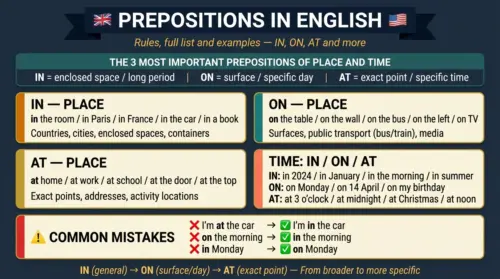
In short In / On / At (place): in for an enclosed space, on for a surface, at for a precise point In / On
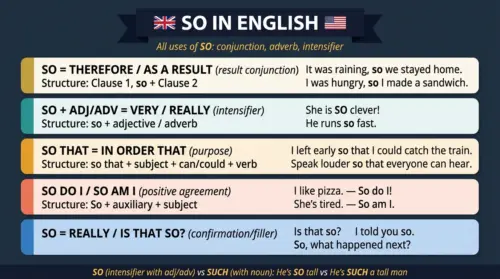
In short Multiple roles: So acts as an adverb, a conjunction, and a discourse marker depending on context. Degree: Before an adjective or adverb, so
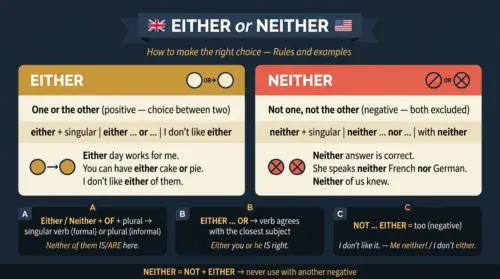
In short Either… or: used in affirmative sentences to express two choices. Neither… nor: used in negative sentences when both choices are excluded. Expressing agreement
In short Two main roles: Which acts as both an interrogative word and a relative pronoun. Making choices: Which is used when selecting from a