

In short
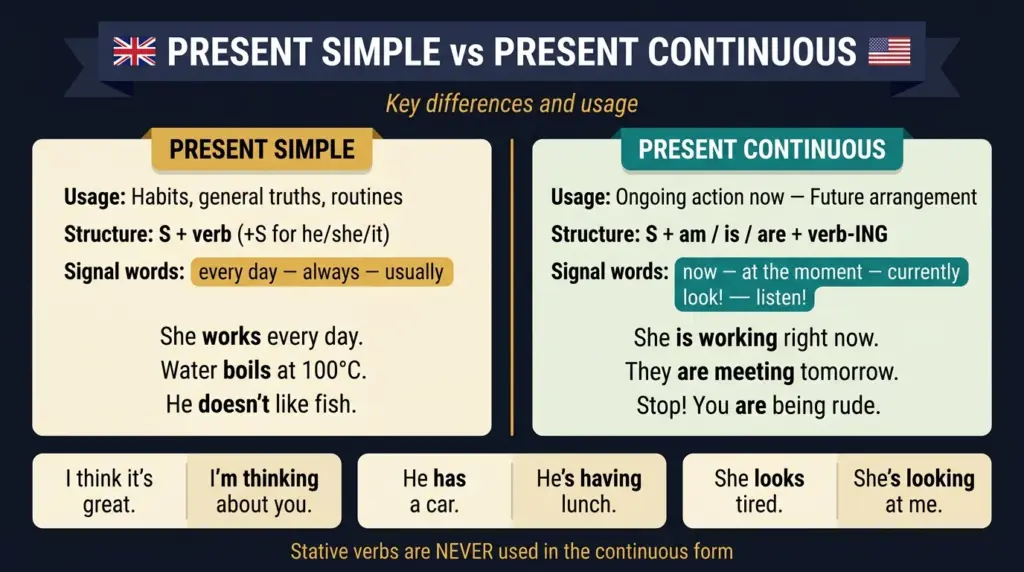
- Present simple: It describes habits, routines, and permanent general truths.
- Present continuous: It describes actions happening right now at the exact moment of speaking.
- Simple formation: The base verb takes an ‘s’ only in the third person singular.
- Continuous formation: The auxiliary ‘be’ is conjugated in the present tense and the action verb takes the ‘-ing’ ending.
- Stative verbs: Verbs expressing a feeling or an opinion generally do not take the continuous form.
In English, speaking in the present tense requires choosing between two very distinct forms. This choice depends on a single question: is the action a habit or is it happening right now? Here is a clear explanation for ESL beginners so you will never confuse present simple vs present continuous again.
The present simple for habits and truths
The present simple is used to describe everyday life. It is used to express repeated actions. These actions are habits or routines. This tense is also used to state proven facts. It expresses permanent and undeniable truths. Scientific nature always uses this tense.
Here is how to build an affirmative sentence. The pattern requires the subject followed by the base verb. The base verb is the verb without the word to. A unique rule applies to the third person singular. You must add an ‘s’ to the end of the verb with he, she, or it.
| Subject | Example with the verb work |
|---|---|
| I | I work in an office. (I work in an office.) |
| You | You work very hard. (You work very hard.) |
| He / She / It | She works every day. (She works every day.) |
| We | We work together. (We work together.) |
| They | They work in London. (They work in London.) |
Some verbs change their spelling in the third person singular. Verbs ending in ‘o’, ‘ch’, ‘sh’, ‘ss’, ‘x’, or ‘z’ take an ‘es’. For example, the verb go becomes goes. The verb watch becomes watches. Verbs ending in a consonant followed by a ‘y’ change this ‘y’ to ‘ies’. The verb study becomes studies.
The negative form requires the use of an auxiliary. The auxiliary do carries the negation mark with the word not. We use the contraction don’t in everyday language. In the third person singular, the auxiliary becomes does and takes the contracted form doesn’t. The main verb then loses its final ‘s’.
| Subject | Contracted negative form |
|---|---|
| I / You / We / They | I don’t play tennis. (I do not play tennis.) |
| He / She / It | He doesn’t play tennis. (He does not play tennis.) |
The interrogative form also uses this same auxiliary. The auxiliary is always placed before the subject. The action verb remains in its base verb form.
| Structure | Interrogative example |
|---|---|
| Do + I/You/We/They + verb | Do you speak English? (Do you speak English?) |
| Does + He/She/It + verb | Does she speak English? (Does she speak English?) |
Words that accompany the present simple
Certain words almost always signal the use of the present simple. They are called adverbs of frequency. They indicate how often an action is repeated. These words are generally placed between the subject and the verb.
Here are the most common adverbs of frequency. The word always means at all times. The word usually means most of the time. The term often translates to frequently. The word sometimes indicates occasionally. The term rarely means not often. The word never means not at all.
Specific time expressions also accompany this tense. The expression every day means each day. The expression once a week means one time per week. The phrase on Mondays indicates Mondays in general. These expressions are often placed at the end of the sentence.
The present continuous for ongoing actions
The present continuous is also known as the present progressive. This tense is used to describe a specific action. This action is happening at the moment of speaking. The action is not yet finished. It has a temporary nature.
The construction of this tense requires two distinct elements. The first element is the auxiliary be conjugated in the present tense. The second element is the action verb followed by the -ing ending. Forgetting the auxiliary makes the sentence incorrect.
| Subject + Auxiliary | Verb ending in -ing |
|---|---|
| I am (I’m) | I am reading a book. (I am reading a book.) |
| You are (You’re) | You are listening to music. (You are listening to music.) |
| He / She / It is (He’s) | It is raining. (It is currently raining.) |
| We are (We’re) | We are eating dinner. (We are eating dinner right now.) |
| They are (They’re) | They are playing outside. (They are playing outside right now.) |
Spelling rules apply when adding the -ing ending. A verb ending in a silent ‘e’ loses this final ‘e’. The verb make becomes making. A short, one-syllable verb doubles its final consonant. This rule applies if the verb ends in a consonant preceded by a single vowel. The verb sit becomes sitting. The verb run becomes running.
The negative form of the present continuous is very simple to form. You just need to add the negation particle not after the auxiliary be. Contractions are very common in spoken language.
| Full form | Contracted negative form |
|---|---|
| I am not sleeping. | I’m not sleeping. (I am not sleeping.) |
| She is not working. | She isn’t working. (She is not currently working.) |
| They are not coming. | They aren’t coming. (They are not coming right now.) |
The interrogative form follows the rule of inversion. The auxiliary be goes before the subject of the sentence. The action verb keeps its -ing ending at the end. For example, the sentence becomes Are you watching television? (Are you watching television?). Another possible sentence is Is he studying now? (Is he studying now?).
Time markers for the present continuous
The present continuous is often accompanied by specific time indicators. These words draw attention to the present moment. The word now translates to at this time. The expression right now emphasizes the immediate moment.
The phrase at the moment means currently. The term currently translates to at present. Commands like Look! or Listen! require the use of this tense. They point out an immediate action to observe.
The difference in meaning explained by example
Using the wrong tense completely changes the meaning of the sentence. A direct comparison helps to understand this temporal mechanic. Observe the impact of the tense on the verb live.
The sentence I live in Paris uses the present simple. This phrasing expresses a permanent situation. The person resides in Paris permanently. It is their main address on a long-term basis.
The sentence I am living in Paris uses the present continuous. This construction indicates a temporary situation. The person lives in Paris for a limited time. They plan to move in the future.
Let’s take the verb work. The question What do you do? corresponds to the present simple. It asks about the person’s profession. The question What are you doing? corresponds to the present continuous. It asks what action the person is performing at this exact moment.
Stative verbs incompatible with the continuous form
English grammar separates verbs into two categories. Action verbs describe active physical or mental movements. Stative verbs describe motionless conditions. They express inner feelings, deep thoughts, or material possessions.
Stative verbs are almost never used in the present continuous. Even if the state is happening now, we use the present simple. We say I know the answer. We never say I am knowing the answer.
Here are the main verbs related to senses and perception. The verb see means to perceive with the eyes. The verb hear means to perceive sound. The verb smell translates to perceiving an odor. The verb taste means to perceive flavor.
Here are verbs expressing feelings and emotions. The verb like means to find agreeable. The verb love means to feel deep affection. The verb hate translates to feeling intense dislike. The verb want means to desire. The verb need means to require.
Here are verbs expressing mental processes. The verb know means to be aware of. The verb understand means to comprehend. The verb believe translates to accepting as true. The verb remember means to recall. The verb forget means to fail to remember.
Finally, here are verbs related to possession. The verb have means to possess. The verb own means to be the owner of. The verb belong translates to being the property of.
The verb have requires special attention. If it expresses possession, it stays in the present simple. We say I have a car. If it expresses an action in an expression, it accepts the continuous form. We say I am having breakfast.
The verb think also has this dual grammatical identity. To express an opinion, it requires the present simple. We say I think this is a good idea. To express an ongoing thought process, it accepts the present continuous. We say I am thinking about my holidays.
Expressing the future with present tenses
English often uses present forms to talk about the future. Each form has a specific nuance for talking about the future. The choice depends on the nature of the upcoming event.
The present simple is used for future events based on fixed schedules. These are official programs and timetables planned in advance. The speaker has no personal control over these events.
We use this form for public transportation. The sentence The train leaves at 8 PM tomorrow is correct. Movie or store schedules also use this rule. The sentence The film starts in ten minutes demonstrates this usage.
The present continuous is used for future personal arrangements. It describes plans already organized with certainty by the speaker. Appointments made in advance fall into this specific category.
A future time indicator always accompanies the sentence. This precaution avoids confusion with an ongoing action. The sentence I am meeting John tomorrow morning illustrates this concept. The appointment is already set and noted in the planner.
Practical exercise
Test your English knowledge on the difference between the present simple and the present continuous:
Question 1: Which of these sentences describes an ongoing action?
Question 2: What is the correct form to express a permanent fact?
Question 3: Choose the correct translation for “Je ne comprends pas l’exercice”.
Question 4: Complete the sentence: “Shh! The baby ___.”
Question 5: Which question asks about a habit?
Question 6: Which tense should be used for the sentence “Mon train part à 18h ce soir”?
Your score