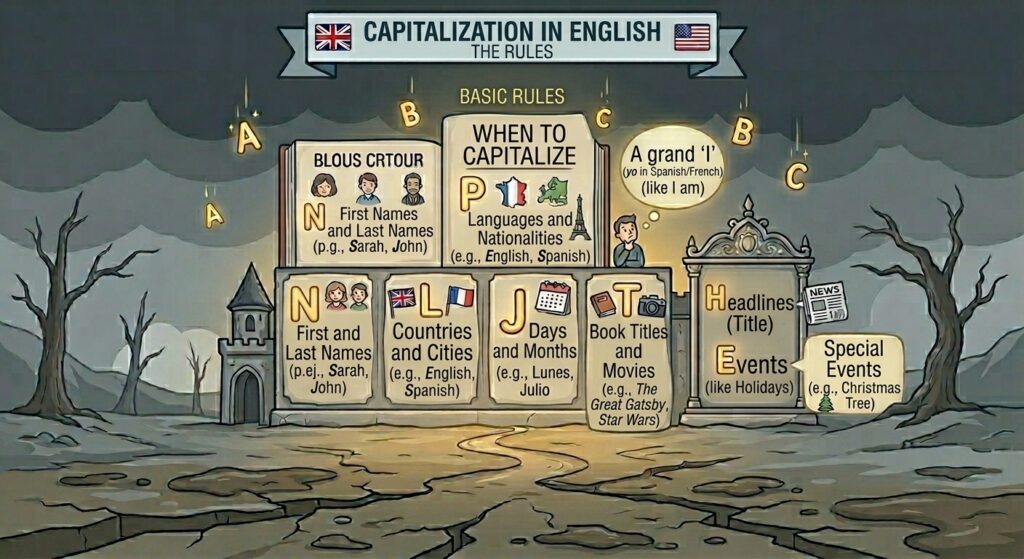
In English, a capital letter is used far more often than in French. Several categories of words that are written in lowercase in French are systematically capitalized in English: days of the week, months, nationalities, languages, and the personal pronoun I. Knowing these rules helps avoid recurring mistakes in professional emails, academic texts, and everyday correspondence.
Vocabulary for capital letters in English
Before covering the rules, here are a few useful terms to know:
| English term | Meaning | Common usage |
|---|---|---|
| Capital letter | Uppercase letter | Official and formal term |
| Capital | Capital | Shortened form, very common |
| Uppercase | Uppercase / in capitals | Computing, typography |
| Lowercase | Lowercase | Computing, typography |
| Caps | Capitals | Informal, web and text messaging |
| All caps / All capitals | All in capitals | Text written entirely in uppercase |
| Capitalize | To capitalize | Verb used in instructions |
Rule 1: Beginning of a sentence and after strong punctuation
As in French, every sentence begins with a capital letter. This rule applies after a full stop, a question mark, and an exclamation mark, regardless of the type of sentence.
The sun is shining today.
Where are you going? I don’t know.
Stop! That’s dangerous.
Direct quotations also begin with a capital letter when they form a complete sentence:
She said, “We need to leave now.”
She said, “we need to leave now.” (incorrect)
Rule 2: The personal pronoun I
The first-person singular personal pronoun is always written as I with a capital letter, regardless of its position in the sentence — at the beginning, in the middle, or at the end. There are no exceptions to this rule.
I went to the market this morning.
She told me that I was late.
I’m ready when you are.
she told me that i was late. (incorrect)
Historical background: this rule dates back to the first English printers of the 15th century. The lowercase pronoun i appeared too insignificant visually in the middle of a printed line of text. The use of the capital I gradually became standardized and was established as an official rule of the language in the 18th century.
Rule 3: Proper nouns — people and places
All proper nouns are capitalized: first names, last names, nicknames, names of cities, countries, regions, streets, buildings, monuments, companies, and institutions.
| Category | Examples with capital letters |
|---|---|
| First names and last names | John, Emma Watson, Dr. Smith |
| Cities and countries | Paris, France, New York, South Korea |
| Streets and neighborhoods | Baker Street, Fifth Avenue, Notting Hill |
| Buildings and monuments | the Eiffel Tower, the White House, Big Ben |
| Companies and brands | Apple, Google, Coca-Cola, the BBC |
| Institutions and organizations | the United Nations, Harvard University, the Red Cross |
| Rivers, seas, mountains | the Thames, the Pacific Ocean, the Alps, Mount Everest |
| Planets and celestial bodies | Jupiter, Mars, the Milky Way |
Special case: Earth, Moon, and Sun are capitalized when they refer to specific celestial bodies in a scientific or astronomical context. In everyday use, you can write the earth (the ground), the moon (tonight) or the sun in lowercase.
Rule 4: Nationalities, languages, and cultural adjectives
This is one of the most important differences between French and English. In English, nationalities, languages, and all adjectives derived from the name of a country or people are always capitalized, whether used as nouns or as adjectives.
| Category | English (capitalized) | French (lowercase) |
|---|---|---|
| Nationality (noun) | She is French. | Elle est française. |
| Nationality (adjective) | French food | la cuisine française |
| Language | I speak English and Spanish. | Je parle anglais et espagnol. |
| People | the British, the Japanese | les Britanniques, les Japonais |
| Cultural adjective | German engineering | l’ingénierie allemande |
Are you American?
Do you want to learn how to make English tea?
French people usually speak English better than German.
she speaks french and italian. (incorrect)
Rule 5: Days of the week and months
In English, all days of the week and all months of the year begin with a capital letter, even when they appear in the middle of a sentence. This rule often surprises learners whose native language does not capitalize these words.
| Days of the week | Months of the year |
|---|---|
| Monday, Tuesday, Wednesday | January, February, March |
| Thursday, Friday, Saturday | April, May, June, July |
| Sunday | August, September, October |
| November, December |
We will meet on Tuesday.
My birthday is in March.
I work every Friday.
we will meet on tuesday in march. (incorrect)
Holidays and public holidays are also capitalized: Christmas, Easter, Thanksgiving, Boxing Day, New Year’s Eve, Halloween.
Rule 6: Titles and roles preceding a proper noun
Titles of address, job titles, and ranks are capitalized when they directly precede a proper noun. However, when used alone or after a name, they remain in lowercase.
| With capital letter (before a proper noun) | Without capital letter (general use) |
|---|---|
| President Biden gave a speech. | He became president in 2021. |
| Doctor Smith will see you now. | She is a doctor. |
| Professor Williams teaches history. | He is a professor at Oxford. |
| Queen Elizabeth reigned for 70 years. | She was a beloved queen. |
| General Johnson commanded the troops. | He retired as a general. |
Notable exception: President is always capitalized in American English when referring to the President of the United States, even without a proper noun: The President signed the bill. Prime Minister follows the same logic in British English when referring to the incumbent Prime Minister.
Rule 7: Titles of works — books, films, songs, articles
In English, titles of works follow a specific rule called title case: all important words are capitalized. Short, unimportant words (articles, short conjunctions, short prepositions) remain in lowercase, unless they are the first or last word of the title.
Words that generally stay in lowercase in a title are: articles (a, an, the), short prepositions (in, on, at, to, for, of, by, up), and short conjunctions (and, but, or, nor).
Harry Potter and the Philosopher’s Stone
The Lord of the Rings
Gone with the Wind
Pride and Prejudice
harry potter and the philosopher’s stone (incorrect)
Harry Potter And The Philosopher’s Stone (incorrect: And and The should be lowercase in this context)
Difference with French: in French, only the first word and proper nouns in a title are capitalized (Le Seigneur des anneaux). In English, nearly all words are capitalized: The Lord of the Rings. This is one of the most frequent errors made by French-speaking learners.
Rule 8: Historical events and periods
The names of historical events, wars, periods, movements, and eras are capitalized in English.
| Category | Examples |
|---|---|
| Wars and conflicts | World War II, the Vietnam War, the Cold War, the American Civil War |
| Major events | the French Revolution, the Industrial Revolution, the Great Depression |
| Historical periods | the Middle Ages, the Renaissance, the Victorian Era, the Bronze Age |
| Political movements | the Civil Rights Movement, the Enlightenment, the Reformation |
| Treaties and documents | the Declaration of Independence, the Treaty of Versailles, Magna Carta |
Rule 9: Religions, deities, and sacred texts
The names of religions, deities, prophets, and sacred texts are capitalized in English.
Religions: Christianity, Islam, Buddhism, Judaism, Hinduism, Catholicism
Deities: God, Allah, Buddha, Zeus, Jehovah, the Virgin Mary
Sacred texts: the Bible, the Quran, the Torah, the Talmud
Nuance: the word god in lowercase refers to a deity in the general sense or to the gods of mythology (the gods of Olympus). God with a capital letter refers to the monotheistic God of the Abrahamic religions.
Rule 10: Cardinal directions — capital or lowercase?
This is one of the trickiest rules. Cardinal directions are capitalized only when they refer to a geographic region or form part of a proper noun. When they simply indicate a direction, they remain in lowercase.
| Capital letter (proper noun or region) | Lowercase (direction) |
|---|---|
| the North Pole | We are traveling from the north to the south. |
| South Korea, North America | Turn left and head west for two miles. |
| the Middle East, Eastern Europe | The wind is coming from the east. |
| the South of France (established region) | I live in the south of the city. |
Rule 11: Seasons — no capital letter
Unlike days and months, seasons are never capitalized in English, even in the middle of a sentence (unless, of course, they begin a sentence).
I love spring and summer.
This plant blooms in winter.
She took the entire month of July off for her summer vacation.
I love Spring and Summer. (incorrect)
Rule 12: Family member names
This rule is often overlooked by learners. A word referring to a family member is capitalized when it is used as a proper noun — that is, without an article or possessive determiner. If it is preceded by an article or a possessive, it stays in lowercase.
| With capital letter (equivalent to a name) | Without capital letter (common noun with determiner) |
|---|---|
| I called Mom this morning. | I called my mom this morning. |
| Can you ask Dad? | Can you ask my dad? |
| Grandma is coming for Christmas. | His grandma is coming for Christmas. |
| Thanks, Aunt Sarah. | She is my aunt. |
Rule 13: Acronyms and initialisms
Most acronyms and initialisms are written in capitals in English. This convention applies to organizations, countries, media outlets, and common technical terms.
Organizations: NASA, NATO, UNESCO, WHO, EU, UN
Media: BBC, CNN, NBC, ABC
Countries and regions: USA, UK, UAE, EU
Common terms: PDF, USB, FAQ, ASAP, FYI, DIY
Some very common acronyms have entered everyday language and are written in lowercase: laser (Light Amplification by Stimulated Emission of Radiation), radar, scuba. These are exceptions worth remembering.
What does not take a capital letter in English
Several categories remain systematically in lowercase, which may be counterintuitive for speakers of certain other languages:
| Category | Examples (correct lowercase) |
|---|---|
| Seasons | spring, summer, autumn, winter |
| General school subjects | I study history and mathematics. |
| Simple cardinal directions | go north, turn east |
| Titles after a proper noun | John Smith, president of the company |
| General animal names | a cat, some dogs, the eagle |
| Common nouns after a proper noun | the Amazon river (sometimes), the English channel |
Exception for school subjects: names of languages are always capitalized even as school subjects. You say I study French and I study English, but I study history and I study science.
Capital letters in emails and professional correspondence
Writing professional emails in English comes with its own typographic conventions related to capitalization.
Email subject line
The most widespread practice is to use title case (capitalizing all important words) for the subject line: Meeting Scheduled for Thursday Afternoon, Follow-up on Your Application. Some writers use standard sentence case with only an initial capital: Meeting scheduled for Thursday afternoon. Both are acceptable, but title case is more formal.
Opening and closing formulas
The opening formula (salutation) is capitalized on the first word only, followed by a comma or colon: Dear Mr Johnson, / Hi Sarah,. The closing formula follows the same logic, with a capital only on the first word: Kind regards, / Best wishes, / Yours sincerely,.
Titles in emails
Abbreviated titles of address are written with a capital letter and a period in American English (Mr., Mrs., Ms., Dr., Prof.), and without a period in British English (Mr, Mrs, Ms, Dr, Prof).
Summary table of the main rules
| Category | Capitalized in English | Same rule in French? |
|---|---|---|
| Beginning of a sentence | Yes | Yes |
| Pronoun I | Always | No (je) |
| Proper nouns (people, places) | Yes | Yes |
| Nationalities and peoples | Always | Only as a noun |
| Languages | Always | No |
| Cultural adjectives | Always | No |
| Days of the week | Always | No |
| Months of the year | Always | No |
| Holidays and public holidays | Yes | Variable |
| Seasons | No | No |
| Titles of works | Title case (all important words) | First word + proper nouns only |
| Titles before a proper noun | Yes | Variable |
| Historical events | Yes | Variable |
| Religions and deities | Yes | Variable |
| Cardinal directions (region) | Yes | Yes |
| Cardinal directions (direction) | No | No |
| Family members (without determiner) | Yes | No |
| Acronyms and initialisms | Yes | Yes |
Capital letters and the English alphabet
Mastering capital letters in English also means knowing the written form of each letter well, which can differ depending on whether you are writing by hand or on screen. The page dedicated to the English alphabet covers all 26 letters in their uppercase and lowercase forms, with their exact pronunciation. Mastering English sounds naturally complements the learning of spelling and typography, since certain uppercase English letters pronounced in isolation (such as A, B, C) have specific sounds that are useful to identify.
Common mistakes to correct
Learners frequently make the same mistakes. Identifying them clearly helps eliminate them for good:
| Common mistake | Incorrect form | Correct form |
|---|---|---|
| Forgetting to capitalize adjectival nationalities | an english teacher | an English teacher |
| Writing languages in lowercase | I speak french and spanish | I speak French and Spanish |
| Writing days in lowercase | see you on monday | see you on Monday |
| Writing months in lowercase | we leave in august | we leave in August |
| Writing i in lowercase | she told me i was wrong | she told me I was wrong |
| Capitalizing seasons | I love Summer | I love summer |
| Wrong title case | harry potter And The Chamber Of Secrets | Harry Potter and the Chamber of Secrets |
| Capitalizing a title after a proper noun | John Smith, President of the company | John Smith, president of the company |