

Summary
In the first example, the seeing happens immediately after opening. In the second, the breaking of the vase happened before the door was opened; the speaker sees the result (broken pieces).
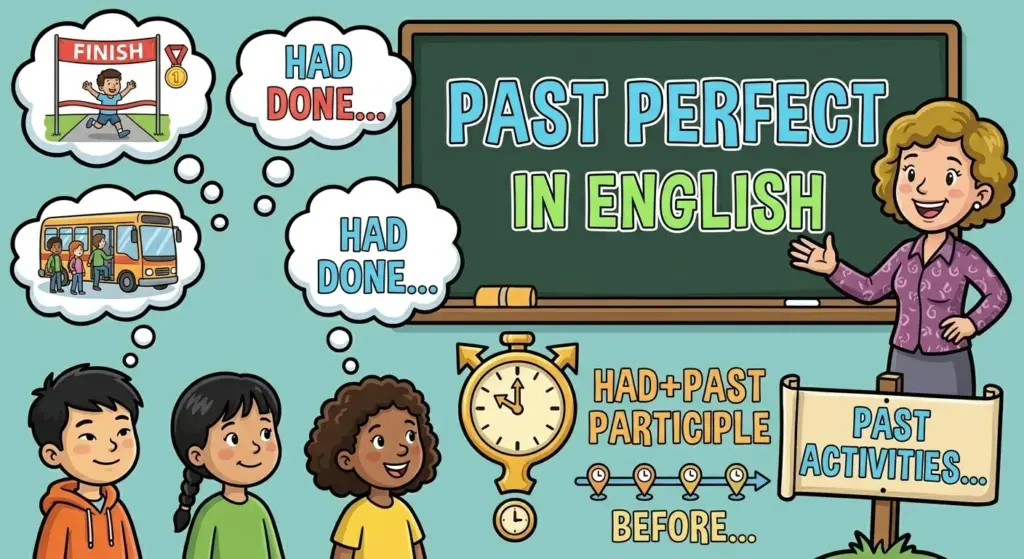
- Structure: Subject + had + past participle.
- Main usage: To indicate an action that occurred before another past action.
- Time markers: Already, just, never, by the time, before, after.
- Key difference: The Past Perfect clarifies chronology, unlike the Past Simple.
- Negative form: Had not (hadn’t) + past participle.
- Interrogative form: Had + subject + past participle?
Definition and Function of the Past Perfect
The Past Perfect, often described as the “past of the past,” is a verb tense used to demonstrate that an action was completed prior to another specific moment or action in the past. While the Past Simple tells us what happened, the Past Perfect provides the background information or the sequence of events. It is formed using the auxiliary verb had combined with the past participle of the main verb. Understanding this tense is crucial for mastering narrative tenses in English. Without it, the sequence of events can become confusing. For example, consider the difference between “When I arrived, the train left” (simultaneous or sequential actions) and “When I arrived, the train had left” (the train was already gone). The latter uses the Past Perfect to emphasize the earlier action.Formation of the Past Perfect Simple
The structure of the Past Perfect remains consistent regardless of the subject. Unlike the Present Perfect, which changes between “have” and “has,” the auxiliary “had” is used for all persons (I, you, he, she, it, we, they).Affirmative Form
In positive statements, the subject is followed by “had” and the past participle. Contractions are frequently used in spoken English and informal writing, where “had” is shortened to ‘d (e.g., I’d, she’d, they’d). Example: He had finished the project before the deadline. (Il avait fini le projet avant la date limite.)Negative Form
To create a negative sentence, “not” is placed after the auxiliary “had.” The contraction hadn’t is standard in most contexts. Example: They had not (hadn’t) eaten breakfast when they arrived. (Ils n’avaient pas pris leur petit-déjeuner quand ils sont arrivés.)Interrogative Form
Questions are formed by inverting the subject and the auxiliary “had.” Example: Had you seen the movie before last night? (Aviez-vous vu le film avant hier soir ?)| Form | Structure | Example |
|---|---|---|
| Affirmative | Subject + had + Past Participle | She had worked. / She’d worked. |
| Negative | Subject + had not + Past Participle | She had not worked. / She hadn’t worked. |
| Interrogative | Had + Subject + Past Participle? | Had she worked? |
Chronology: The Earlier of Two Past Actions
The primary use of the Past Perfect is to show the order of two past events. The earlier action takes the Past Perfect, while the later action usually takes the Past Simple. This distinction is vital for accurate storytelling. Consider the following examples from the source material:- When the police arrived, the thief had escaped. (Quand la police est arrivée, le voleur s’était échappé.) Chronology: 1. Thief escaped -> 2. Police arrived.
- He couldn’t make a sandwich because he’d forgotten to buy bread. (Il ne pouvait pas se faire de sandwich car il avait oublié d’acheter du pain.) Chronology: 1. Forgot bread -> 2. Couldn’t make sandwich.
Time Up to a Point in the Past
Similar to how the Present Perfect connects the past to the present, the Past Perfect connects an earlier past to a later past moment. It expresses the duration or completion of an activity up to a certain point. Examples:- She’d published her first poem by the time she was eight. (Elle avait publié son premier poème avant l’âge de huit ans.)
- We’d finished all the water before we were halfway up the mountain. (Nous avions fini toute l’eau avant d’être à mi-chemin de la montagne.)
Using Adverbs with Past Perfect
Specific adverbs act as signal words for the Past Perfect. These include already, still, just, ever, and never. Their placement is typically between the auxiliary “had” and the past participle.Already and Just
These adverbs emphasize that an action happened sooner than expected or a very short time before the second past action.- I called his office but he’d already left. (J’ai appelé son bureau mais il était déjà parti.)
- I went to visit her when she’d just moved to Berlin. (Je suis allé lui rendre visite alors qu’elle venait juste d’emménager à Berlin.)
Never and Ever
These refer to experience at any time before the specified past moment.- It was the most beautiful photo I’d ever seen. (C’était la plus belle photo que j’aie jamais vue.)
- I’d never met anyone from California before I met Jim. (Je n’avais jamais rencontré quelqu’un de Californie avant de rencontrer Jim.)
Still
“Still” indicates a situation continuing longer than expected. Note that “still” is placed before the auxiliary “had” in negative sentences.- It still hadn’t rained at the beginning of May. (Il n’avait toujours pas plu début mai.)
The Specific Use of “Before”
The conjunction before creates a specific nuance when used with the Past Perfect. It can indicate that an action was not done or was incomplete when the Past Simple action occurred. This structure highlights interruption or unfulfilled expectations. Examples:- They left before I’d spoken to them. (Ils sont partis avant que je ne leur aie parlé.) Meaning: The speaking action did not happen.
- Sadly, the author died before he’d finished the series. (Malheureusement, l’auteur est mort avant d’avoir fini la série.) Meaning: The series remained unfinished at the time of death.
Past Perfect vs. Past Simple: The Distinction
Learners often overuse the Past Perfect. It is essential to remember that if the sequence of events is clear from the context or the use of words like “then” or “after,” the Past Simple is often preferred for simplicity. The Past Perfect is mandatory only when the order would otherwise be ambiguous or when emphasizing the completion of the first action is necessary.| Tense | Usage Context | Example Sentence |
|---|---|---|
| Past Simple | Sequential actions (A, then B). | I opened the door and saw the cat. |
| Past Perfect | Non-sequential or background info (B happened, because A had happened). | I opened the door. The cat had broken a vase. |
Advanced Structure: Third Conditional
While not part of the basic narrative structure, the Past Perfect is a fundamental component of the Third Conditional. This structure expresses hypothetical situations in the past—things that did not happen and their imagined results. Structure: If + Past Perfect, … would have + Past Participle. Example: If I had known you were coming, I would have baked a cake. (Si j’avais su que tu venais, j’aurais fait un gâteau.) This demonstrates the flexibility of the Past Perfect beyond simple storytelling, serving as a tool for expressing regret or alternative pasts.Reported Speech (Backshifting)
Another critical area where the Past Perfect appears is in reported speech (indirect speech). When reporting a statement that was originally in the Present Perfect or Past Simple, the verb “backshifts” to the Past Perfect.- Direct Speech (Past Simple): “I finished the work,” said Tom.
- Reported Speech (Past Perfect): Tom said that he had finished the work.
- Direct Speech (Present Perfect): “I have been to Paris,” she said.
- Reported Speech (Past Perfect): She said that she had been to Paris.
Exercice pratique
Testez vos connaissances en Past Perfect :
Question 1 : Choose the correct form to complete the sentence: “When I arrived at the cinema, the film _____.”
Correct! We use the Past Perfect (had started) to show the action happened before the arrival.
Question 2 : Which sentence is grammatically INCORRECT?
Correct! For a single historical fact or event without a connection to a later past event, we use the Past Simple (“The Romans spoke Latin”), not the Past Perfect.
Question 3 : Where do we place the adverb “already”? “He _____ left.”
Correct! The adverb usually goes between the auxiliary “had” and the past participle.
Question 4 : Complete the sentence: “I was hungry because I _____ to eat lunch.”
Correct! The forgetting happened before the feeling of hunger, so we use the Past Perfect.
Question 5 : Which is the correct negative form?
Correct! The structure is Subject + had not (hadn’t) + Past Participle (finished).
Question 6 : “She died before she’d finished the book.” What does this mean?
Correct! Using “before” + Past Perfect implies the action was not completed.