

If you’re learning English, you’ve probably come across possessive adjectives and possessive pronouns without really knowing when to use them. That’s completely normal, it’s one of the most common confusions for learners! The thing is, even though they both express possession, they work in very different ways. Let’s sort this out together, and we’ll also cover the English possessive genitive, which is another common way to show who something belongs to.
Possessive Adjectives
What is a Possessive Adjective?
A possessive adjective is a word that accompanies a noun to show who or what it belongs to. It must always be followed by a noun in the sentence.
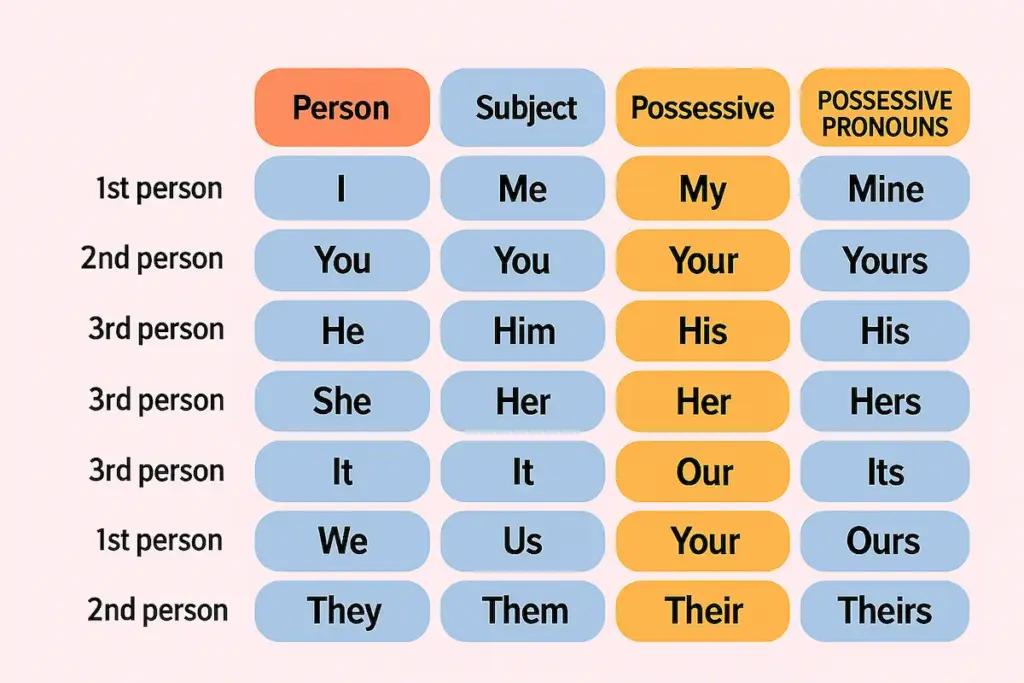
Table of Possessive Adjectives
| Personal Pronoun | Possessive Adjective | Example |
|---|---|---|
| I | my | my book, my friend |
| You | your | your house, your car |
| He | his | his pen, his family |
| She | her | her sister, her dog |
| It | its | its tail, its color |
| We | our | our home, our school |
| They | their | their garden, their money |
Explanation and Examples
Possessive adjectives modify the noun that follows them. They’re much more common than possessive pronouns in real life and you’ll use them far more often when speaking or writing.
Example 1:
This is my book
The adjective my accompanies the noun book.
Example 2:
Her sister is a doctor
Example 3:
We love our parents
Important: Possessive Adjectives Don’t Change with Gender
In English, the possessive adjective stays the same regardless of the gender of the noun. The important thing is who owns it, not what it is:
- His car (the owner is male)
- His apartment (the owner is male – same “his” for both!)
- Her car (the owner is female)
- Her apartment (the owner is female)
Possessive Pronouns
What is a Possessive Pronoun?
A possessive pronoun is a word that replaces a noun to show who something belongs to. It works independently in the sentence and should never be followed by a noun.
Table of Possessive Pronouns
| Personal Pronoun | Possessive Pronoun | Example |
|---|---|---|
| I | mine | This pen is mine |
| You | yours | That house is yours |
| He | his | The car is his |
| She | hers | The phone is hers |
| It | its | The toy is its |
| We | ours | This garden is ours |
| They | theirs | These books are theirs |
Explanation and Examples
Possessive pronouns completely replace the noun phrase. They let you avoid repeating something you’ve already mentioned.
Example 1:
This is my book (with possessive adjective)
This is mine (with possessive pronoun)
The pronoun mine replaces “my book”.
Example 2:
Their car is red, but ours is blue
Example 3:
Is this pen yours or hers?
Common Mistake to Avoid
Don’t confuse its (possessive) with it’s (contraction of “it is”). They’re two different words:
- The cat lost its ball ✓ (its = possessive)
- It’s raining outside ✓ (it’s = it is)
Differences Between Possessive Adjectives and Pronouns
Comparison Table
| Possessive Adjectives | Possessive Pronouns |
|---|---|
| Always come before a noun | Stand alone without a noun |
| my book | mine |
| your house | yours |
| his car | his |
| her phone | hers |
| our ideas | ours |
| their plans | theirs |
The Key Difference
The most important thing to remember:
- Possessive Adjective = word + noun together
- Possessive Pronoun = word that replaces the noun
Contrasting Examples
Case 1: With Possessive Adjective
I have my keys
The word my comes before the noun keys.
Case 2: With Possessive Pronoun
I have mine
The pronoun mine stands alone and replaces “my keys”.
Case 3: In the Same Sentence
My dog is bigger than yours
- My = possessive adjective (comes before “dog”)
- Yours = possessive pronoun (stands alone)
Possession with the Possessive Genitive (‘s)
What is the Possessive Genitive?
The possessive genitive (also called “possessive case”) is another way to express possession in English. It’s formed by adding ‘s (apostrophe + s) to a noun.
When to Use the Genitive?
The genitive is used with people, animals, and organizations:
- John’s book
- The teacher’s classroom
- The dog’s tail
- Apple’s products
Table: Possessive Adjective vs. Genitive
| Situation | Possessive Adjective | Genitive |
|---|---|---|
| Basic possession | My house is nice | John’s house is nice |
| Very common | Your ideas are good | The team’s ideas are good |
| With pronouns | His car, her phone | NOT used with pronouns |
| Things (non-living) | Not usually used | The roof of the house (preferred) |
Special Rules for the Genitive
Plural nouns ending in -s:
The students’ books (add only apostrophe)
The teachers’ classroom
Plural nouns NOT ending in -s:
The children’s playground (add ‘s)
The men’s room
Shared possession (one thing together):
John and Mary’s house (they share one house)
Only the last person gets ‘s
Individual possession (separate things):
John’s and Mary’s houses (they each have their own)
Each person gets ‘s
Comparison Examples
With Possessive Adjective:
Her car is red
With Genitive:
Sarah’s car is red
Both mean the same thing, but the genitive tells us specifically that Sarah owns it.
Common Mistakes
Mistake 1: Confusing its and it’s
- The cat lost its toy ✓ (its = possessive)
- It’s raining ✓ (it’s = it is)
Mistake 2: Using genitive with things
- The leg of the table ✓
- The table’s leg ✗ (wrong – “table” is not alive)
Mistake 3: Possessive pronouns don’t take ‘s
- This pen is mine ✓
- This pen is mine’s ✗ (wrong)
Practice Exercise
Question 1: Complete the sentence with the correct word.
This is _____ book. It belongs to me.
Question 2: Choose the correct answer.
The car is _____. It belongs to Tom and Sarah.
Question 3: Select the correct sentence.
Question 4: Complete the sentence.
My house is big, but _____ is bigger. (referring to your house)
Question 5: Choose the correct answer.
The _____ ideas were excellent. (referring to the team)
Question 6: Complete the sentence.
Is this _____ pen or _____? (John’s and Mary’s)
Question 7: True or False?
“It’s classroom is nice.” – This sentence is correct.
Question 8: Choose the correct word.
The children love _____ toys.
Results:
Conclusion
Now you understand the three ways to express possession in English:
- Possessive Adjectives (my, your, his, her, its, our, their) – always come before a noun
- Possessive Pronouns (mine, yours, his, hers, its, ours, theirs) – stand alone without a noun
- The Genitive (with ‘s) – used with people, animals, and organizations
The best way to master this? Write your own sentences using each form. Practice and repetition will make it natural!