


Speaking English in a lesson is very different from using it in a real business conversation. During a class, you can pause, ask a teacher for help and try the sentence again. In a meeting, exhibition or client visit, the conversation continues while you are still searching for the right words.
Live translation can help at these moments, but only if it is used carefully. If you translate every sentence before speaking, you may become slower and less confident. If you refuse all assistance, however, you may misunderstand a price, deadline or product requirement.
The most useful approach is to treat translation as a safety net. Use it when accuracy matters, then turn the difficult parts of the conversation into material for further English practice.
Translation Should Be a Safety Net, Not a Script
Relying on a translated script can make a conversation feel controlled, but it has several disadvantages.
First, spoken conversations rarely follow the prepared order. A client may interrupt, change the subject or ask an unexpected question. If you depend on a complete translated response, one small change can leave you unable to continue.
Second, written translations may sound unnatural when read aloud. Spoken business English often uses shorter sentences, contractions and phrases that allow the other person to respond.
Third, translating everything prevents you from practising rapid recall. Fluency develops when familiar words and phrases become available without a long internal search.
This does not mean that translation tools have no place in language development. An AI translator app such as Owll Translator can support communication during travel, work and everyday conversations. It offers two-way voice translation, photo translation, earphone listening and post-conversation notes. The important question is when to use those features.
Divide the Conversation Into Three Levels

Before an international meeting or trip, separate the language you may encounter into three levels.
Language You Can Use Independently
This includes phrases you already know well enough to say without assistance:
- Introducing yourself and your role
- Explaining why you are attending
- Asking someone to repeat a sentence
- Confirming that you understand
- Making simple arrangements
- Closing the conversation politely
Using this language independently builds confidence and keeps the interaction natural.
Language You Can Clarify in English
You may understand the general subject but miss a word or detail. Instead of immediately opening a translation tool, try asking for clarification:
- “Could you say that again more slowly, please?”
- “What do you mean by that?”
- “Could you give me an example?”
- “Do you mean that the delivery date has changed?”
- “Could you write the product name down for me?”
These phrases are useful because they keep the conversation in English while giving you more information.
Information That Requires Precise Confirmation
Some details should not be guessed. Translation can provide an additional check when the conversation includes:
- Prices and percentages
- Delivery dates
- Addresses and room numbers
- Product dimensions
- Technical terminology
- Contract conditions
- Allergies or safety instructions
- Names of medicines
- Transport changes
Even after using a translation tool, repeat the information back to the other person. For example: “Just to confirm, you need 500 units by 14 November. Is that correct?”
Try English Before Reaching for the Tool$
A helpful rule is to make one attempt in English before using translation.
Suppose a supplier uses a term you do not recognise. First ask for a simpler explanation. The speaker may be able to describe the concept in familiar English, which gives you valuable listening practice.
If the explanation remains unclear, use translation for the specific word or sentence rather than the entire conversation. This keeps the interruption short and helps you connect the new expression with its real context.
You can also prepare a few repair phrases before an important meeting:
- “I understand the main point, but I am not sure about the last detail.”
- “Could you show me which part you mean?”
- “I do not know the English term for this. May I show you a picture?”
- “Let me check that word so I do not give you the wrong answer.”
These expressions demonstrate care rather than weakness. In professional communication, confirming a detail is usually better than pretending to understand it.
Use Voice Translation in Short, Focused Exchanges

Voice translation works best when both speakers understand how the exchange will proceed. Ask one person to speak at a time, use complete but reasonably short sentences and pause while the speech is processed.
Avoid giving the tool a long paragraph containing several questions, dates and conditions. Break it into separate statements:
- “We can deliver the first order in November.”
- “The minimum order is 500 units.”
- “Would you like us to send a sample first?”
This structure is easier for the listener, the translation system and the person who will later review the conversation.
Background noise can also affect speech recognition. At a busy exhibition or railway station, move to a quieter area when discussing important details. Watch the recognised text before relying on the translation. If the displayed source sentence is wrong, the translated version may also be unreliable.
A Spanish-to-English Business Example
Imagine that Lucía, a Spanish sales representative, is attending an international trade fair in London. She can introduce her company, explain its main products and answer common questions in English. However, a potential distributor asks about a technical certification that she has not discussed in English before.
Lucía first says:
“I understand the question, but I do not know the English name for that certificate. Could you show me the requirement?”
The distributor displays the term on a document, but Lucía is still uncertain about its meaning. She can then use an online Spanish-to-English voice translator to check a short spoken explanation.
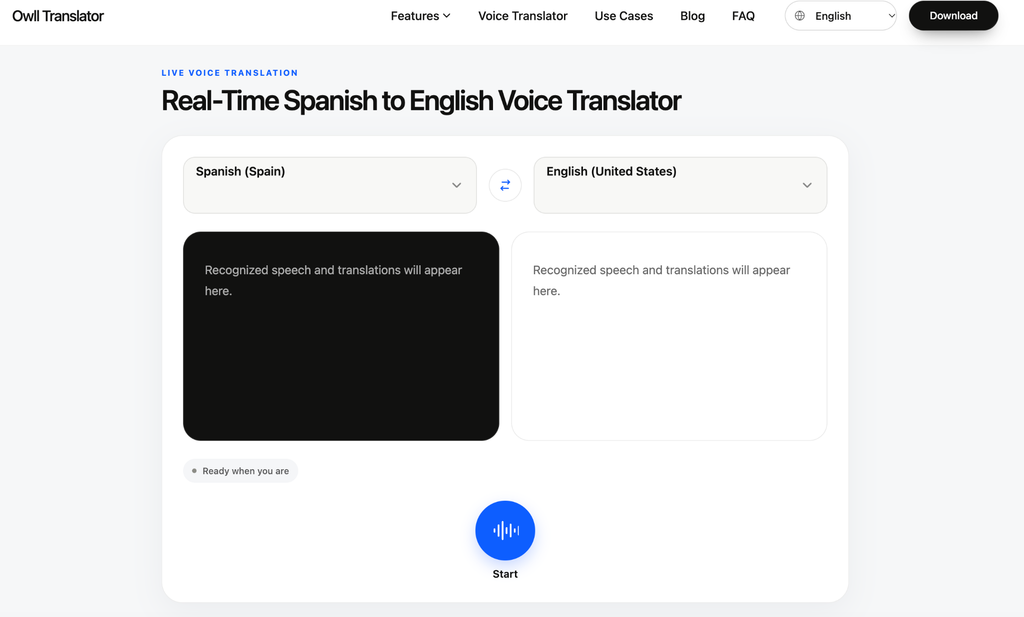
The browser-based Owll Translator tool allows users to select Spanish and English, permit microphone access and take turns speaking. Recognised text and translated subtitles appear in two fixed language windows. The web experience is limited to a cumulative one-minute allowance, so it is best suited to a brief test or an urgent exchange rather than a full meeting.
After checking the term, Lucía returns to English:
“Thank you. I understand now. We have a related certificate, but I need to confirm whether it meets this exact standard. I will send you the document tomorrow.”
The tool helps her cross one communication barrier, but Lucía still controls the conversation. She does not claim something she cannot verify, and she now has a useful sentence pattern for future meetings.*
Turn Difficult Moments Into Study Material
After the conversation, do not save only isolated translations. Record the complete phrase and the situation in which it appeared.
A practical entry might include:
- Expression: “meet the required standard”
- Meaning: satisfy an official or agreed requirement
- Situation: discussing product certification
- Personal example: “Our packaging meets the required safety standard.”
- Question: “Does this material meet the required standard?”
- Next action: use the phrase in the next lesson or role-play
This method helps you remember how words work together. Learning “standard” alone is less useful than learning expressions such as “meet a standard”, “industry standard” and “safety standard”.
If the translation session produces notes or a summary, use them to identify topics that caused difficulty. Check names, numbers and specialist terms against the original conversation before treating the notes as accurate.
Gradually Reduce Your Dependence on Translation
Try a simple one-week practice plan after an important conversation.
Day 1: Review
List five phrases you needed help with. Check their meaning and pronunciation.
Day 2: Rebuild
Rewrite the original exchange using shorter English sentences that you could say naturally.
Day 3: Speak
Practise the sentences aloud without reading them. Change the price, date or product so that you are not merely memorising one script.
Day 4: Role-Play
Ask a teacher, colleague or language partner to recreate the situation and add one unexpected question.
Day 5: Reflect
Decide which parts you can now handle independently and which technical details would still require confirmation.
Over time, the number of situations requiring translation should decrease. The goal is not to stop using useful technology entirely. It is to make deliberate choices about when assistance improves accuracy and when it prevents practice.
Keep Human Communication at the Centre
Translation tools can help English learners participate in conversations that might otherwise stop at the first unfamiliar term. They are particularly useful when a misunderstanding could affect money, timing, safety or a professional commitment.
Owll Translator can provide short-term support through voice, photo, earphone and offline translation features. However, a tool cannot build your speaking confidence, notice every cultural nuance or give personalised feedback on how your English sounds.
Use translation to cross the difficult part of a conversation, then return to English. Review what caused the problem, practise the language with another person and prepare to handle the same situation more independently next time. That is how a translation tool becomes part of language development rather than a substitute for it.