

In short
- A unique form: English modal verbs never take an s in the third person singular.
- No to: A modal verb is always followed by a bare infinitive without to.
- Total autonomy: They form their own questions and negations without the auxiliary do.
- Nuances of meaning: Each modal expresses a specific intention like obligation, ability, or probability.
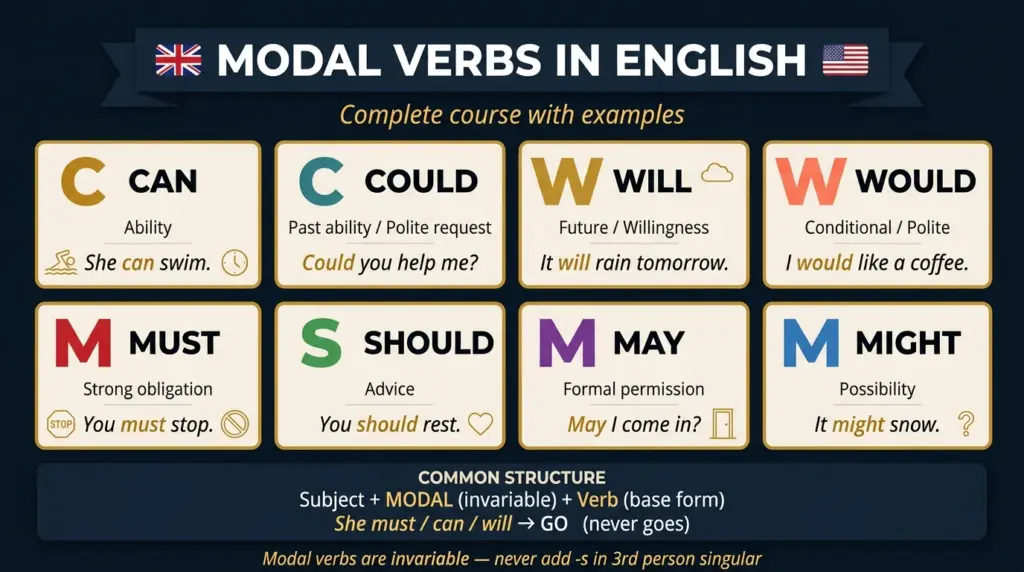
English modal verbs change the meaning of a sentence to express ability, obligation, or probability. They follow very regular grammar rules compared to other verbs.
Basic rules of English modal verbs
Modals have a unique function in English. They are not conjugated like other verbs. Their form remains identical for all persons. You will never find a specific ending with the pronouns he, she, or it. Adding a final s is a major grammar mistake, whether you are at an A1 or C2 CEFR level.
A modal verb is always accompanied by another verb. This second verb is placed in the infinitive. The particle to systematically disappears between the modal and the main verb. The structure remains the same in the present and the future.
For negation, simply add not after the modal. Using do not or does not is impossible. In the interrogative form, the modal moves in front of the subject. The inversion is enough to ask a complete question.
Can and Could for ability
The verb can is used to express a physical or intellectual ability in the present. It generally translates to being able to or knowing how to do something. It is used to talk about an acquired skill.
| English sentence | Meaning |
|---|---|
| They can speak three languages. | They know how to speak three languages. |
| He can swim very fast. | He is able to swim very fast. |
| She cannot play the piano. | She does not know how to play the piano. |
The modal could represents the past equivalent of can. It expresses a past ability. It is used to describe what a person knew how to do in the past. This word also expresses a very polite request in the present.
| English sentence | Meaning |
|---|---|
| I could run ten miles yesterday. | I was able to run ten miles yesterday. |
| Could you pass the salt? | Would you be able to pass the salt? |
Must and Have to for obligation
The word must indicates a strong obligation. It often comes from the speaker themselves. It is used to impose a rule or express an absolute necessity.
In the negative form, must not or mustn’t expresses a strict prohibition. It does not mean a lack of obligation. It is a direct order not to do something.
| English sentence | Meaning |
|---|---|
| You must wear a seatbelt. | One is required to wear a seatbelt. |
| Employees must wash their hands. | Employees are required to wash their hands. |
| We mustn’t walk on the grass. | Walking on the grass is forbidden. |
The expression have to translates an external obligation. It replaces must to express a rule imposed by law or circumstances. It is not a true modal, because it uses do for questions and negations.
The negation don’t have to indicates a lack of obligation. The action remains possible but is no longer required. The difference with mustn’t changes the entire meaning of the sentence.
Should and Ought to for advice
The modal should is used to give an opinion or advice. It is often used to indicate the best thing to do in a given situation.
| English sentence | Meaning |
|---|---|
| You should sleep more. | It would be better to sleep more. |
| They shouldn’t eat too much sugar. | It is not recommended for them to eat too much sugar. |
| Should we call a taxi? | Is it a good idea to call a taxi? |
The expression ought to has the same meaning as should. Its use is more formal and less frequent in spoken English, especially in American English, whereas British English might use it slightly more often. It is the only quasi-modal that keeps the particle to before the following verb.
May and Might for probability
The modals may and might express uncertainty. They convey the idea that an event has a chance of happening. The word may indicates a probability of about fifty percent.
The term might marks a lower probability. The described event seems less likely than with may. These two English modal verbs are widely used to formulate hypotheses about the future.
| English sentence | Meaning |
|---|---|
| It may rain tomorrow. | It is possible that it will rain tomorrow. |
| The keys might be in the car. | The keys are possibly in the car. |
| She may not come to the party. | It is possible that she will not come to the party. |
The modal may also expresses a very formal permission. It is often heard in administrative contexts or formal CEFR testing environments. The phrase may I remains the most respectful way to ask for authorization.
Will and Would for the future and conditional
The word will is used to build the future tense in English. It also expresses willingness, a spontaneous decision, or a promise. The contracted negative form becomes won’t.
The modal would forms the conditional. It is used to imagine unreal situations. This word also expresses a habit in the past, or a polite request in the present.
| English sentence | Meaning |
|---|---|
| I will call back later. | I promise to call back later. |
| He would travel if he had money. | He would travel under the condition that he had money. |
| Would you like some tea? | Do you desire some tea? |
Shall for suggestions
The modal shall is used almost exclusively in the first person singular and plural. It is used to propose an idea or ask for instructions. Its use brings a touch of British politeness, as it is rarely used in everyday American English.
| English sentence | Meaning |
|---|---|
| Shall we dance? | How about we dance? |
| Shall I open the window? | Do you want me to open the window? |
Modals in the past
To express a modal idea in the past, the structure changes. You cannot simply put the modal in the past tense. The correct form requires the use of have followed by the past participle of the main verb. This structure is used to express regrets or deductions about completed events.
The expression should have expresses a regret. It indicates that an action would have been preferable, but was not carried out. Conversely, shouldn’t have shows that an action took place even though it was ill-advised.
| English sentence | Meaning |
|---|---|
| I should have studied more. | It would have been better if I had studied more. |
| They shouldn’t have bought this car. | It was a bad idea for them to buy this car. |
The structure must have expresses a strong certainty regarding a past event. It is a logical deduction based on evidence. The speaker appears almost certain of their statement.
The phrase could have describes an ability or possibility in the past that did not materialize. This means that the action was possible, but ultimately did not take place.
| English sentence | Meaning |
|---|---|
| The ground is wet, it must have rained. | The ground is wet, so it certainly rained. |
| He could have won the race. | It was possible for him to win the race. |
The use of might have or may have indicates a simple assumption about the past. The event may have occurred, but the uncertainty remains total.
Semi-modals and other expressions
Some verbs share characteristics with modals. However, they do not follow all the rules. The verb need sometimes acts like a modal in questions and negations. The form needn’t is found to express a lack of immediate obligation, mostly in British English.
The expression had better gives very strong advice. It often implies a threat or a negative consequence if the advice is not followed. The word had is generally contracted to ‘d.
| English sentence | Meaning |
|---|---|
| You needn’t worry about the tickets. | There is no need to worry about the tickets. |
| We’d better leave now. | It is highly advisable that we leave now. |
The expression used to describes a past habit. It talks about a frequent action in the past that no longer exists today. It functions like a normal verb in the past tense for negation with didn’t use to.
Summary of probabilities
English modal verbs allow you to establish a very precise scale of probability. To express almost total certainty, use must. If the situation seems very likely, choose should. For an average probability, may is perfectly suitable. If the event is unlikely, might or could will be appropriate. Finally, to express total impossibility, use cannot or can’t.
| Modal used | Degree of probability expressed |
|---|---|
| Must | Almost total certainty (95%) |
| Should | High probability (80%) |
| May | Real possibility (50%) |
| Might | Low probability (30%) |
| Can’t | Absolute impossibility (0%) |
Word order remains strict with modals. In a statement, place the subject, the modal, then the verb. Adverbs of frequency like always or never are placed right after the modal verb. This positioning rule has no exceptions in modern English.
Practical exercise
Test your knowledge by completing these sentences with the correct modal verb:
Question 1: Which modal expresses an absolute prohibition?
Question 2: Complete the sentence: “When I was young, I ___ run very fast.”
Question 3: Which modal should be used to give simple advice?
Question 4: What does the sentence “It might rain today” mean?
Question 5: How do you express a regret in the past: “I should have studied”?
Question 6: Which of these modals expresses a total logical impossibility?
Your score