

Summary
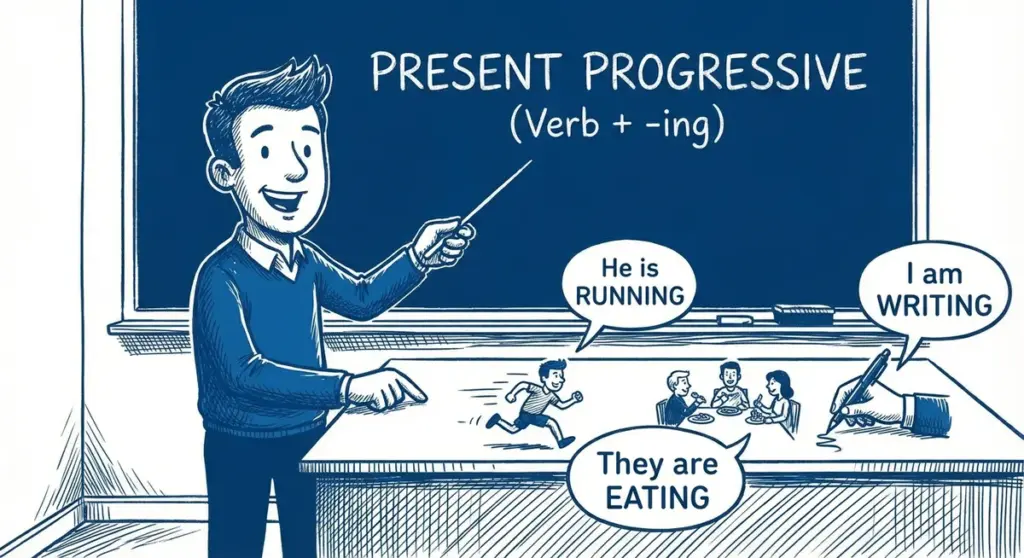
The present continuous, also known as the present progressive, is a fundamental tense in English grammar used to describe dynamic actions occurring at the specific moment of speech or around the present time. Mastering this tense allows for precision in describing temporary situations, future arrangements, and evolving trends, distinguishing it clearly from the permanence of the present simple.
- Construction: Auxiliary “be” in the present + verb ending in “-ing”.
- Main usage: Actions in progress at the moment of speaking.
- Future: Confirmed plans and upcoming personal arrangements.
- Exceptions: Stative verbs are rarely used in the continuous form.
- Nuance: Also expresses current trends or irritation with “always”.
Structure and Formation of the Present Continuous
The formation of the present continuous is strictly logical and consistent. It requires two distinct components: the auxiliary verb to be conjugated in the present simple, followed by the main verb in its present participle form (ending in -ing). The general formula is: Subject + am/is/are + Verb-ing.| Subject | Auxiliary (to be) | Main Verb (-ing) | Example |
|---|---|---|---|
| I | am | working | I am working on a project. |
| You | are | playing | You are playing football. |
| He / She / It | is | talking | She is talking to her boss. |
| We | are | staying | We are staying at a hotel. |
| They | are | sleeping | They are sleeping upstairs. |
Spelling Rules for the “-ing” Form
While most verbs simply add “-ing” to the base form (e.g., walk → walking), specific orthographic rules apply to ensure correct pronunciation and writing.- Verbs ending in “e”: When a verb ends with a silent “e”, this letter is dropped before adding “-ing”.
- Make → Making
- Write → Writing
- Live → Living
- One-syllable verbs ending in Consonant-Vowel-Consonant (CVC): The final consonant is doubled to preserve the short vowel sound.
- Sit → Sitting
- Run → Running
- Stop → Stopping
- Verbs ending in “ie”: The “ie” suffix changes to “y” before adding “-ing”.
- Die → Dying
- Lie → Lying
- Tie → Tying
Describing Actions at the Moment of Speaking
The most common function of the present continuous is to describe an activity happening precisely now. The action has started but has not yet finished. It is in progress. Examples:- “Please be quiet. The children are sleeping.” (S’il vous plaît, taisez-vous. Les enfants dorment.)
- “I‘m just leaving work. I’ll be home in an hour.” (Je quitte juste le travail. Je serai à la maison dans une heure.)
Temporary Situations and Current Trends
The present continuous is not limited to the exact second of speaking. It is also used for actions happening “around now” or for temporary states that differ from the norm. This usage highlights the impermanence of the situation.Actions happening “around now”
An action can be in progress during a broader period (this week, this month, this year) without happening at the exact moment of speech. Examples:- “I‘m reading a fascinating book about history.” (Je lis un livre fascinant sur l’histoire.) — The speaker is not necessarily holding the book right now, but has started it and hasn’t finished.
- “Michael is at university. He‘s studying history.” (Michael est à l’université. Il étudie l’histoire.) — This is his current occupation for a few years, not a permanent state for life.
Contrasting with previous states
When discussing changes, developments, or new habits that contrast with the past, the continuous form is preferred. Examples:- “These days most people are using email instead of writing letters.” (De nos jours, la plupart des gens utilisent l’email au lieu d’écrire des lettres.)
- “The climate is changing rapidly.” (Le climat change rapidement.)
- “Your English is improving.” (Votre anglais s’améliore.)
Future Arrangements and Plans
A frequent source of confusion for learners is the use of the present continuous to refer to the future. This tense is used specifically for definite arrangements—plans that have been organized, confirmed, or scheduled with a specific time or place. Examples:- “Mary is going to a new school next term.” (Mary va dans une nouvelle école le trimestre prochain.) — The enrollment is done; it is a fixed plan.
- “What are you doing next week?” (Qu’est-ce que tu fais la semaine prochaine ?)
- “We are flying to Paris on Friday morning.” (Nous prenons l’avion pour Paris vendredi matin.) — Tickets are likely bought.
Interrogative and Negative Forms
Forming questions and negatives in the present continuous relies entirely on the manipulation of the auxiliary “to be”. No other auxiliary like “do” or “does” is required.Questions
To form a question, the auxiliary “am”, “is”, or “are” is placed before the subject (Inversion).| Question Word (Optional) | Auxiliary | Subject | Verb-ing | Example |
|---|---|---|---|---|
| – | Are | you | listening? | Are you listening? |
| When | is | she | going | When is she going home? |
| What | am | I | doing | What am I doing here? |
Negatives
Negation is achieved by placing “not” immediately after the auxiliary. Contractions (isn’t, aren’t) are standard in spoken English. Examples:- “I‘m not doing that.” (Je ne fais pas ça.)
- “You aren’t listening.” / “You‘re not listening.” (Tu n’écoutes pas.)
- “She isn’t going home until Monday.” (Elle ne rentre pas chez elle avant lundi.)
Stative Verbs: The Major Exception
A critical rule in English grammar is that certain verbs, known as stative verbs (or state verbs), are generally not used in the continuous form. These verbs describe states of being, thoughts, feelings, or possession, rather than active physical processes. Even if the feeling is happening “right now”, the present simple is used.Categories of Stative Verbs
- Thinking and Mental Processes: believe, know, realise, recognise, remember, suppose, think (meaning ‘have an opinion’), understand.
- Correct: “I understand you.”
- Incorrect: “I am understanding you.”
- Emotions and Feelings: dislike, hate, like, love, prefer, want, wish.
- Correct: “I want a coffee.”
- Incorrect: “I am wanting a coffee.”
- Senses: appear, feel, look, seem, smell, sound, taste.
- Correct: “This cake tastes wonderful.”
- Incorrect: “This cake is tasting wonderful.”
- Possession and Existence: belong, own, possess, owe, be, exist.
- Correct: “This book belongs to me.”
- Incorrect: “This book is belonging to me.”
- Thinking: “I think it’s good” (Opinion = Simple) vs. “I am thinking about the problem” (Mental activity = Continuous).
- Tasting: “It tastes sweet” (Quality of the food = Simple) vs. “The chef is tasting the soup” (Action of testing = Continuous).
Intermediate and Advanced Uses
Beyond basic descriptions, the present continuous carries subtle nuances used by intermediate and advanced speakers to convey specific attitudes or narrative styles.Repetition and Irritation with “Always”
Normally, “always” is associated with the present simple for habits. However, when used with the present continuous, it expresses irritation, annoyance, or surprise regarding a repetitive action that happens too frequently. Examples:- “They are always arguing.” (Ils sont tout le temps en train de se disputer.) — Implies the speaker finds this annoying.
- “It‘s always raining in London.” (Il pleut tout le temps à Londres.) — Focuses on the repetitive, negative nature of the weather.
- “George is great. He‘s always laughing.” (George est génial. Il rit tout le temps.) — Here, it emphasizes a positive, frequent characteristic.
Narrative Present (Storytelling)
Advanced speakers often use the present continuous when recounting past events to make the story feel more immediate, vivid, and engaging. This technique is common in spoken English or informal writing. Example:- “The other day I‘m just walking down the street when suddenly this man comes up to me… he‘s carrying a big stick and he looks a bit dangerous, so I‘m wondering what to do…”
Comparison: Present Simple vs. Present Continuous
Distinguishing between these two tenses is vital for accuracy. The choice depends on whether the speaker views the action as permanent or temporary.| Feature | Present Simple | Present Continuous |
|---|---|---|
| Time Frame | Permanent, general, habits. | Temporary, around now, at the moment. |
| Keywords | Always, usually, often, every day. | Now, at the moment, currently, this week. |
| Example | “I live in Paris.” (It is my home.) | “I am living in Paris.” (For a month.) |
| Example | “He drives a taxi.” (His job.) | “He is driving carefully.” (Right now.) |
Exercice pratique
Testez vos connaissances en present continuous :Question 1 : Which sentence is grammatically correct?
Correct structure: Subject + am/is/are + Verb-ing. “I am playing” is the only correct form.
Question 2 : Choose the correct spelling for the verb “sit” in the continuous form:
For one-syllable verbs ending in Consonant-Vowel-Consonant (sit), you must double the final consonant.
Question 3 : Which sentence expresses a future arrangement?
“We are meeting John tomorrow” describes a confirmed plan for the future. The others describe current actions or habits.
Question 4 : Identify the mistake in this sentence: “I am wanting a new car.”
“Want” is a verb of feeling/desire (stative verb). It is rarely used in the continuous form. It should be “I want a new car.”
Question 5 : What is the negative form of “They are coming”?
The negative is formed by adding “not” after the auxiliary “are”. “Are not” becomes “aren’t”.
Question 6 : “He is always losing his keys.” What does this sentence imply?
Using “always” with the present continuous usually expresses irritation about a repetitive habit.