

Quick Summary
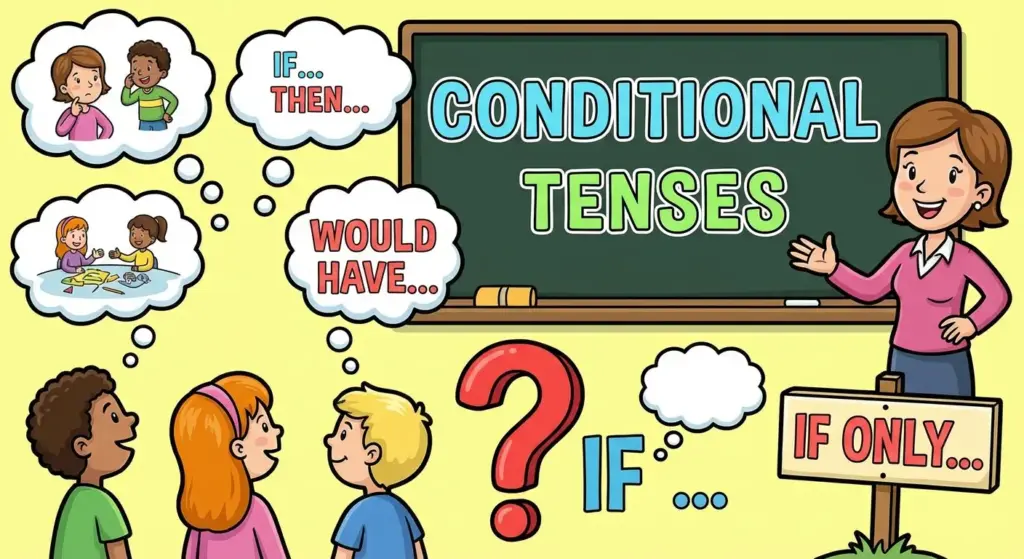
- Second Conditional (Unreal Present): Used for hypothetical or unlikely situations in the present or future — If + past simple, would + base verb
- Third Conditional (Unreal Past): Used for impossible situations in the past, expressing regret or imagining different outcomes — If + past perfect, would have + past participle
- Practice essential: These conditionals require mastery of verb forms and understanding of when to use each type based on time reference
Practical Exercise
Test mastery of second and third conditionals. Choose the correct verb form for each sentence.
Question 1: If she _______ more confident, she would apply for the management position.
Second conditional (unreal present): If + past simple, would + base verb. The situation is hypothetical present/future.
Question 2: If they _______ to the meeting, they would have heard the announcement.
Third conditional (unreal past): If + past perfect, would have + past participle. They didn’t come, so they didn’t hear.
Question 3: I _______ that book if I were you. It’s really interesting.
Second conditional with advice formula “If I were you”: would + base verb in the main clause.
Question 4: If we hadn’t missed the train, we _______ late for the wedding.
Third conditional negative: If + past perfect negative, wouldn’t have + past participle. Both clauses refer to past.
Question 5: Life _______ much easier if everyone spoke the same language.
Second conditional: hypothetical present situation using would + base verb in the main clause.
Question 6: If he _______ so much last night, he wouldn’t have a headache now.
Mixed conditional: past perfect in if-clause (past action) + would + base verb (present result). Past action affects present.
Question 7: If I _______ enough money, I would buy that car immediately.
Second conditional: If + past simple (had), would + base verb. Hypothetical present situation.
Question 8: She _______ the promotion if she had applied for it.
Third conditional: If + past perfect, would have + past participle. She didn’t apply, so she didn’t get promoted.
Question 9: If the weather _______ better, we could go to the beach this weekend.
Second conditional with modal “could”: If + past simple (were), could + base verb. Hypothetical present/future.
Question 10: If you had told me earlier, I _______ you with the preparations.
Third conditional with modal “could”: If + past perfect, could have + past participle. You didn’t tell me, so I couldn’t help.
Question 11: Unless you _______ harder, you won’t achieve your goals.
This is first conditional (real future), not unreal. Unless = if not. Present simple after “unless,” will in main clause.
Question 12: If I _______ more organized, I wouldn’t have forgotten your birthday last week.
Mixed conditional: If + past simple (present characteristic), wouldn’t have + past participle (past result). Permanent trait affected past action.
Question 13: They _______ the house if the price had been lower.
Third conditional: If + past perfect, would have + past participle. Past hypothetical situation.
Question 14: If we _______ a car, we could drive to the countryside every weekend.
Second conditional with modal “could”: If + past simple, could + base verb. Present hypothetical.
Question 15: If she _______ the instructions carefully, she wouldn’t have made so many mistakes.
Third conditional: If + past perfect, wouldn’t have + past participle. She didn’t read them carefully.
Question 16: What _______ if you won a million dollars tomorrow?
Second conditional question: What + would + subject + base verb. Hypothetical future scenario.
Question 17: If it _______ so much, the farmers would have had a better harvest.
Third conditional negative: If + past perfect negative, would have + past participle. It rained too much.
Question 18: I _______ to the party if I didn’t have to work late.
Second conditional: If + past simple negative, would + base verb. Present/future hypothetical.
Question 19: If they _______ the warning signs, the accident could have been avoided.
Third conditional with modal “could”: If + past perfect, could have + past participle. They didn’t notice.
Question 20: If I _______ better at math, I would have studied engineering at university.
Mixed conditional: If + past perfect (past state), would have + past participle (past result). Past ability affected past decision.
Your Score
Grammar Rules and Explanations
Understanding unreal conditionals is essential for expressing hypothetical situations, regrets, and imagined scenarios in English.Second Conditional: Unreal Present or Future
The second conditional describes hypothetical situations in the present or future that are unlikely, impossible, or imaginary. Structure: If + past simple, would + base verb
Example: If I had a million dollars, I would travel the world.
Reality: I don’t have a million dollars, so I’m not traveling the world.
Common Uses:
- Imaginary present situations: If I were taller, I could reach the top shelf.
- Unlikely future events: If she won the lottery, she would quit her job.
- Giving advice (with “If I were you”): If I were you, I would apologize immediately.
- Polite requests or suggestions: It would be helpful if you could send that report today.
- Use “were” (not “was”) for all persons with the verb “to be” in formal English
- The past simple doesn’t refer to past time—it signals unreality
- Modal verbs can replace “would”: could, might, should
- Never use “would” in the if-clause
Third Conditional: Unreal Past
The third conditional describes hypothetical situations in the past that did not happen. It expresses regret, criticism, or imagines different outcomes. Structure: If + past perfect, would have + past participle
Example: If I had studied harder, I would have passed the exam.
Reality: I didn’t study hard, so I didn’t pass the exam.
Common Uses:
- Expressing regret: If I had known, I would have acted differently.
- Criticizing past actions: If he had listened to me, this wouldn’t have happened.
- Imagining different outcomes: If we had left earlier, we would have caught the train.
- Speculating about past events: If she had been there, she would have helped us.
- Both clauses refer to past time that never actually happened
- Modal verbs can replace “would have”: could have, might have, should have
- Never use “would have” in the if-clause (common mistake)
- The past perfect shows the earlier action that didn’t happen
Mixed Conditionals
Mixed conditionals combine elements of second and third conditionals when time references differ between clauses. Type 1: Past condition, present result
If I had taken that job, I would be living in Paris now.
(Past perfect + would + base verb)
Type 2: Present condition, past result
If I were more organized, I wouldn’t have missed the deadline.
(Past simple + wouldn’t have + past participle)
Common Mistakes to Avoid
- Using “would” in the if-clause: ✗ If I would have known → ✓ If I had known
- Mixing tenses incorrectly: ✗ If I studied, I would have passed → ✓ If I had studied, I would have passed
- Using “was” instead of “were”: ✗ If I was you → ✓ If I were you (formal)
- Forgetting “have”: ✗ If I had known, I would told you → ✓ I would have told you
- Double past perfect: ✗ If I had had known → ✓ If I had known
Quick Reference Chart
Second Conditional (Unreal Present/Future)- If-clause: past simple (were, had, went, etc.)
- Main clause: would/could/might + base verb
- Example: If I knew the answer, I would tell you.
- If-clause: past perfect (had been, had gone, had known, etc.)
- Main clause: would/could/might + have + past participle
- Example: If I had known, I would have told you.
- If-clause: past perfect
- Main clause: would + base verb
- Example: If I had saved money, I would be rich now.
- If-clause: past simple
- Main clause: would have + past participle
- Example: If I were smarter, I wouldn’t have made that mistake.
Practice Tips for Mastery
- Identify the time reference first: present/future or past
- Remember: never use “would” in the if-clause
- Practice both positive and negative forms regularly
- Pay attention to mixed conditionals where time differs
- Create personal examples to reinforce patterns
- Listen to native speakers using these structures
- Review mistakes and understand why the correct answer works