

Asking for and giving directions in English is necessary when you travel to an English-speaking country. This guide presents all the vocabulary you need to find your way and help others.
Basic directions
These are the fundamental words you need to know:
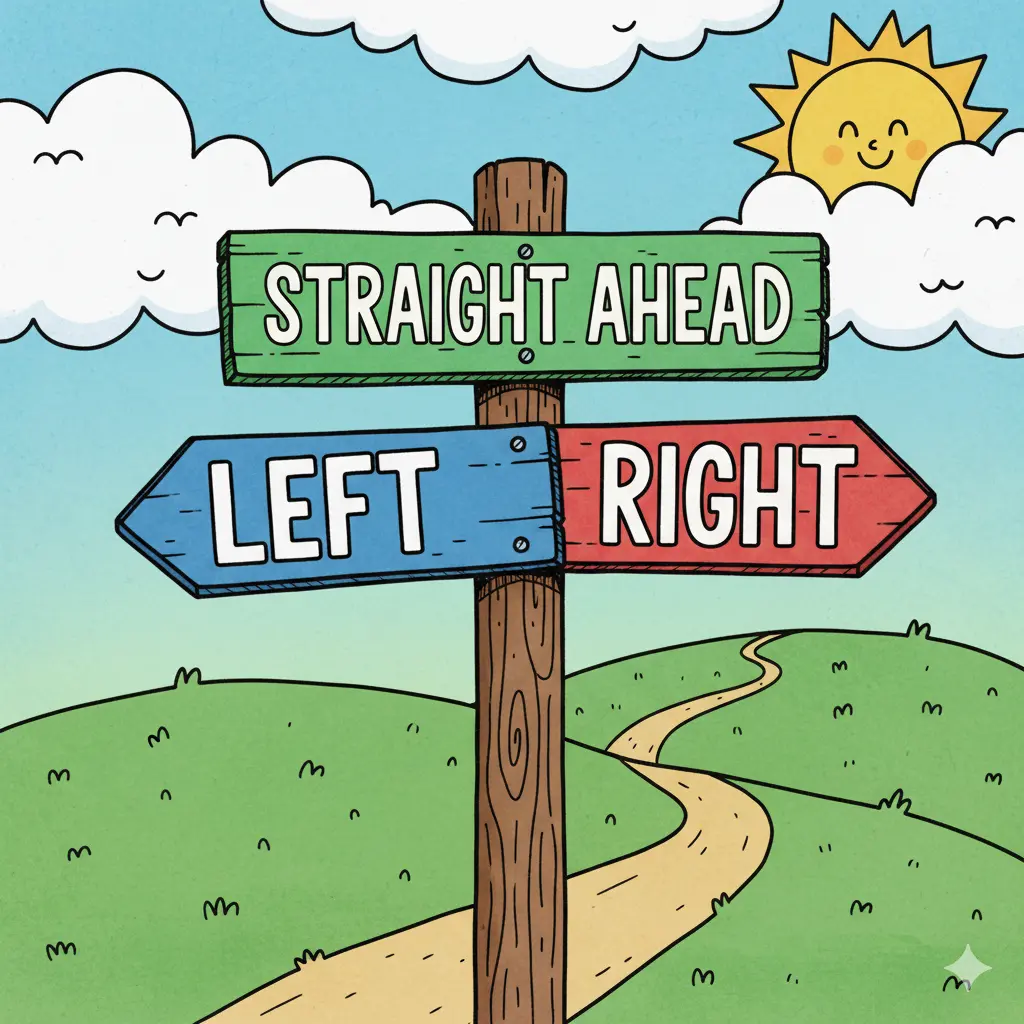
- Left – The direction to the side of your body where your heart is located.
Turn left at the next corner.
- Right – The opposite direction from left.
The bank is on your right.
- Straight – Moving forward without turning.
Go straight for two blocks.
- Forward – Moving in the direction you are facing.
Keep moving forward.
- Back / Backward – Moving in the opposite direction, behind you.
Go back the way you came.
- North / South / East / West – The four cardinal directions on a compass.
The museum is north of here.
Turning and changing direction
These phrases tell you how to change the direction you’re moving:
- Turn left – Change direction toward your left side.
Turn left at the traffic lights.
- Turn right – Change direction toward your right side.
Turn right after the gas station.
- Go straight – Continue moving forward without turning.
Go straight until you reach the park.
- Turn around – Rotate to face the opposite direction.
You’re going the wrong way. Turn around.
- Take the first/second left – Make a left turn at the first or second street you reach.
Take the second left after the bank.
- Take the first/second right – Make a right turn at the first or second street you reach.
Take the first right and you’ll see it.
Moving along the street
These expressions describe how to move through an area:
- Go straight on / Go straight ahead – Continue moving forward in the same direction.
Go straight on until you reach the traffic lights.
- Go along [street] – Follow a particular street in one direction.
Go along Main Street for three blocks.
- Go up/down [street] – Move in one direction or the other along a street.
Go down Elm Street until you see the park.
- Go past / Pass [building] – Continue moving beyond a building or landmark without stopping.
Go past the supermarket and keep driving.
- Walk across the bridge – Travel over a bridge from one side to the other.
Walk across the bridge and turn left.
- Go through the tunnel – Enter and exit from the other side of a tunnel.
Go through the tunnel and continue straight.
- Cross the street – Go from one side of the street to the other.
Cross the street at the zebra crossing.
- Go for two/three blocks – Continue traveling for a specific number of city blocks.
Go for three blocks and then turn right.
- Stay on [street/road] – Continue following the same street without turning off it.
Stay on Pine Road until you get to the roundabout.
- Go to the end of the street – Continue until the street finishes.
Go to the end of the street and you’ll see the library.
Asking for directions
Always start politely when asking for help:
- Excuse me, could you help me? – A polite way to get someone’s attention.
Excuse me, could you help me find the train station?
- Hello, can you help me, please? – A friendly greeting followed by a request for help.
Hello, can you help me, please? I’m looking for the museum.
Then ask your question:
- How can I get to…? – Ask for the way to reach a specific place.
How can I get to the nearest petrol station?
- Where is the nearest…? – Ask about the location of the closest place of a certain type.
Where’s the nearest grocery store?
- Is there a… near here? – Ask if a particular type of place exists nearby.
Is there a pharmacy near here?
- Could you tell me how to get to…? – A polite way to ask for directions.
Could you tell me how to get to the post office?
- Which way is…? – Ask about the direction to a place.
Which way is the subway station?
- Am I going the right way? – Check if you’re moving in the correct direction.
Am I going the right way for the airport?
- Are we on the right road to…? – Confirm you’re on the correct route.
Are we on the right road to the city center?
- What’s the best way to get to…? – Ask for the most efficient route.
What’s the best way to get to the airport?
Indicating position
These prepositions describe where a place is located:
- On the left / On the right – Located on the left or right side.
The pharmacy is on the left.
- On your left/right – Located on your personal left or right side.
You’ll see the museum on your right.
- In front of – Located in the forward position relative to something.
The hotel is in front of the park.
- Behind – Located at the back of something.
The parking lot is behind the building.
- Next to – Located immediately beside something.
The bakery is next to the post office.
- Between – Located in the middle of two things.
The cafe is between the bookstore and the supermarket.
- Opposite / Across from – Located on the other side of the street.
The bank is opposite the supermarket.
- Near – Located close to but not necessarily next to something.
The pharmacy is near the train station.
- At the corner – Located at the point where two streets meet.
Turn left at the corner.
- On the corner of [street A] and [street B] – Located at the intersection of two specific streets.
The pharmacy is on the corner of Main Street and 5th Avenue.
Distances and measurements
- Close / Near – A short distance away.
The station is very close to here.
- Far – A long distance away.
Is it far from here?
- It’s about 5 minutes away – Describes the time it takes to reach a place.
The hotel is about 10 minutes away on foot.
- It’s two blocks from here – Describes distance in city blocks.
It’s about two blocks from here.
- It’s a short walk – A brief distance that can be walked.
Don’t worry, it’s just a short walk.
- It’s a long way – A considerable distance.
The airport is a long way from the city center.
Common places in the city
- Bank – A financial institution where you can deposit or withdraw money.
- Post office – A place where you can send letters and packages.
- Pharmacy – A store where you can buy medicine and health products.
- Supermarket / Grocery store – A large store selling food and household items.
- Gas station / Petrol station – A place where you can buy fuel for vehicles.
- Train station – A building where trains stop to pick up and drop off passengers.
- Subway station – An underground train station.
- Bus stop – A designated place where buses stop to pick up passengers.
- Airport – A place where airplanes take off and land.
- Hospital – A place where sick or injured people receive medical treatment.
- Park – A public outdoor area with grass, trees, and recreational facilities.
- Museum – A building where objects of historical or cultural interest are displayed.
- Library – A building containing books that people can borrow.
- Cinema – A theater where films are shown.
- Mall / Shopping center – A large building with many stores inside.
Road elements
- Traffic lights – Colored lights that control traffic at intersections.
- Roundabout – A circular intersection where traffic moves in one direction around a central island.
- Intersection / Crossroads – A place where two or more streets meet.
- Bridge – A structure built over a river or road to allow people to cross.
- Tunnel – An underground passage.
- Corner – The point where two streets meet.
- Sidewalk / Pavement – The path beside a street for people to walk on.
- Zebra crossing / Crosswalk – A marked area where pedestrians can cross the street.
- Block – The distance along a street between one cross street and the next.
- Highway / Motorway – A major road designed for fast traffic.
Useful phrases
- You’ll see it on your left – The place will be visible on your left side.
After you pass the bridge, you’ll see it on your left.
- It’s just around the corner – The place is very close, just past the next corner.
Don’t worry, the cafe is just around the corner.
- You can’t miss it – The place is very easy to find or very noticeable.
It’s a big red building. You can’t miss it.
- You’re going the wrong way – You’re moving in the incorrect direction.
Actually, you’re going the wrong way. Turn around.
- Until you get to / come to / reach [location] – Continue until you arrive at a specific place.
Stay on this street until you get to the hospital.
Practice Exercise
Complete the following sentences with the appropriate word:
Get ahead with Break Into English. Would you like to learn English in a natural and optimal way? Our native teachers offer online English courses specially designed to help you progress. You will learn vocabulary, conjugation and grammar and all the English concepts necessary to master the language of Shakespeare.