

Quick Summary
- 12-hour format: English uses “am” for the morning and “pm” for the afternoon.
- On the hour: We add the word “o’clock” after the number.
- Direct reading: We simply read the hours then the minutes, like regular numbers.
- Classic reading: We state the minutes first, followed by “past” or “to”, then the hour.
When learning how to tell time in English, you will notice that time is usually read on a twelve-hour cycle instead of twenty-four. You must specify the time of day to avoid any confusion. Here are the rules to read, say, and write the time correctly.
The twelve-hour system: using am and pm
English-speaking countries use a system based on two twelve-hour cycles. The first cycle covers the morning. The second cycle covers the afternoon and evening.
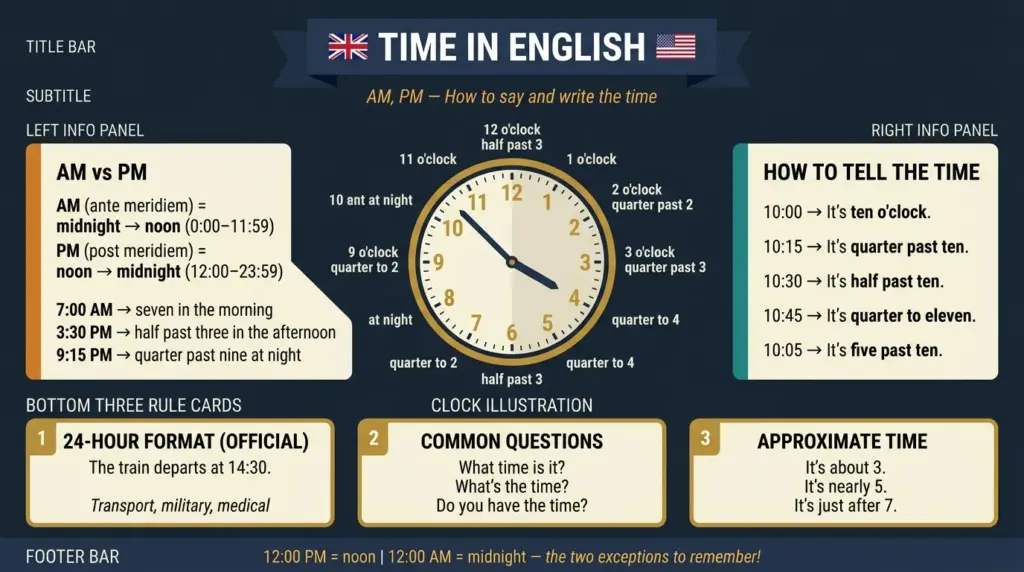
The abbreviation “am” comes from the Latin “ante meridiem”. It means before noon. It is used from midnight until 11:59 in the morning.
The abbreviation “pm” comes from the Latin “post meridiem”. It means after noon. It is used from noon until 11:59 at night.
Using the twenty-four-hour format is rare. The military and transportation schedules sometimes use the twenty-four-hour format. In daily life, the twelve-hour format remains the standard.
| 24-hour time | English format | Meaning |
|---|---|---|
| 08:00 | 8:00 am | 8 o’clock in the morning |
| 14:00 | 2:00 pm | 2 o’clock in the afternoon |
| 20:00 | 8:00 pm | 8 o’clock in the evening |
| 23:00 | 11:00 pm | 11 o’clock at night |
Asking for the time in English
Several phrases exist to ask for the time. The most common question is very simple to memorize.
To ask for the time in a neutral way, we say: “What time is it?”. This is the standard way to ask.
Another common option is: “What is the time?”. This question is used in similar contexts.
To ask a stranger on the street, we use a more polite form. For example, we would say: “Excuse me, do you have the time?”.
Do not confuse “Do you have the time?” with “Do you have time?”. The first question asks for the current time. The second question asks if the person is available or free.
Giving the exact hour: the use of o’clock
To answer a question about the time, the sentence always starts with “It is”. This expression is very often contracted to “It’s”.
When the hour is exact, with no extra minutes, we use the term “o’clock”. This word comes from the old expression “of the clock”.
We place “o’clock” directly after the hour number. Here are some concrete examples.
To say it is exactly seven, we say: “It’s seven o’clock”.
To say it is exactly ten, we say: “It’s ten o’clock”.
The term “o’clock” is used only for a full hour. It is never spoken if there are minutes. Saying “It’s seven thirty o’clock” is a mistake.
The direct method: reading the numbers simply
There are two ways to read the minutes in English. The first method is the simplest and most modern.
This approach consists of reading the numbers from left to right. You state the hour number. Then, you state the minute number.
To read 10:15 with this method, we say: “It’s ten fifteen”.
To read 2:30 pm, we say: “It’s two thirty”.
A specific rule applies for minutes between 01 and 09. The zero is pronounced like the letter “O” in English.
To say 8:05, the correct pronunciation is: “It’s eight O five”.
To say 4:09 pm, we pronounce it: “It’s four O nine”.
This direct method is very common in the United States. It is also widely used in the business world for its great clarity.
The classic method: reading the minutes before the hour
The second method is more traditional. It remains widely used, particularly in the United Kingdom.
The principle reverses the reading order. We state the minutes first. Then, we state the hour.
To link the minutes to the hour, we use two connecting words. These words are “past” and “to”. The choice depends on the number of minutes.
Using “past” from minute 1 to minute 30
The word “past” indicates that the minutes have passed after the given hour. It is used for the entire first half of the clock face.
For 9:10, we say: “It’s ten past nine”. This literally means ten minutes have passed nine o’clock.
For 11:20, we say: “It’s twenty past eleven”.
For 3:05 pm, we say: “It’s five past three”.
The word “after” sometimes replaces “past” in American English. Saying “It’s ten after nine” is perfectly correct in the United States.
Using “to” from minute 31 to minute 59
The word “to” indicates the missing minutes to reach the next hour. It is used for the second half of the clock face.
This rule requires a little mental math. You must subtract the displayed minutes from sixty. You must also add one hour to the indicated number.
For 8:40, there are twenty minutes left before nine o’clock. So we say: “It’s twenty to nine”.
For 2:50 pm, there are ten minutes left before three o’clock. We will say: “It’s ten to three”.
In the United States, the word “before” or “of” sometimes replaces “to”. You will sometimes hear “It’s a quarter of three”.
Expressions for quarters and the half-hour
English speakers use specific words for fractions of an hour. The number fifteen is replaced by a quarter. The number thirty is replaced by a half.
Expressing the quarter hour
Fifteen minutes represent a quarter of an hour. In English, we say “a quarter”. The article “a” is very important before the word “quarter”.
To say “quarter past”, the phrase is “a quarter past”.
Example for 7:15: “It’s a quarter past seven”.
To say “quarter to”, the phrase is “a quarter to”.
Example for 7:45: “It’s a quarter to eight”.
Expressing the half-hour
Thirty minutes represent a half-hour. In English, we use the word “half”. The letter “L” is silent in the pronunciation of the word “half”.
The half-hour is located on the first half of the clock face. Therefore, we always use the word “past”.
To say “half past”, the phrase is “half past”.
Example for 9:30: “It’s half past nine”.
We never say “half to”. The expression “half past” is the only correct form for the half-hour in the classic method.
Noon and midnight: specific vocabulary
The words noon and midnight have their own translations. Using them avoids confusion related to the am and pm format.
The word for noon is “noon” or “midday”.
To say it is noon, we say: “It’s noon” or “It’s midday”.
The word for midnight is “midnight”.
To say it is midnight, we say: “It’s midnight”.
The abbreviation “am” and “pm” for noon and midnight sometimes causes problems. Exactly twelve o’clock in the middle of the day corresponds to 12:00 pm. Exactly twelve o’clock in the middle of the night corresponds to 12:00 am.
Time prepositions related to the hour
Indicating the time in a sentence requires the use of a preposition. The choice of preposition depends on the context of the sentence.
To give a specific time, we always use the preposition “at”.
Example: “The train leaves at 5 pm”.
To indicate a time of day, we use the preposition “in”.
Example: “I drink coffee in the morning”.
To specify the time of day after the hour, “in” is also used.
Example: “It’s eight o’clock in the evening”.
Nighttime has a different rule. We say “at night” and not “in the night”.
Example: “I sleep at night”.
Typographical rules for writing the time
Writing the time follows several formal rules. These conventions vary slightly depending on the regions of the English-speaking world.
The abbreviations “am” and “pm” are written in different ways. They can be written in lowercase (am/pm). You can use periods (a.m./p.m.). You can also write them in uppercase (AM/PM).
A space must separate the number from the abbreviation. We write “10 am” and not “10am”. This rule makes the text easier to read.
The separator between hours and minutes varies by country. In the United States, a colon is used. The time is written “10:30”.
In the United Kingdom, a simple period is frequently used. The time is written “10.30”. Both formats are understood everywhere.
Exact hours can be written without the zeros. Writing “8 am” is correct. Writing “8:00 am” is also correct and provides more precision.
Practice Exercise
Test your knowledge on the time in English:
Question 1: How do you naturally translate 15:00 into English?
Question 2: What does “It’s half past ten” mean?
Question 3: What is the correct way to say 8:45 according to the classic method?
Question 4: Which preposition is used to indicate a specific time?
Question 5: How do you read the time 7:05 in a direct way?
Question 6: Which expression corresponds to 12:00 in the middle of the day?