


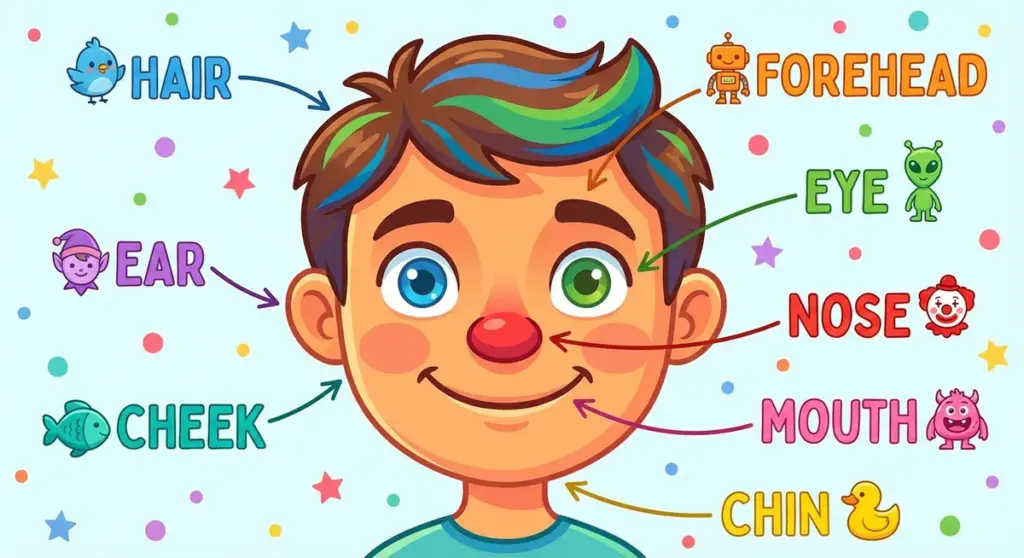
| Part of the Face | Category | Brief Definition |
|---|---|---|
| Forehead | Upper Face | Area between the eyebrows and the hairline |
| Cheek | Middle Face | Fleshy area on either side of the nose |
| Chin | Lower Face | Protruding part at the bottom of the face |
| Jawline | Structure | The lower contour of the bone structure |
| Temple | Side Face | Flat area between the eye and the ear |
Primary Frontal Features
These fundamental terms describe the most visible landmarks of the human visage.- Face : The front part of the head, from the forehead to the chin. — She washed her face with cold water.
- Forehead : The flat area above the eyebrows and below the hairline. — A high forehead is often considered a sign of intelligence in literature.
- Cheek : The soft skin on each side of the face below the eyes. — Tears rolled down her cheeks.
- Nose : The organ of smell and breathing in the center of the face. — A prominent nose.
- Bridge of the nose : The hard, bony upper part of the nose. — Glasses sit on the bridge of the nose.
- Nostril : One of the two channels of the nose. — The horse flared its nostrils.
- Septum : The cartilage wall separating the two nostrils. — A deviated septum can cause breathing issues.
- Philtrum : The vertical groove between the base of the nose and the upper lip. — The philtrum is more defined in some individuals than others.
- Mouth : The opening used for eating and speaking. — He covered his mouth when coughing.
- Chin : The bottom part of the face below the mouth. — He rested his chin on his hand.
Detailed Eye Anatomy
The eyes contain specific components often required for detailed observation or medical description.- Eye : The organ of sight. — Blue eyes.
- Eyebrow : The strip of hair growing on the ridge above the eye socket. — She raised an eyebrow in surprise.
- Eyelid : The fold of skin that covers and protects the eye. — His eyelids felt heavy with sleep.
- Eyelash : A short hair growing on the edge of the eyelid. — Long eyelashes protect the eye from dust.
- Pupil : The black circular opening in the center of the eye. — Pupils dilate in low light.
- Iris : The colored ring of tissue surrounding the pupil. — The iris controls the size of the pupil.
- Sclera : The white outer layer of the eyeball. — Redness in the sclera indicates irritation.
- Cornea : The transparent front part of the eye covering the iris and pupil. — Contact lenses sit on the cornea.
- Tear duct : The small channel in the inner corner of the eye for drainage. — Blocked tear ducts are common in infants.
- Canthus : The angle or corner where the upper and lower eyelids meet. — The inner canthus is near the nose.
Mouth and Lower Face Structure
Expanding beyond the basics allows for a better understanding of how these features connect to broader body parts in English.- Lip : One of the two fleshy parts forming the edges of the mouth. — Upper lip and lower lip.
- Cupid’s bow : The double-curve shape of the upper lip. — Lipstick is often applied to accentuate the Cupid’s bow.
- Jaw : The bony framework of the mouth. — A square jaw.
- Mandible : The lower jawbone (medical term). — The mandible is the strongest bone in the face.
- Tooth (Plural: Teeth) : Hard structures in the mouth used for biting. — Brushing teeth daily is essential.
- Gum : The firm pink flesh surrounding the teeth. — Healthy gums do not bleed.
- Tongue : The muscular organ in the mouth used for tasting and speaking. — The tip of the tongue.
- Cleft chin : A chin with a Y-shaped dimple in the center. — A genetic trait often called a dimple chin.
Side Features and Bone Structure
These terms define the lateral aspects and the underlying framework of the face.- Ear : The organ of hearing on the side of the head. — He tucked his hair behind his ear.
- Earlobe : The soft, fleshy lower part of the ear. — Earrings are typically worn on the earlobe.
- Tragus : The small pointed eminence of the outer ear. — The tragus protects the ear canal.
- Temple : The flat region on either side of the forehead. — She massaged her temples to relieve the headache.
- Cheekbone : The bone below the eye that gives shape to the cheek. — High cheekbones are a distinctive facial feature.
- Adam’s apple : The lump of cartilage in the neck, usually more visible in men. — His Adam’s apple moved when he swallowed.
Skin, Hair, and Surface Details
Vocabulary related to texture, marks, and facial hair adds depth to character descriptions.- Complexion : The natural color, texture, and appearance of the skin. — A pale complexion.
- Pore : A tiny opening in the skin releasing oil or sweat. — Clogged pores can lead to acne.
- Wrinkle : A slight line or fold in the skin, often associated with aging. — Crow’s feet are wrinkles near the eyes.
- Freckle : A small patch of light brown color on the skin. — Freckles often appear after sun exposure.
- Mole : A small dark spot on the skin. — A beauty mark is a type of mole.
- Dimple : A small natural indentation in the flesh of the chin or cheek. — Dimples often appear when smiling.
- Scar : A mark left on the skin where a wound has healed. — A faint scar above the eyebrow.
- Pimple : A small inflamed elevation of the skin (acne). — Adolescents frequently experience pimples.
- Hairline : The edge where hair growth begins on the forehead. — A receding hairline.
- Sideburns : Strips of facial hair growing down the sides of the face. — Sideburns connect the hair to the beard area.
- Beard : Hair growing on the chin and lower cheeks. — A full beard covers the jawline.
- Mustache : Hair growing on the upper lip. — He trimmed his mustache.
- Stubble : Short, rough hair growth appearing after shaving. — Five o’clock shadow is a type of stubble.