

Introducing yourself in English follows a simple and universal logic: greeting, identity, origin, activity, then a few personal details depending on the context. Whether for travel, an informal meeting, a job interview, or a group introduction, the basic structures remain the same. This page brings together all the useful phrases, with their translations, grammar points to watch out for, and examples of complete introductions.
The structure of a self-introduction in English
In English as in French, a personal introduction follows a logical progression. There is no strict rule, but a natural order that English-speaking listeners immediately recognize:
- Greet the other person
- Signal that you’re about to introduce yourself (in formal or group contexts)
- Give your first name and, if necessary, your last name
- Say where you’re from and where you live
- Mention your age if the context calls for it
- Talk about your job or studies
- Mention your hobbies or interests
- Share your personal or family situation (if appropriate)
- Close with a polite phrase and hand the floor back
The shorter and more direct the introduction, the more effective it is. English-speaking listeners don’t expect a detailed speech at first contact. One or two sentences per point are enough to make a positive impression and open the conversation.
Cultural codes to know: in England and the United States, cheek-kissing is not part of introduction etiquette. A handshake is sufficient in a professional context, and a simple smile with a Hi in an informal one. Contrary to what many French speakers think, it is perfectly normal not to shake hands in a relaxed setting.
Greeting before introducing yourself
Every introduction begins with a greeting. The choice of phrase depends on the time of day, the context, and the person you’re talking to. For more on greetings and farewells, see the dedicated page on saying hello and goodbye in English.
| English phrase | Meaning | Context |
|---|---|---|
| Hello | Hello | Neutral, universal, always appropriate |
| Hi | Hi | Informal, friends, close colleagues |
| Hey | Hey | Very informal, close friends only |
| Good morning | Good morning | Before noon, neutral to formal |
| Good afternoon | Good afternoon | Afternoon, neutral to formal |
| Good evening | Good evening | After 6 p.m., neutral to formal |
| Good morning, everyone | Good morning, everyone | Meetings, speaking to a group |
In a formal context or in front of a group, you can open your introduction with a set phrase:
| English phrase | Meaning |
|---|---|
| Let me introduce myself. | Allow me to introduce myself. |
| May I introduce myself? | May I introduce myself? |
| I would like to introduce myself. | I would like to introduce myself. |
| Allow me to introduce myself. | Allow me to introduce myself. (very formal) |
Saying your name in English
Two main structures allow you to give your name. The first is slightly more relaxed, the second more neutral or formal:
| English phrase | Meaning | Register |
|---|---|---|
| I’m Emma. | I’m Emma. | Informal, common in spoken language |
| My name is Emma Dupont. | My name is Emma Dupont. | Neutral to formal |
| My first name is Emma. | My first name is Emma. | To distinguish first name from last name |
| My surname is Dupont. | My last name is Dupont. | Useful for spelling or clarifying |
| I would like to introduce myself: my name is Emma Dupont. | I would like to introduce myself: my name is Emma Dupont. | Formal, group setting |
Common false friend: surname means “last name” or “family name”, not a nickname. A nickname is called a nickname. This is a very common point of confusion for French speakers because the two words look visually similar.
After giving your name, the other person will often respond with a welcoming phrase. It’s important to know how to reply naturally:
| What the other person says | Meaning | Natural reply |
|---|---|---|
| Nice to meet you. | Pleased to meet you. | Nice to meet you too. |
| Pleased to meet you. | Pleased to meet you. | Likewise. / Me too. |
| It’s a pleasure. | It’s a pleasure. | The pleasure is mine. |
| I’m delighted to make your acquaintance. | I’m delighted to make your acquaintance. | Likewise. (very formal) |
| How do you do? | How do you do? (very formal greeting) | How do you do? (same phrase in return) |
Classic trap: How do you do? is not a question about your health. It is a very formal first-contact phrase, equivalent to “pleased to meet you.” The reply is How do you do? — not I’m fine. This phrase is rare in everyday exchanges and is reserved for very formal contexts.
Saying your age and date of birth
In English, age is expressed using the verb to be, not to have as in French. This is one of the most frequent mistakes French speakers make when speaking.
| English phrase | Meaning |
|---|---|
| I’m 28. | I’m 28 (years old). |
| I’m 28 years old. | I’m 28 years old. (full form) |
| I was born in 1995. | I was born in 1995. |
| I was born on April 12th, 1995. | I was born on April 12th, 1995. |
| How old are you? | How old are you? |
| When were you born? | When were you born? |
Mistakes to avoid: I have 28 years is a literal translation from French that does not exist in English. You should always say I am 28 or I’m 28 years old. Similarly, I am born is incorrect: you must always say I was born.
Saying where you’re from and where you live
Geographic origin is an almost standard piece of information in any introduction. Two main structures coexist: I’m from and I come from. The first is more natural and more commonly used in speech.
| English phrase | Meaning |
|---|---|
| I’m from France. | I’m from France. |
| I’m from Paris. | I’m from Paris. |
| I come from Lyon. | I come from Lyon. |
| I’m originally from Bordeaux. | I’m originally from Bordeaux. |
| I’m originally from France but I live in London now. | I’m originally from France but I live in London now. |
| I live in Paris. | I live in Paris. |
| I live near Lyon. | I live near Lyon. |
| I live about 20 km from Nantes. | I live about 20 km from Nantes. |
| I live in a small town in the south of France. | I live in a small town in the south of France. |
| Where are you from? | Where are you from? |
| Where do you live? | Where do you live? |
Key point: in English, the preposition used with towns and countries is always in. You say in Paris, in France, in Martinique. Never at Paris or on France.
Talking about your job and studies
The topic of work comes up in almost every English-language introduction. The most natural phrase is What do you do for a living?, which is far more idiomatic than the literal translation What is your job?
| English phrase | Meaning |
|---|---|
| What do you do for a living? | What do you do for a living? |
| What is your job? | What is your job? |
| I’m a teacher / an engineer / a nurse. | I’m a teacher / an engineer / a nurse. |
| I work as a project manager. | I work as a project manager. |
| I work for a company called… | I work for a company called… |
| I work in renewable energy / healthcare / finance. | I work in renewable energy / healthcare / finance. |
| I’m in charge of a team of ten people. | I’m in charge of a team of ten people. |
| I’m self-employed. | I’m self-employed. |
| I’m currently looking for a job. | I’m currently looking for a job. |
| I’m a student. | I’m a student. |
| I’m studying medicine / law / computer science. | I’m studying medicine / law / computer science. |
| I’m in my third year of… | I’m in my third year of… |
| I have a degree in… | I have a degree in… |
| I graduated three years ago. | I graduated three years ago. |
Talking about your hobbies and interests
Mentioning your hobbies makes an introduction more personal and naturally opens the conversation. Three main structures allow you to express your interests: I like, I enjoy, and I’m into. Each has its own grammatical properties.
| English phrase | Meaning |
|---|---|
| What are your hobbies? | What are your hobbies? |
| What do you like to do in your free time? | What do you like to do in your free time? |
| I like / I love hiking / cooking / reading. | I like / I love hiking / cooking / reading. |
| I enjoy playing the guitar. | I enjoy playing the guitar. |
| I’m really into photography / travel / sport. | I’m really into photography / travel / sport. |
| I’m not really into horror films. | I’m not really into horror films. |
| I used to play football but I stopped. | I used to play football but I stopped. |
| I’ve been learning French for two years. | I’ve been learning French for two years. |
Grammar rule: after I enjoy, I’m into, I’m good at, and I’m keen on, the verb always takes the -ing form. You say I enjoy hiking, not I enjoy to hike. After I like and I love, both forms are accepted: I like hiking and I like to hike are both correct.
Talking about your personal and family situation
This information tends to come up in informal introductions or when the conversation deepens. In a professional context, it remains optional and can be slipped in naturally if the other person asks.
| English phrase | Meaning |
|---|---|
| I’m married / single / divorced. | I’m married / single / divorced. |
| I’m in a relationship. | I’m in a relationship. |
| I have two children. | I have two children. |
| I don’t have any children. | I don’t have any children. |
| I have a dog / a cat. | I have a dog / a cat. |
| I have two brothers and one sister. | I have two brothers and one sister. |
| I’m an only child. | I’m an only child. |
| I live alone / with my family / with roommates. | I live alone / with my family / with roommates. |
Introducing yourself in a professional context
A self-introduction in a job interview or at a meeting follows the same basic structure, but places greater emphasis on background, skills, and goals. The register is more formal and the sentences more structured.
Opening a professional introduction
| English phrase | Meaning |
|---|---|
| Good morning. Allow me to introduce myself. | Good morning. Allow me to introduce myself. |
| Thank you for having me today. | Thank you for having me today. |
| I’m pleased to be here. | I’m pleased to be here. |
| It’s a pleasure to meet you all. | It’s a pleasure to meet you all. |
Talking about your background and skills
| English phrase | Meaning |
|---|---|
| I have five years of experience in marketing. | I have five years of experience in marketing. |
| I worked as a developer at… for three years. | I worked as a developer at… for three years. |
| I graduated from… university five years ago. | I graduated from… university five years ago. |
| I have a master’s degree in finance. | I have a master’s degree in finance. |
| I’m able to manage a team of ten people. | I’m able to manage a team of ten people. |
| I can work independently or as part of a team. | I can work independently or as part of a team. |
| I’m fluent in English and intermediate in Spanish. | I’m fluent in English and intermediate in Spanish. |
| I’m currently looking for a new challenge in… | I’m currently looking for a new challenge in… |
| My goal is to… | My goal is to… |
Closing a professional introduction
| English phrase | Meaning |
|---|---|
| I’m very motivated to join your team. | I’m very motivated to join your team. |
| I look forward to working with you. | I look forward to working with you. |
| Please feel free to ask me any questions. | Please feel free to ask me any questions. |
| That’s it for my introduction. Thank you. | That’s it for my introduction. Thank you. |
Core vocabulary by theme
Nationalities and languages
| Country | Nationality | Language |
|---|---|---|
| France | French | French |
| England / the UK | English / British | English |
| The United States | American | English |
| Spain | Spanish | Spanish |
| Germany | German | German |
| Italy | Italian | Italian |
| Canada | Canadian | English / French |
| Australia | Australian | English |
| Morocco | Moroccan | Arabic / French |
| Brazil | Brazilian | Portuguese |
Identity vocabulary
| English | Meaning |
|---|---|
| first name | first name |
| last name / surname | last name / family name |
| nickname | nickname |
| age | age |
| date of birth | date of birth |
| nationality | nationality |
| profession / job | profession / job |
| married | married |
| single | single |
| divorced | divorced |
| widowed | widowed |
| spouse / partner | spouse / partner |
| only child | only child |
| eldest / youngest | eldest / youngest |
Examples of complete introductions
Informal introduction, first contact
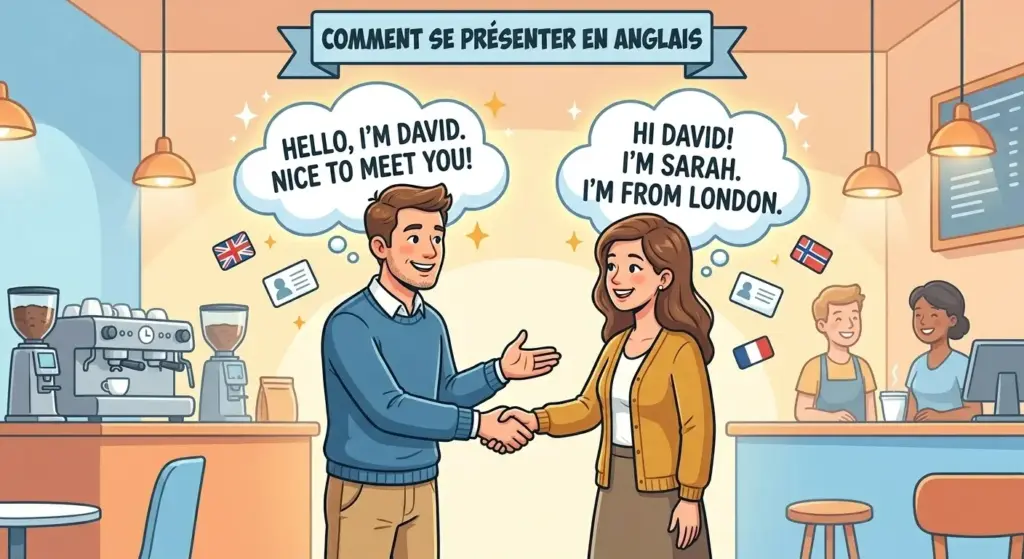
A: Hi! I’m Emma. Nice to meet you.
B: Hi Emma, I’m Lucas. Nice to meet you too. Where are you from?
A: I’m from France, originally from Bordeaux, but I live in Paris now. And you?
B: I’m from Spain but I live in Paris too. What do you do for a living?
A: I’m an engineer. I work in renewable energy. How about you?
B: I’m a project manager in IT. What do you enjoy doing in your free time?
A: I’m really into hiking and photography. And you?
B: I enjoy traveling and I love cooking.
Group introduction or meeting
Good morning, everyone. Allow me to introduce myself. My name is Sarah Muir. I’m originally from Edinburgh, but I’m based in London now. I’m 34 years old. I work as a marketing director at a tech company. I’ve been in this field for about ten years. Outside of work, I’m really into running and I enjoy cooking. I’m delighted to be here today, and I look forward to meeting all of you.
Job interview introduction
Good morning. Thank you for having me today. My name is Thomas Bernard. I’m 29 years old and I’m from Lyon, though I now live in Paris. I have a master’s degree in computer science and five years of experience as a software developer. I worked at a startup for three years, then joined a larger company where I managed a team of six developers. I’m passionate about solving complex technical problems, and I’m currently looking for a new challenge in a dynamic environment. I’m very motivated to join your team. Please feel free to ask me any questions.
Fill-in-the-blank template for practice
This template lets you prepare your own introduction by replacing the blanks with your personal information:
Hello, my name is ……… and I’m ……… years old. I’m from ……… and I live in ………. I work as a ……… and I’ve been doing this for ……… years. In my free time, I enjoy ……… and ………. I’m ……… (married / single) and I have ……… (children / no children). Nice to meet you!
Handing the floor back and continuing the conversation
An introduction is never a monologue. Handing the floor back to the other person is an implicit social rule in English, particularly in informal exchanges. These phrases allow you to do so naturally and show genuine interest in the other person:
| English phrase | Meaning |
|---|---|
| And you? | And you? |
| How about you? | How about you? |
| What about you? | What about you? |
| Tell me about yourself. | Tell me about yourself. (common in interviews) |
| I’d love to know more about you. | I’d love to know more about you. |
To go further in everyday exchanges, see the page useful phrases to know in English, which brings together expressions for thanking, apologizing, handling misunderstandings, and wrapping up a conversation.
How to memorize and practice your introduction
Memorizing these phrases is a starting point, but fluency only comes from repeated practice in real situations. Three concrete approaches for making quick progress:
Prepare two versions of your introduction. A short version of three to five sentences for informal exchanges, and a longer version of around ten sentences for professional contexts. Read them aloud until you can produce them without looking at your notes.
Vary the phrases to avoid getting stuck. Knowing two ways to say the same thing (for example, I’m from France and I come from France) prevents a mental blank under pressure. Stress might erase the one phrase you know; having two ensures that at least one comes out naturally.
Practice with a real conversation partner. Practicing in front of a mirror or recording yourself reveals hesitations and pronunciation mistakes. But nothing replaces a real exchange with a native or advanced speaker, who can give immediate feedback and help you handle the unexpected.