

- Present: The verb takes the form have or has in the third person singular.
- Past: The single form had is used for all subjects.
- Double role: This word acts as a main verb for possession and as an auxiliary for compound tenses.
- Action or state: The meaning changes depending on the context, especially for meals or experiences.
The verb to have is used to express material possession or a family relationship. It also helps to construct other verb tenses as an auxiliary.
Conjugation in the present simple
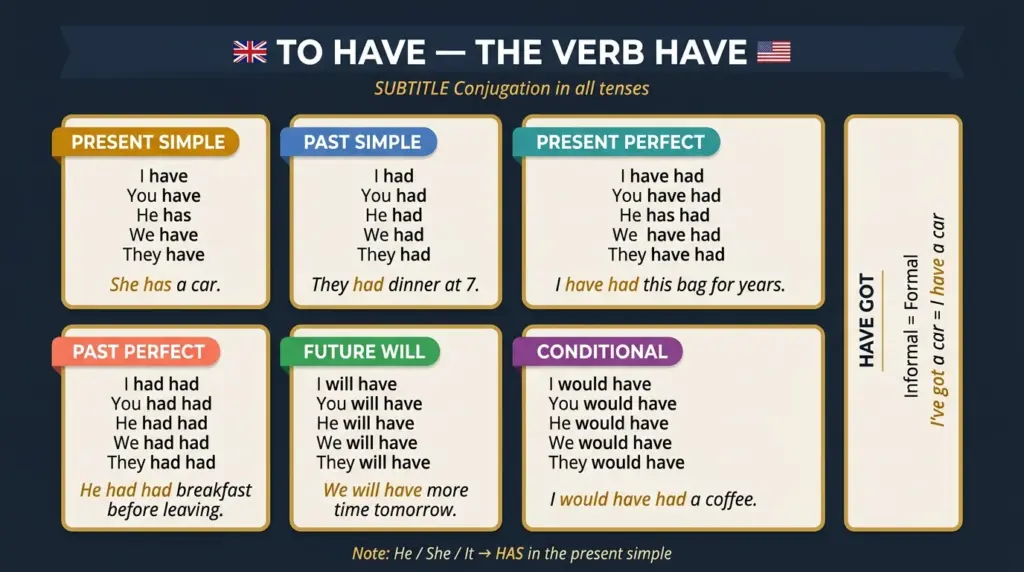
The present simple is used to talk about a permanent possession or a habit. The conjugation remains regular, except for the third person singular. This person takes a final “s”.
| Subject | Affirmative form |
|---|---|
| I | have |
| You | have |
| He / She / It | has |
| We | have |
| They | have |
Here are concrete examples in the present simple:
I have a big house.
She has three cats.
They have a new car.
The negative form in the present
Negation requires the addition of the auxiliary do or does. The verb have then remains in its base form. Contraction is very common in spoken language.
| Subject | Full form | Contracted form |
|---|---|---|
| I / You / We / They | do not have | don’t have |
| He / She / It | does not have | doesn’t have |
We do not have time.
He doesn’t have a brother.
The interrogative form in the present
To ask a question, the auxiliary is placed before the subject. The verb follows the subject.
Do you have a pen?
Does she have the keys?
The variant with got
The expression have got is used very often in British English. The meaning remains exactly the same as have alone. This form is used only in the present to express possession or an illness.
| Subject | Affirmative form | Contracted form |
|---|---|---|
| I / You / We / They | have got | ‘ve got |
| He / She / It | has got | ‘s got |
I’ve got an idea.
She’s got a headache.
Negation and interrogation are constructed differently. The word have acts here as an auxiliary. There is therefore no need for do or does.
I haven’t got any money.
Has he got a car?
Conjugation in the past simple
The past simple is used to talk about completed past actions. The conjugation becomes very simple. The form had applies to all persons without exception.
| Subject | Affirmative | Negative |
|---|---|---|
| All subjects | had | did not have (didn’t have) |
I had a dog when I was young.
They had a great idea.
She didn’t have time to call.
Did you have a good trip?
The present continuous
The present continuous is formed with the auxiliary to be and the verb ending in -ing. This form is used for an ongoing action. Possession cannot be expressed with this form.
The verb have takes the form having when it describes an action, an experience, or a meal.
| Subject | Continuous form |
|---|---|
| I | am having |
| He / She / It | is having |
| You / We / They | are having |
We are having dinner right now.
She is having a shower.
They are having fun.
Use as an auxiliary
The verb have is used to form compound tenses (“perfect tenses”). It then loses its meaning of possession. It helps the main verb to be situated in time.
The present perfect
This tense links the past to the present. It is formed with have or has followed by the past participle of the main verb.
I have finished my work.
She has lived here for ten years.
I have had this car since 2015.
The past perfect
This tense expresses an action prior to another past action. It is equivalent to the French pluperfect. The construction uses had followed by the past participle.
When I arrived, they had left.
He had had a long day.
The future simple
The future is formed with the modal auxiliary will. The verb have remains in the infinitive without to. The form is identical for all subjects.
| Subject | Affirmative | Negative |
|---|---|---|
| All subjects | will have | will not have (won’t have) |
I will have a new computer tomorrow.
She won’t have time later.
Will they have enough money?
The conditional
The conditional is expressed with the modal would. This construction is used to talk about an imaginary situation or an assumption.
| Subject | Affirmative | Negative |
|---|---|---|
| All subjects | would have | would not have (wouldn’t have) |
I would have a dog if I lived in a house.
He wouldn’t have a problem with that.
Idiomatic expressions with to have
English often uses this word in expressions where other languages prefer a different verb. These expressions generally describe actions of daily life.
For meals: To have breakfast — To have a drink
For hygiene: To have a bath — To have a shower
For rest and discussions: To have a break — To have a chat — To have a dream
Obligation with have to
The expression have to is used to express a strong obligation. This structure requires another verb in the infinitive right after.
I have to go now.
She has to work on Saturday.
In the past, obligation is expressed with had to: We had to pay immediately.
The negative form removes the obligation. It indicates that an action is not necessary.
You don’t have to wait.
He didn’t have to buy a ticket.
The causative passive
This advanced grammatical structure indicates that a person has an action done by someone else. The construction uses the verb have, followed by the object, then the past participle of the action verb.
I have my car washed every week.
She had her hair cut yesterday.
They will have the roof repaired.
Practical exercise
Test your knowledge of the conjugation of the verb to have in English:
Question 1: How do you conjugate in the third person singular in the present simple?
Question 2: What is the correct form for a question in the present simple?
Question 3: Choose the correct sentence to express the past:
Question 4: How do you say “I don’t have time” in the present?
Question 5: Which sentence correctly uses the present continuous?
Question 6: Complete the sentence in the future: “They ___ enough money to buy it.”