

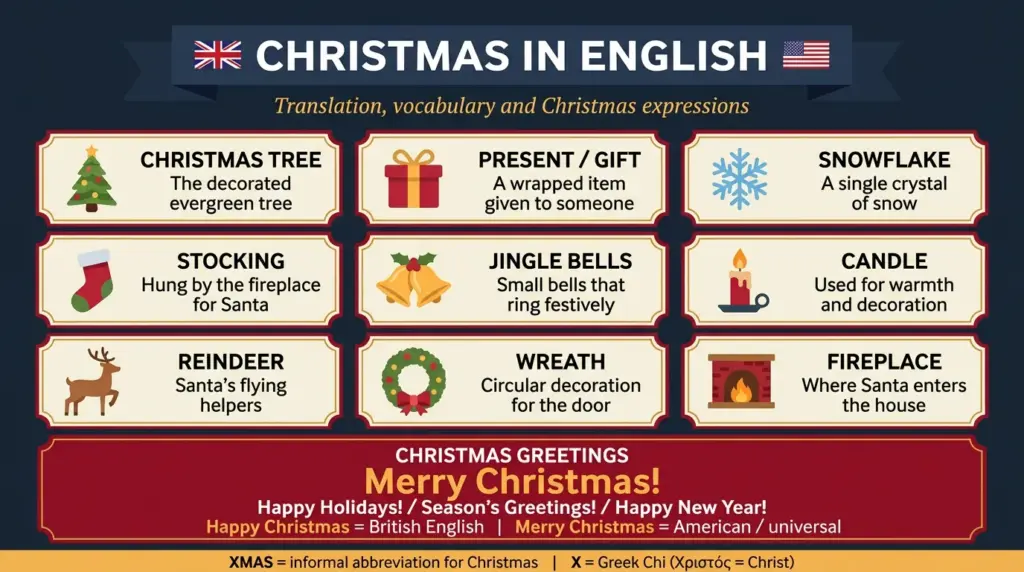
- Translation: Noël = Christmas, from the Latin Missa Christi (Mass of Christ).
- Common greetings: Merry Christmas is universal; Happy Christmas is more British.
- Two dates: Christmas Eve = 24 December; Christmas Day = 25 December.
- Gifts: Gift and present both mean the same thing.
- Idiomatic expressions: many fixed phrases exist for talking about the Christmas season.
Christmas: meaning and origin of the word
Christmas comes from the Middle English Cristes mæsse, meaning “the Mass of Christ”. The term was gradually shortened to Christmas.
The French word “Noël” has a different origin. It comes from the Latin Natalis, linked to the Roman festival Dies Natalis Solis Invicti — the day of the birth of the Sun. Emperor Constantine set the date on 25 December in the 4th century AD.
| English | Meaning |
|---|---|
| Christmas | The Christmas holiday |
| Christmas Eve | The evening of 24 December |
| Christmas Day | 25 December |
| Christmas tree | A decorated fir tree |
| Christmas and New Year | The end-of-year holiday period |
| the holiday season | The festive period |
How to wish someone a Merry Christmas in English
Several phrases exist for wishing someone well over the festive period. The choice depends on the country and the context.
| Expression | Meaning | Context |
|---|---|---|
| Merry Christmas! | Joyeux Noël! | Universal, widely used |
| Happy Christmas! | Joyeux Noël! | Common in the United Kingdom |
| Have a jolly Christmas! | Have a fun Christmas! | Informal, warm tone |
| Season’s Greetings | Best wishes for the season | Neutral, professional setting |
| Happy Holidays! | Enjoy the holidays! | Inclusive, common in the US |
| Wishing you a wonderful Christmas | I hope you have a wonderful Christmas | Written, greeting card |
| All the best for the festive season | Best wishes for the holidays | Formal, professional email |
Christmas idiomatic expressions in English
Beyond the basic vocabulary, English has many fixed expressions linked to Christmas. These phrases are heard in conversations, films and songs.
Phrases for responding to a Christmas invitation
| English | Meaning |
|---|---|
| I’d be delighted to join you for Christmas dinner. | I’d love to come to your Christmas meal. |
| I can’t wait to come to your Christmas party. | I’m really looking forward to your party. |
| I’m sorry, I won’t be able to make it this year. | Unfortunately I can’t come this year. |
| What do you want me to bring? | Is there anything I can bring along? |
| Count me in! | I’m in! |
| I wouldn’t miss it for the world. | Nothing would stop me from being there. |
Phrases for organising a Christmas gathering
| English | Meaning |
|---|---|
| Would you like to join us for Christmas? | Do you want to spend Christmas with us? |
| We’re hosting Christmas dinner this year. | We’re having everyone over for Christmas dinner. |
| If you don’t have anywhere to go, we’d be happy to welcome you. | You’re welcome to join us if you have no plans. |
| I make my own Christmas eggnog. | I prepare my own homemade eggnog. |
| Where can I buy Christmas decorations? | Where is the best place to find decorations? |
| Are you doing anything for Christmas? | Do you have any plans for the holidays? |
| We’re doing a Secret Santa this year. | We’re organising a Secret Santa exchange. |
Christmas vocabulary in English: the complete glossary
| English | Meaning |
|---|---|
| Angel | A winged heavenly figure used as a tree topper |
| Candle | A wax light used as decoration |
| Chimney | The flue through which Santa enters |
| Christmas bauble | A round decorative ball for the tree |
| Christmas cake | A rich fruit cake eaten at Christmas |
| Christmas card | A seasonal greeting card |
| Christmas carol | A traditional Christmas song |
| Christmas dinner | The main festive meal, usually on 25 December |
| Christmas wreath | A circular decoration hung on the door |
| Decoration | Any festive ornament |
| Fireplace | The hearth where stockings are hung |
| Gift / Present | Something given as a gift |
| Holly | An evergreen plant with red berries |
| Mistletoe | A plant under which people traditionally kiss |
| Ornament | A decorative object for the tree |
| Reindeer | The animals that pull Santa’s sleigh |
| Santa Claus | Father Christmas |
| Sleigh | Santa’s vehicle pulled by reindeer |
| Snowman | A figure built from packed snow |
| Star | The tree topper representing the Star of Bethlehem |
| The nativity scene | A display representing the birth of Jesus |
| Turkey | The traditional Christmas roast |
| Yule log | A large log burned at Christmas (or a chocolate cake) |
| Advent calendar | A calendar counting down the days to Christmas |
| Stocking | A large sock hung by the fireplace for gifts |
| Tinsel | Shiny metallic strands used as decoration |
| Fairy lights | Small decorative lights strung on trees |
| Gingerbread | A spiced biscuit or cake, often shaped into houses |
| Eggnog | A creamy drink made with eggs, milk and spices |
| Mulled wine | Warm spiced red wine |
Christmas in English-speaking countries: some cultural differences
In the United Kingdom, Christmas is the most widely celebrated national holiday. On 25 December, the royal family addresses the nation — a televised tradition followed by millions for decades.
In the United States, the Christmas season lasts several weeks. Outdoor light displays are spectacular. Countless films and songs are released every year for the occasion. The expression Happy Holidays is often preferred there to include other celebrations such as Hanukkah and Kwanzaa.
In the Nordic countries, the Danish tradition of hygge comes into its own: thick socks, blankets, hot drinks. The idea is to create a warm cocoon against the harsh winter.
The Christmas tree finds its roots in Scandinavian and Germanic peoples. They decorated fir trees with ribbons and torches during the Yule festival, long before the Christian tradition.
Christmas songs in English
Music plays an important role in the Anglo-Saxon Christmas. These songs return every year and their phrases have become part of everyday language.
| Title | Artist | Famous phrase |
|---|---|---|
| All I Want for Christmas Is You | Mariah Carey | All I want for Christmas is… |
| It’s the Most Wonderful Time of the Year | Andy Williams | The most wonderful time of the year |
| Have a Holly Jolly Christmas | Burl Ives | Have a jolly Christmas |
| Jingle Bells | Traditional | Dashing through the snow |
| White Christmas | Bing Crosby | I’m dreaming of a white Christmas |
| ‘Tis the Season to Be Jolly | Traditional | ‘Tis the season (common everyday expression) |
To go further
Christmas vocabulary in English goes far beyond a handful of isolated words: it reflects a culture, a set of traditions and a way of celebrating the holidays specific to English-speaking countries. Watching Christmas films in the original version, listening to songs without translating them, or taking English classes focused on thematic vocabulary are all concrete ways to make progress. December, with its rich lexicon and countless opportunities for conversation, is one of the best times of year to get started.