


Writing a resume in a language that isn’t your first can be challenging. Beyond describing your experience, you also need to get the tone, grammar, and wording right so your resume reads naturally rather than like a direct translation. Here is a list of seven tips to help you create a resume that meets the expectations of English-speaking recruiters
1. Write in Plain, Direct English
Avoid using complicated words just to sound more professional. In English, it’s all about simplicity. A short, clear sentence is almost always better than a long one filled with awkward or overly complex wording. A hiring manager should understand who you are and what you bring to the role within seconds of scanning your resume.
This is especially important if English is not your first language. Simple, well-structured sentences are easier to understand and leave less room for grammatical mistakes.
This doesn’t mean your resume has to sound basic. It means every word should be doing real work. If a sentence still makes sense after you remove a word, take it out. Recruiters read dozens of resumes in a sitting, and the ones that get remembered are usually the ones that are easiest to read quickly.
2. Avoid Translating it From Your Native Language

This is one of the most common mistakes non-native English writers make. Instead of translating word for word, think about how a native English speaker would naturally describe the same accomplishment.
The safer approach is to stop thinking in your native language before you write the sentence. Picture the achievement itself, the project you led, the result you produced, the skill you used, and then describe that picture in English from scratch. Don’t start with a sentence in your own language and convert it word by word. It takes a little more effort per sentence. However, the result reads far more naturally, and it’s usually the single biggest difference between a resume that sounds translated and one that doesn’t.
3. Use a Resume Builder to Save Structure and Wording
If you aren’t an expert in writing down your skills and achievements in proper English, use a resume builder. These tools do the formatting automatically and can suggest professional wording for different sections of your resume. It’s really helpful when you know what you want to say, but don’t know how to phrase it properly.
Here are a few resume builder tools to consider:
a. CVwizard:
CVwizard is an AI-assisted resume builder specifically designed for applicants writing their resume in English as a second language. The builder provides suggestions for phrases in English in each section targeted to your specific job applications. This saves time and effort as you don’t have to come up with your own phrases from scratch and you can simply modify the professional content to make sure it’s correct for your experience.
You can also upload an existing CV or your LinkedIn profile, and it will rewrite it in coherent, polished English, filling in any verb tenses or general phrases.
Moreover, CVwizard has free resume templates already formatted for English resume writing, which ensures that your application is attractive to recruiters. It takes a lot of the ‘guesstimation’ out of the writing process for a non-native speaker, allowing you to concentrate on creating accurate content without worrying about language mistakes.
b. Zety:
A guided resume builder that’s particularly useful if you are unsure how to describe your responsibilities and achievements in professional English. It offers a large library of pre-written bullet points organized by industry and job title. So instead of translating your experience word for word from your own language, you can browse examples of how similar roles are typically described in English and adapt the phrasing to fit your background.
Its built-in content suggestions also flag when a sentence sounds vague or repetitive. This is a common issue for non-native writers who default to safe, general phrasing rather than specific, English-appropriate action verbs. The tool also walks you through each section with prompts in plain English, asking what you did and what resulted from it. It eventually helps you build sentences in the achievement-focused style that English-language resumes favor rather than the more descriptive, duty-based style common in some other countries.
c. Novoresume:
Best known for easy-to-use, ATS-friendly templates, for the English-based part. It allows you to keep formatting easy and consistent, thereby minimizing the risk that a hiring manager can easily notice. It also contains short phrases to illustrate how to use each word in sample sentences. It helps you make sure you are not using the word in a way that’s too informal or too formal for an English-language resume.
The section prompts are also written in short, direct English and can serve as a mini model for the tone you wish to adopt in the rest of your document. It’s ideal for people who are relatively at ease in their writing skills in English and just want the right structure to present their writing in, rather than needing lots of help with the words from start to finish.
These tools provide a solid starting point if you are writing a resume in English for the first time.
4. Use the Correct Verb Tense
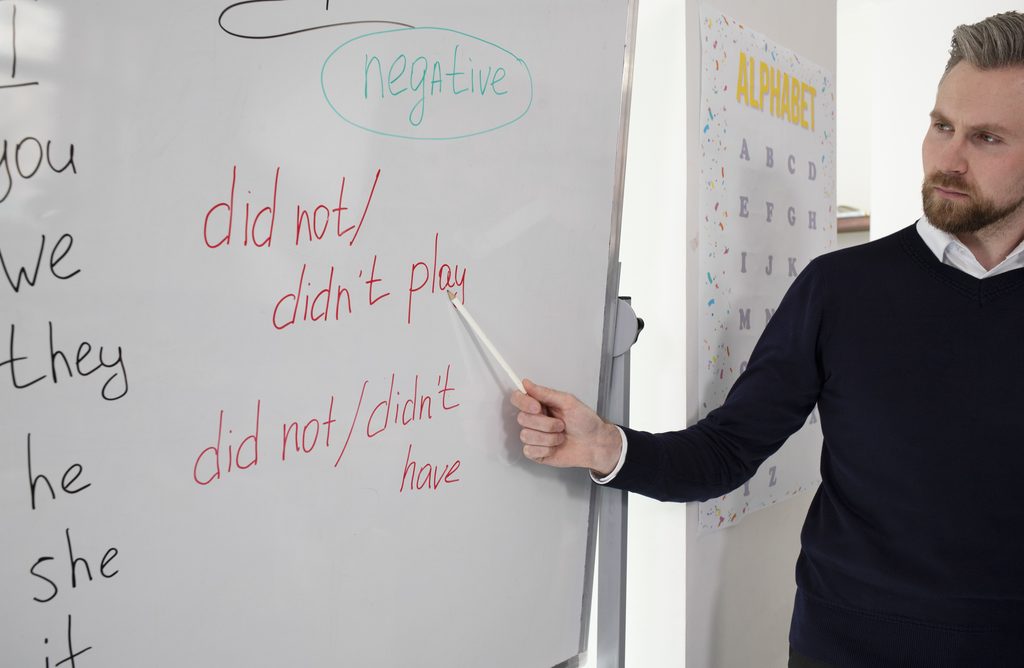
This is a little bit of grammar that can mean a lot. Use the past simple tense (“managed,” “developed,” “led”) for previous jobs, and the present simple (“manage,” “develop,” “lead”) for your current role. It’s common to mix tenses in one resume, but it can make even strong experience look unpolished.
The mistake usually shows up in one of two ways:
- The first is switching tense mid-bullet, describing a past job partly in past tense and partly in present tense within the same line.
- The second is applying present tense to a role that’s already finished, which reads as a small but noticeable inconsistency to a native English speaker, even if the meaning is still clear.
A quick way to check your own resume is to go through it role by role: everything under a current job should stay in present tense, and everything under a past job should stay in past tense, all the way down the list.
5. Keep Your Tone Formal but Natural
The tone of an English resume should be professional without sounding overly formal. Do not use slang or contractions such as “I’ve” or “didn’t.” Avoid outdated phrases such as “responsible for the undertaking of.” Aim for the same tone you’d use in a professional email to someone you respect but don’t know personally. If you aren’t sure whether a phrase sounds natural, do a quick online search. If it appears in very few results, it’s probably not a common expression in English.
It helps to think of tone as a spectrum, with texting-casual on one end and legal-document-formal on the other. A professional English resume sits closer to the middle than most non-native writers expect.
One useful test is to imagine reading the sentence out loud to a colleague you respect but don’t know well. If it sounds like something you’d genuinely say to that person, the tone is probably right. If it sounds like you’re reading from a dictionary or a legal contract, it’s worth simplifying.
6. Be Aware of Confusing Word Usage
Some English words look or sound familiar but have completely different meanings. For instance, ‘accept and except,’ and ‘adapt or adept.’ A resume is one of those documents where you don’t want any word to fall in the wrong context. These small word-choice mistakes are easy for native speakers to spot.
A few other common mix-ups worth double-checking:
- “affect” (a verb, meaning to influence) versus “effect” (usually a noun, meaning a result),
- “principal” (main, or a person in charge) versus “principle” (a rule or belief), and
- “complement” (to go well with) versus “compliment” (praise).
None of these look particularly risky on their own, but they show up often enough in resumes that a single mix-up can catch a recruiter’s eye for the wrong reason.
Most job seekers don’t realize that grammar and spelling errors are significant (77% of hiring managers disqualify resumes containing such mistakes). For non-native English speakers, that makes careful proofreading less of an extra step and more of a requirement.
7. Read Your Resume Out Loud
Reading your resume silently makes it easy to overlook mistakes because your brain fills in missing words automatically. Reading it aloud helps you catch awkward phrasing, missing words, and inconsistent verb tense. If possible, ask a native English teacher, speaker, or trusted colleague to review it before you send it.
Reading out loud is especially useful for catching two things non-native speakers often miss when reading silently:
- missing articles (“a,” “an,” “the”)
- sentence rhythm.
Many languages don’t use articles the same way English does. So it’s common for a sentence to be missing one without the writer noticing, since the meaning still feels complete to them. Hearing the sentence spoken out loud tends to make the gap more obvious than seeing it on the page.
If you don’t have anyone available to review it with you, try reading each bullet point starting from the bottom of the resume rather than the top. It breaks the flow you’re used to and makes it easier to judge each sentence on its own, rather than skimming through content you’ve already reread several times.
Final Thoughts
A resume written in English, or any second language, doesn’t have to sound like it was written by a native speaker. It just needs to be clear, straightforward, and free of the kinds of mistakes that distract from your experience. Follow these tips, proofread your resume carefully before sending it, and you’ll be in a much stronger position to showcase what you have to offer.