


Quick Summary
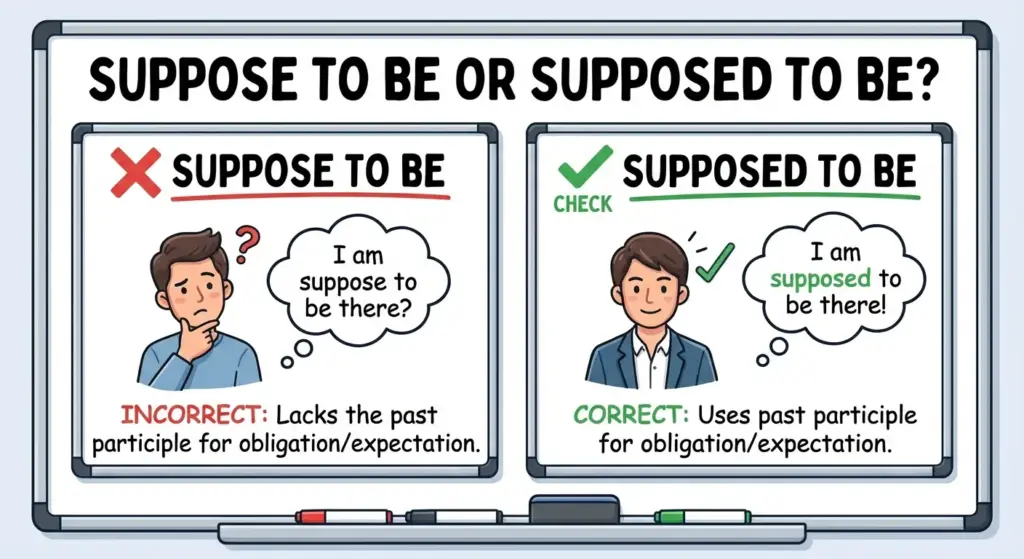
- Correct form: “supposed to be” (with -ed) functions as a past participle meaning “expected to” or “required to”
- Incorrect form: “suppose to be” is grammatically wrong, though commonly heard in casual speech
- Key rule: “suppose” (without -ed) is only correct as a present tense verb meaning “to assume”
What Is the Difference Between “Suppose to Be” and “Supposed to Be”?
“Supposed to be” is the grammatically correct form. The word “supposed” functions as a past participle, creating a modal verb phrase that expresses expectation or obligation. “Suppose to be” is incorrect when expressing expectation. The confusion arises because both forms sound nearly identical in spoken English, especially when the “-ed” ending is not clearly pronounced. Structure: Subject + be (conjugated) + supposed to + base verb- The package was supposed to arrive yesterday.
- Students are supposed to submit assignments by Friday.
- The movie is supposed to start at 7:00 PM.
Three Main Uses of “Supposed To”
1. Expressing Obligation or Expectation Indicates what someone is required or expected to do, though compliance is not guaranteed.- Employees are supposed to clock in before 9:00 AM.
- The contractor was supposed to finish the repairs last week.
- This restaurant is supposed to serve the best sushi in town.
- The new software is supposed to increase productivity by 30%.
- Rain is supposed to begin around midnight.
- The meeting was supposed to last only one hour.
When to Use “Suppose” (Without the -ed)
The word “suppose” without the “-ed” ending serves as the present tense form of the verb meaning “to assume,” “to presume,” or “to believe something is likely.”- I suppose the traffic delayed him. (assumption)
- They suppose the problem stems from outdated equipment. (belief)
- Do you suppose she’ll accept the job offer? (question)
- Suppose it rains tomorrow—what will we do? (hypothetical)
- Suppose = Present tense verb (to assume/presume)
- Supposed to = Modal phrase (expected to/required to)
Why “Suppose to Be” Sounds Correct
Many native speakers write “suppose to” instead of “supposed to” for several reasons:- Pronunciation similarity: The “-ed” ending blends into “to,” making it nearly inaudible
- Informal speech patterns: Casual conversation drops unstressed syllables
- Grammatical confusion: The past participle structure may not be obvious
- Lack of visual reinforcement: Learning through listening without seeing written form
Original: The train is supposed to/suppose to arrive at noon.
Test: The train is expected to arrive at noon.
Correct: The train is supposed to arrive at noon.
“Supposed To” vs. “Have To” vs. “Ought To”
These modal phrases express obligation with subtle differences in meaning and intensity. “Supposed To” = Expected obligation (may not happen)- Conveys what is expected, planned, or required
- Implies the action may or may not occur
- The repairman is supposed to come today, but I haven’t heard from him.
- Indicates absolute necessity or requirement
- Suggests no choice, implies consequences
- Employees have to complete safety training before starting work.
- Expresses advice or suggestion
- Indicates what would be best without mandate
- Students ought to review notes before the exam.
“Supposedly” vs. “Supposably”
“Supposedly” is the correct adverb meaning “as is generally assumed or believed” (often with skepticism). This word is grammatically correct and widely accepted.- The CEO is supposedly announcing changes next week. (implies doubt)
- This product supposedly delivers results in 30 days. (suggests skepticism)
- Supposedly = as is generally believed (common, correct)
- Supposably = possibly, conceivably (rare, often misused)
Practical Examples in Context
Professional Settings (Correct):- The client meeting is supposed to begin at 2:00 PM sharp.
- All expense reports are supposed to be submitted by month-end.
- The new software is supposed to streamline workflow.
- Students are supposed to cite all sources in research papers.
- The experiment is supposed to demonstrate chemical reactions.
- The mail carrier is supposed to deliver packages by 5:00 PM.
- I suppose we could try the new restaurant downtown.
- Suppose the power goes out—do we have flashlights?
Memory Tips
Remember the past participle: Think of “supposed to” as parallel to other past participles used as adjectives:- Expected to arrive → Supposed to arrive
- Required to attend → Supposed to attend
- Scheduled to begin → Supposed to begin
- An expectation or obligation → Use “supposed to” (with -ed)
- An assumption or hypothesis → Use “suppose” (without -ed)
Quick Reference Guide
Use “Supposed To” When:- Expressing what is expected to happen
- Indicating obligations or requirements
- Describing reputations or general beliefs
- The phrase can be replaced with “expected to”
- Making assumptions about something
- Expressing beliefs or opinions
- Asking hypothetical questions
- Using it as a present tense verb
- Expressing expectations or obligations (always use “supposed to”)
- Any context where “expected to” would fit (always use “supposed to”)
- Formal or professional writing (always use “supposed to”)
Key Takeaways
- Always write “supposed to” (with -ed) when expressing expectations or obligations
- Use “suppose” (without -ed) only as a present tense verb for assumptions
- Remember that “supposed to” functions as a modal phrase similar to “expected to”
- In doubt, substitute “expected to”—if it works, use “supposed to”