

Picture a normal afternoon. You’re in a shop, on a bus, or at your desk. Someone beside you suddenly grabs their chest and slides to the floor. Your heart pounds. You know you have to get help, and you have to get it now. But the English words stick in your throat. For anyone still building confidence in a second language, those few seconds can feel like forever. Here’s the hopeful part: the words you need in an emergency are learnable, just like any other English, and a quick search for First Aid training near me can teach you the skill and the vocabulary together.
If you’re a newcomer, a student, or a worker improving your English in Kitchener, this matters more than you might think. You already study English for work, for school, for daily life. Why not learn the version of English that could help you save someone?
Why Is Emergency English So Hard at the Moment?
Fear changes how our brains work. Even fluent speakers freeze when they’re scared. Add a second language on top of that stress, and the simplest sentence can disappear.
That’s not a weakness. It’s just how pressure works. The fix is practice. When you’ve said a phrase out loud many times, it comes back to you automatically, even when you’re shaking. This is why repetition is a learner’s best friend.
So let’s build your emergency vocabulary now, while things are calm.
What Do You Say When You Call 911?

In Canada, you call 911 for any serious emergency: medical, fire, or police. The person who answers is called a dispatcher or operator. Their job is to stay calm and ask you questions. Your job is to answer clearly and stay on the line.
Here’s a simple script you can practise:
1. “I need an ambulance.” (This tells them it’s a medical emergency.)
2. State the location. “I’m at…” Give the street, building, or nearest intersection.
3. Say what’s wrong. “A man has collapsed. He is not breathing.”
4. Answer their questions. They may walk you through what to do next.
5. Don’t hang up. Wait until the dispatcher says it’s okay.
Notice how short these sentences are. You don’t need perfect grammar. You need to be understood. “Man. Not breathing. Help. 234 King Street.” Those few words are enough to send help.
Which English Words Should You Know by Heart?
A small vocabulary goes a long way. Here are everyday emergency terms with their plain meanings. Say each one out loud a few times.
● Ambulance – the vehicle that brings medical help
● Unconscious – not awake, won’t respond when you talk or tap them
● Breathing / not breathing – air going in and out, or not
● Choking – food or an object is blocking the airway
● Bleeding – losing blood from a wound
● Chest pain – pain in the middle of the body, a warning sign of heart trouble
● Collapse – to suddenly fall down
● Faint – to briefly lose consciousness and fall
● Dizzy – feeling like the room is spinning
● Allergic reaction – the body reacts badly, sometimes with swelling or trouble breathing
● Seizure – the body shakes and the person can’t control it
● Burn – an injury from heat, fire, or hot liquid
Now add a few body-part words, because the dispatcher may ask where it hurts: head, chest, arm, leg, back, stomach, throat. Simple words, big difference.
How Do You Describe Where You Are?
This trips up many learners, so it’s worth its own practice. If help can’t find you, help can’t reach you.
Try these patterns:
● “I’m at [number] [street name].” For example, “I’m at 157 King Street East.”
● “I’m near [a landmark].” A landmark is a place everyone knows, like a mall, a station, or a school.
● “It’s the corner of [street] and [street].” A corner where two streets meet is an intersection.
● “I’m on the [second] floor.”
● “The nearest door is on [street name].”
If you’re outside, look for a street sign, a store name, or a bus stop number. Read it to the dispatcher exactly as you see it. You don’t have to translate it. Numbers and names work in any language.
Why Does First Aid Training Help English Learners Twice?
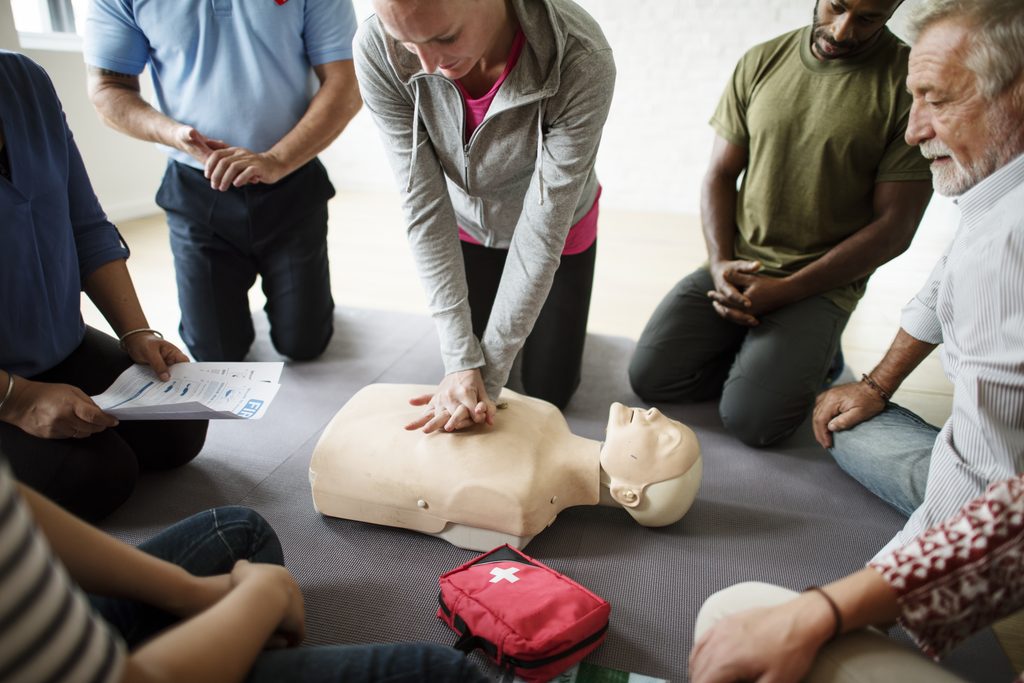
Here’s the part people miss. A hands-on first aid and CPR course isn’t only about bandages and chest compressions. It’s also a language lesson you’ll never forget.
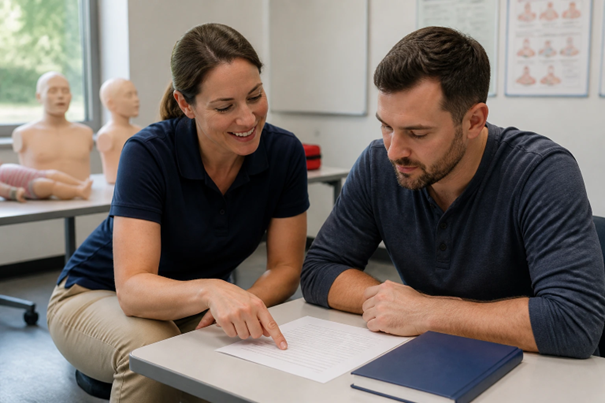
In class, you hear the real words. You say them out loud. You practise them while you kneel beside a training mannequin and press on its chest. Your instructor repeats the same calm phrases again and again: “Are you okay? Call 911. Start compressions.” That repetition sticks the words to the action, and that’s how real learning happens.
You also learn by doing, which is gentler than learning by reading alone. You don’t have to read a long paragraph under pressure. You have to remember a short phrase and move your hands. For many learners, that’s actually easier.
By the end of a session, you’ll know how to check if someone is responsive, how to call for help, and how to do hands-only CPR: pushing hard and fast in the centre of the chest, about 100 to 120 pushes a minute. A trained rescuer adds rescue breaths in a 30:2 pattern, but even compressions alone can keep someone alive. If you want to build both the skill and the confidence, Coast2Coast First Aid classes run blended learning, where you study the theory online at your own pace and then come in for one short in-person skills session.
Studying online first is a real gift for language learners. You can pause the video. You can replay a word. You can look up a term you don’t know before you ever walk into the classroom. By the time you arrive, the vocabulary already feels familiar.
Does This Matter for Work in Ontario?
It can. Many Ontario workplaces are required to have trained first aiders on site under WSIB Regulation 1101. For a small shift of five or fewer workers, at least one person needs Basic First Aid. For six or more, at least one needs Intermediate First Aid. Certificates stay valid for three years.
What does that mean for you? Being certified can make you more useful to an employer and more confident on the job. If you’re a newcomer looking for work in Kitchener, a recognized first aid certificate is a clear, practical credential to add to your resume. It also happens to sharpen the exact English you’d use in a real workplace emergency.
Training is offered in accessible formats too, so the online portion gives you time to absorb the material without the pressure of a fast-talking classroom.
How Can You Practise Before You Ever Need It?
Confidence comes from rehearsal. Try these small habits:
● Read your 911 script out loud once a week until it feels natural.
● Teach the words to a friend or your family. Teaching is one of the best ways to remember.
● Label things at home. Stick notes on the first aid kit, the phone, the emergency exit.
● Watch short first aid videos with English subtitles turned on.
● Role-play. Have someone pretend to faint and practise what you’d say.
Five minutes here and there adds up. The goal isn’t perfect English. The goal is clear English when it counts.
In Canada, there are roughly 60,000 cardiac arrests outside of hospitals each year, and only about 1 in 10 people survive. Fast bystander CPR can double a person’s chance of survival. The person who steps in doesn’t need flawless grammar. They need the skill and a few clear words. That could be you.
What Do You Say to the Person You’re Helping?

There’s one more set of phrases worth learning: the calm, simple things you say to a sick or injured person while you wait for the ambulance. Your voice can steady someone who is frightened, and a frightened person often understands short, gentle words best.
Keep a few ready:
● “Help is coming.” Three words. They do a lot.
● “Can you hear me?” This checks if the person is awake and responsive.
● “Stay with me. Keep looking at me.” This keeps them alert and calm.
● “What’s your name?” A simple question that tells you how alert they are.
● “Does it hurt here?” Point as you ask, so words and gestures work together.
Notice how each sentence is short and clear. You don’t need long explanations. You need warmth and simple questions. Pointing, nodding, and a steady tone fill in the gaps, and they cross every language barrier there is.
The beauty of learning this way is that the English you practise here is useful far beyond emergencies. Clear, calm, simple sentences help you at work, at the doctor’s office, and in everyday life. Emergency English is really just confident, plain English under pressure, and that’s a skill worth having whatever happens.
If you are looking for first aid and CPR training near the downtown Innovation District, King Street East near Frederick Street, or surrounding areas, you may reach out to Coast2Coast First Aid & Aquatics in that area.
Frequently Asked Questions
Q: Do I need perfect English to call 911 in Canada?
A: No. Dispatchers are trained to help callers who are nervous or still learning English. Speak slowly, use short sentences, give your location, and say what’s wrong. If you truly struggle, interpretation services can often be arranged, but clear, simple words usually do the job.
Q: Can I take a first aid course if English is my second language?
A: Yes. Blended learning lets you study the theory online at your own pace, so you can pause, replay, and look up words before the in-person session. The hands-on class reinforces the vocabulary through practice, which many learners find easier than reading alone.
Q: What’s the difference between hands-only CPR and regular CPR?
A: Hands-only CPR means pushing hard and fast in the centre of the chest without rescue breaths, and it’s recommended for untrained bystanders. Trained rescuers add breaths in a 30:2 pattern. Both aim to keep blood moving until help arrives.
Q: How long is a first aid certificate valid in Ontario?
A: A certificate is generally valid for three years. After that, you renew it. Many workplaces track renewal dates, so keep a note of when yours expires.
Q: Will first aid training actually help my workplace English?
A: It can. You’ll hear and say real emergency phrases, practise them with your hands, and repeat them throughout the course. That repetition sticks the words to the action, which is exactly how language learning works best.