

Here is a comprehensive list of words to describe your closest relatives, distant kin, and relationships by marriage. This English family vocabulary will help you describe connections and people in your life accurately.
Immediate Family (Nuclear Family)
These terms refer to the people who are part of the closest family unit, often living in the same house. The word siblings is very useful to talk about brothers and sisters together.
Parents: A mother and a father.
Father: A male parent.
Mother: A female parent.
Dad: An informal word for father.
Mom (US) / Mum (UK): An informal word for mother.
Brother: A male sibling.
Sister: A female sibling.
Siblings: Brothers and sisters collectively.
Son: A male child.
Daughter: A female child.
Child / Children: A young human being / The plural form.
Baby: A very young child, recently born.
Toddler: A young child who is just learning to walk (usually 1–3 years old).
Teenager: A young person between 13 and 19 years old.
Twins: Two children born at the same birth.
Identical twins: Twins who look exactly the same.
Triplets: Three children born at the same birth.
Firstborn: The first child born in a family.
Only child: A person who has no brothers or sisters.
Generations (Grandparents & Ancestors)
English uses the prefix “grand” for two generations apart, and “great” for each additional generation back in time.
Grandparents: The parents of your parents.
Grandfather: The father of your father or mother.
Grandmother: The mother of your father or mother.
Grandson: The son of your son or daughter.
Granddaughter: The daughter of your son or daughter.
Grandchild: A child of your son or daughter.
Great-grandfather: The father of your grandparent.
Great-grandmother: The mother of your grandparent.
Ancestors: Family members from long ago (parents, grandparents, great-grandparents, etc.).
Descendants: People who come after you in your family line (children, grandchildren, etc.).
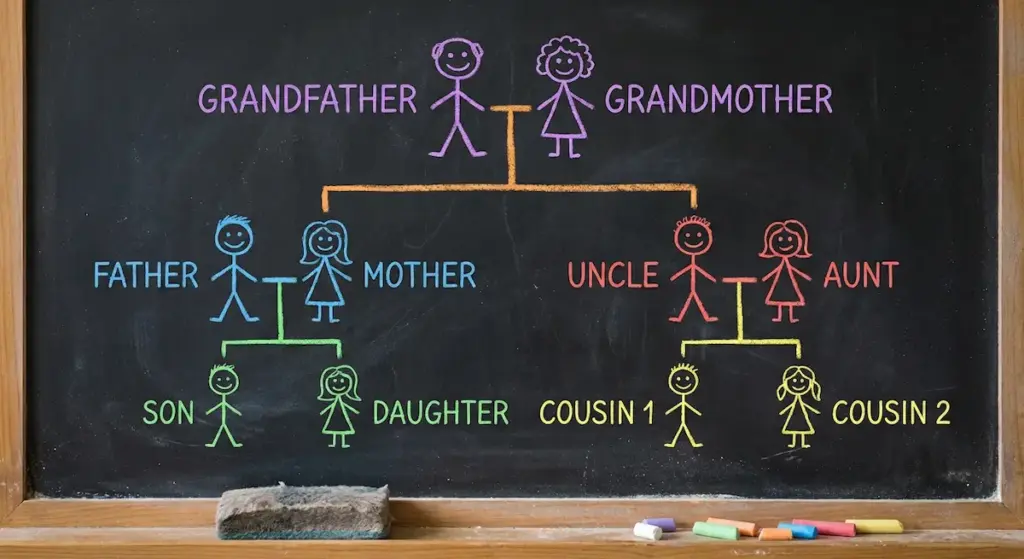
Family tree: A diagram showing the relationships between family members.
Extended Family
To describe family in English outside of your main household, use these terms. Note that cousin is gender-neutral; it works for both males and females.
Relatives: Members of your family (general term).
Blood relative: Someone related to you by birth, not marriage.
Uncle: The brother of your mother or father.
Aunt: The sister of your mother or father.
Nephew: The son of your brother or sister.
Niece: The daughter of your brother or sister.
Cousin: The child of your aunt or uncle.
Distant relative: A family member who is not closely related (like a second cousin).
Next of kin: Your closest living relative (often used in legal situations).
Relationships and Marital Status
Here is the vocabulary to define romantic partners and legal status.
Spouse: A husband or wife.
Husband: A married man.
Wife: A married woman.
Partner: A person you are in a committed relationship with.
Significant other: A romantic partner.
Boyfriend: A male romantic partner.
Girlfriend: A female romantic partner.
Fiancé: A man engaged to be married.
Fiancée: A woman engaged to be married.
Engaged: Having formally agreed to marry.
Married: Having a husband or wife.
Single: Not married or in a relationship.
Divorced: Legally separated from a spouse; the marriage has ended.
Separated: Living apart from a spouse but not yet legally divorced.
Widower: A man whose wife has died.
Widow: A woman whose husband has died.
Late husband/wife: A polite way to refer to a spouse who has passed away.
The In-Laws (Family by Marriage)
This group includes family members in English who join your family when you get married. You simply add the suffix “-in-law”.
Father-in-law: The father of your spouse.
Mother-in-law: The mother of your spouse.
Parents-in-law: The parents of your spouse.
Son-in-law: The husband of your daughter.
Daughter-in-law: The wife of your son.
Brother-in-law: The brother of your spouse, or the husband of your sibling.
Sister-in-law: The sister of your spouse, or the wife of your sibling.
Blended Family (Step & Half)
It is important to distinguish between relationships formed by a parent’s new marriage and biological connections. “Step” means there is no blood relation. “Half” means you share one parent.
Stepfather: The man who has married your mother but is not your biological father.
Stepmother: The woman who has married your father but is not your biological mother.
Stepbrother: The son of your stepparent (no biological relation to you).
Stepsister: The daughter of your stepparent (no biological relation to you).
Half-brother: A brother who shares only one biological parent with you.
Half-sister: A sister who shares only one biological parent with you.
Blended family: A family consisting of a couple and their children from this and all previous relationships.
Godparents, Adoption, and Household
The vocabulary extends to symbolic roles and specific living arrangements.
Godparents: Adults who promise to help guide a child’s life, usually chosen during a religious ceremony.
Godfather: A male godparent.
Godmother: A female godparent.
Godson: The male child a godparent supports.
Goddaughter: The female child a godparent supports.
Adoptive parents: Parents who legally raise a child who is not biologically theirs.
Birth mother/father: The biological parents of a child.
Foster parents: People who temporarily care for a child who cannot live with their own family.
Guardian: Someone legally responsible for a child (who is not necessarily the parent).
Orphan: A child whose parents have died.
Household: All the people living together in one house.
Breadwinner: The person who earns the money to support the family.
Upbringing: The way a child is raised and educated by their parents.
Slang and Casual Terms
In daily life, formal titles are often replaced by these affectionate or casual words.
Daddy: A child’s word for father.
Mommy: A child’s word for mother.
Grandpa / Gramps: Casual words for grandfather.
Grandma / Granny / Nana: Casual words for grandmother.
Bro: Short for brother (often used between friends too).
Sis: Short for sister.
Kiddo: An affectionate way to address a child.
Folks: A casual word for parents (e.g., “I’m visiting my folks”).
Hubby: A cute, informal word for husband.
The old man: Slang for “my father” (can be rude or affectionate depending on context).
Useful Sentences
Here are some examples of using English family lexicon to help you practice.
I come from a large family. (My family has many members.)
She takes after her mother. (She looks or behaves like her mother.)
My brother-in-law is coming over for dinner. (My sister’s husband is visiting.)
They have three children: two boys and a girl. (They are parents to three kids.)
He is the black sheep of the family. (He is the member of the family who is considered different or disgraceful.)
We are going to visit our relatives in London. (We are seeing our family members who live in London.)
Give your children a head start with Break Into English
Do you want your children to learn English in a natural and fun way? Our native teachers offer online English lessons specifically designed for young learners. They will master family vocabulary, grammar, and conjugation—all while having fun!