

In short
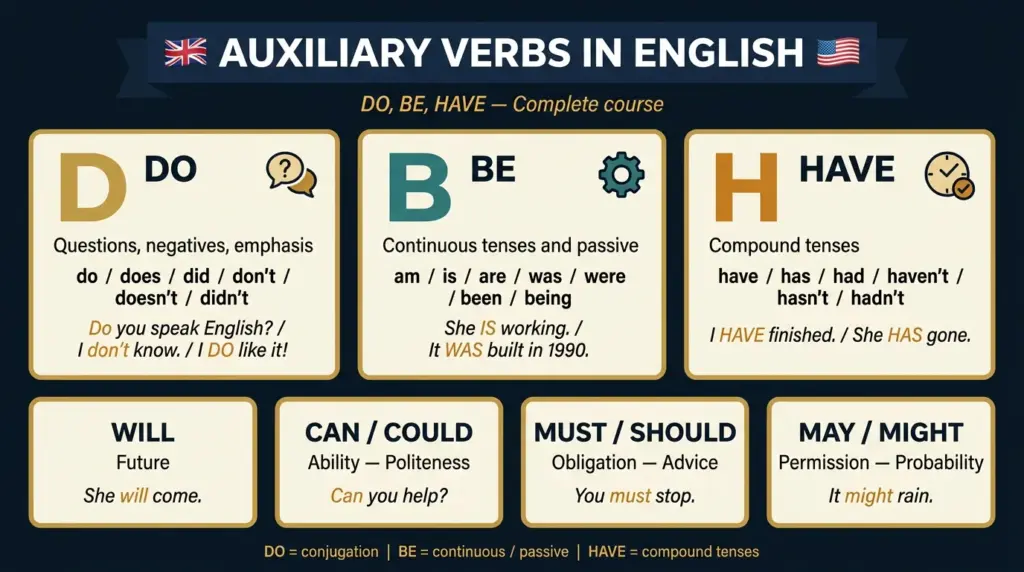
- Main role: An auxiliary verb, often called a helping verb, assists another verb to indicate the tense or form of the sentence.
- Be: This word is used to describe an ongoing action or for the passive voice.
- Have: This verb is used to build compound tenses like the present perfect.
- Do: This term is mandatory for forming a question or a negation in simple tenses.
- Dual purpose: These three words also exist as normal verbs with their own meaning.
Sentence construction in English often relies on small words that can be tricky for ESL learners. The English auxiliary verbs do be have act as grammatical tools to modify the meaning of the main verb. The choice between these three words depends on the verb tense and the form of the sentence.
How auxiliary verbs work
An auxiliary always accompanies a main verb. The main verb provides the meaning of the action. The helping verb provides the tense information. It also indicates whether the sentence is a question or a negation.
In many languages, endings are used to change the tense of a verb. In English, we instead use these small words placed before the verb. For example, the sentence I do not play uses the auxiliary do. The main verb is play. The word do simply signals the negative form in the present tense.
There are three basic helping verbs in English. Each has a defined role and strict usage rules based on standard English grammar. They are conjugated according to the subject, which requires careful attention to subject-verb agreement. They also change according to the tense of the sentence.
The auxiliary BE
The word be helps form several common grammatical structures. It changes form depending on the personal pronoun. Here is its conjugation in the present and the preterit (the English simple past).
| Subject pronoun | Present | Preterit (Past) |
|---|---|---|
| I | am | was |
| You | are | were |
| He / She / It | is | was |
| We | are | were |
| They | are | were |
Ongoing actions
The most common use of be relates to the continuous form. This form describes an action that is currently happening. We associate the auxiliary be with a verb ending in -ing.
In the present, this structure forms the present continuous. The action takes place at the exact moment we are speaking.
Example: They are watching television.
In this sentence, are serves as an auxiliary. The verb watching carries the meaning of the action.
In the past, this same structure forms the past continuous. The action was ongoing at a specific moment in the past.
Example: He was reading a book when the phone rang.
Here, was places the action in the past. The verb reading indicates the action of reading.
The passive voice
The auxiliary be is used to construct the passive voice. In the active voice, the subject performs the action. In the passive voice, the subject receives the action. The structure requires the auxiliary be followed by the past participle of the main verb.
Active example: The dog bites the man.
Passive example: The man is bitten by the dog.
In the second sentence, is helps form the passive. The verb bitten remains the action verb.
This rule applies to all tenses. You simply conjugate the auxiliary be in the desired tense.
Past example: The letter was written yesterday.
The auxiliary HAVE
The word have is used to build compound tenses. It often connects a past action to the present moment. Here is its basic conjugation.
| Subject pronoun | Present | Preterit (Past) |
|---|---|---|
| I / You / We / They | have | had |
| He / She / It | has | had |
The Present Perfect
This tense connects the past to the present. It describes a past action with a consequence on the current moment. The construction requires the auxiliary have in the present followed by the past participle of the verb.
Example: They have lost their keys.
The action of losing happened in the past. The current consequence is obvious: they cannot go home now. The auxiliary have signals this link.
Another example: She has lived in London for ten years.
The action started in the past. It still continues in the present. The word has agrees with the subject she.
The Past Perfect
This tense is used to order two past actions. It indicates which action happened first. The construction uses the auxiliary have in the past (had) followed by the past participle.
Example: When I arrived, the train had left.
The departure of the train happened before the arrival at the station. The word had signals this priority.
The auxiliary DO
The word do has a special status. It almost never appears in a simple affirmative sentence. It comes out of hiding to ask questions or make negative sentences. Here is its conjugation.
| Subject pronoun | Present | Preterit (Past) |
|---|---|---|
| I / You / We / They | do | did |
| He / She / It | does | did |
Asking a question in simple tenses
In English, you cannot simply invert the subject and the verb. You must add the auxiliary do at the beginning of the question. This rule applies to the present simple and the past simple. The main verb remains in its base form. It takes no endings.
Present example: Do you like coffee?
The word do acts as a marker. It just indicates that the sentence is a question in the present tense.
Third-person example: Does he play tennis?
The auxiliary takes the plural or person marker. The verb play remains invariable.
Past example: Did they arrive on time?
The word did indicates the past tense. The verb arrive remains in its base form.
Forming a negative sentence
Negation also requires the help of the auxiliary. The word not attaches to do. The main verb then follows in its base form. Contractions are very common in spoken English.
Present example: I do not eat meat.
We can contract the auxiliary and the negation: I don’t eat meat.
Third-person example: She does not speak Spanish.
Contracted form: She doesn’t speak Spanish.
Past example: We did not see the movie.
Contracted form: We didn’t see the movie.
Emphasis in the affirmative form
There is an exception to the invisibility rule of do. It can be added in a simple affirmative sentence. This technique is used to mark strong emphasis. It often contradicts a previous statement.
Example: I do love this song!
Adding the auxiliary reinforces the feeling. The speaker stresses the word do when speaking.
Another past example: He did call you yesterday.
This sentence could reply to someone doubting this call.
The difference between auxiliary verbs and main verbs
The words do, be, and have wear two hats. They sometimes work as simple helping verbs. Other times, they act as normal verbs with a full meaning. You must look at the other words in the sentence to distinguish them.
The case of DO
As a normal verb, do means the action of doing or accomplishing a task.
Example: I do my homework every evening.
Here, do is the only verb in the sentence. It carries all the meaning.
A sentence can even contain the word do twice.
Example: What do you do?
The first do is the auxiliary of the question. The second do is the main verb of the action.
The case of BE
As a normal verb, be indicates a state, an identity, or a location.
Example: She is a doctor.
No other verb accompanies the word is. It works all by itself.
The case of HAVE
As a normal verb, have expresses possession.
Example: They have a large garden.
The word have designates the fact of possessing.
A sentence can also combine both roles of have in the present perfect.
Example: I have had a long day.
The first have helps build the tense. The second word had is the past participle of the verb to possess.
Summary of tense combinations
Each auxiliary corresponds to a specific aspect of grammatical tense. The word be marks the continuous aspect of an action. It shows a duration or an ongoing process. The word have marks the perfect aspect. It describes a completed action with an impact on another moment. The word do is attached to the simple aspect. It signals facts, habits, or general truths in questions and negations.
The right selection always depends on the speaker’s intention. You must observe the main verb. The presence of an -ing ending calls for the auxiliary be. The presence of a past participle often calls for have. The absence of an ending on the main verb in a question calls for the auxiliary do.
Practical exercise
Test your knowledge by choosing the correct auxiliary for each sentence:
Question 1: ___ you like to play football on weekends?
Question 2: She ___ reading a very interesting book right now.
Question 3: We ___ never visited Japan before.
Question 4: Where ___ they go yesterday evening?
Question 5: The window ___ broken by the wind during the storm.
Question 6: He ___ not know the answer to this question.