

At a glance
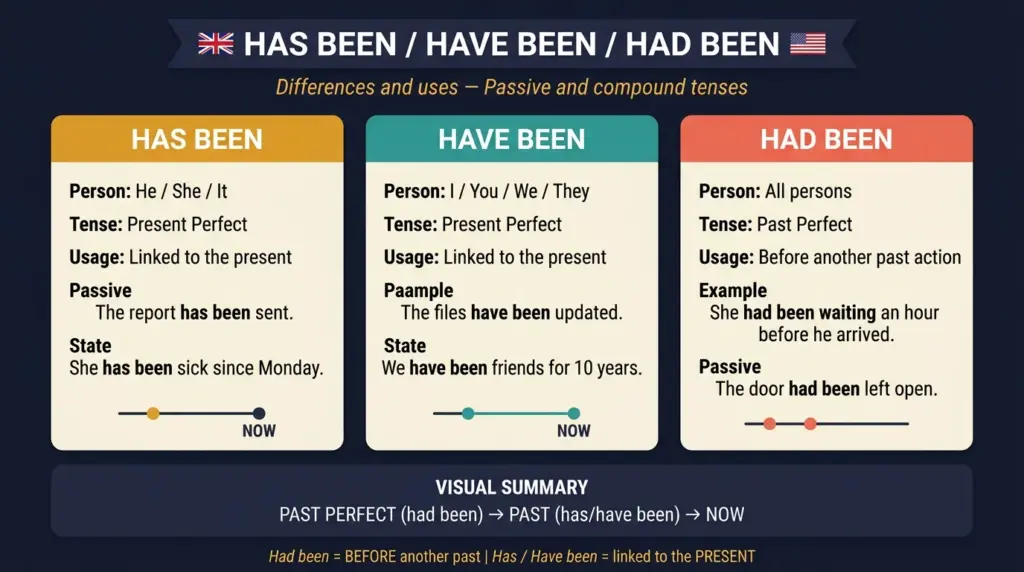
- Have been: Used in the present with the subjects I, you, we, they.
- Has been: Used in the present only with he, she, it.
- Had been: Used in the past with absolutely all subject pronouns.
- Main use: These forms connect a past action to the present or to another moment in the past.
In English, expressing a past action that has a connection to the present requires a specific grammatical structure. Understanding the rules of has been vs have been vs had been depends entirely on the subject of the sentence and the precise timing of the action.
The logic behind these three verb forms
These three expressions belong to the perfect tense family in English. This family serves to create a bridge between two different moments in time. The action is not isolated in the past. It has a direct consequence on another time period. The verb to be is put into the past participle to become been. The auxiliary to have is conjugated according to the subject and the chosen tense. This creates a very common combination in the English language, frequently tested in ESL exams like the TOEFL or IELTS.
You must first look at the first word of the combination. The auxiliary indicates the reference time of the sentence. The words have and has place the action in the present sphere. The word had places the action entirely in the past sphere. This simple rule helps you choose the right structure every time.
How have been works exactly
The expression have been is used within the framework of the Present Perfect. It is used to take stock at the present moment. The rule requires its use with the first person, the second person, and plural persons. The corresponding subjects are I, you, we, and they.
Here are concrete situations to understand its use:
| English sentence | Meaning in context |
|---|---|
| They have been friends for years. | They are still friends today. |
| We have been to London twice. | We visited London and have that experience now. |
| I have been very busy lately. | I was busy recently and still am. |
In these examples, the state or action continues to be true at the time of speaking. The friendship still lasts today. The travel experience is part of the person’s current background. The busy schedule remains relevant.
The specific use of has been
The form has been follows exactly the same temporal logic as the previous form. The only difference concerns the subject of the sentence. We apply has been only to the third person singular. The pronouns involved are he, she, and it. It is also used with a singular noun like the dog or the company.
Observe the following examples:
| English sentence | Meaning in context |
|---|---|
| She has been sick all week. | She is still sick now. |
| The weather has been terrible. | The weather is still bad. |
| He has been a teacher since 2010. | He still teaches today. |
The rule remains constant. The action started in the past. It keeps a strong connection with the present. The person is still sick. The current climate is still bad. The profession practiced remains the same today.
Shifting into the past with had been
The expression had been belongs to the Past Perfect. This form creates a link between two moments in the past. It indicates that an action took place before another past action. This is a universal timeline concept crucial for advanced English fluency. A great advantage makes it easy to learn. The conjugation remains identical for all subject pronouns.
Examine these situations in the past:
| English sentence | Meaning in context |
|---|---|
| The street was wet because it had been raining. | The rain happened before the street was wet. |
| They had been there before the party started. | Their presence predates the party. |
| She was tired because she had been working. | The work happened before she felt tired. |
The chronology is clear. The action with had been happens first on the timeline. The other past event happens second. The rain fell first. The street ended up wet afterward.
The continuous form with the ing verb
These three structures are very often associated with another verb. This second verb ends with the syllable ing. This is called the continuous form. This association emphasizes the duration of an action. It highlights the process rather than the final result.
The Present Perfect Continuous uses have been or has been plus an ing verb. It describes an action started in the past and still ongoing.
| English sentence | Meaning in context |
|---|---|
| They have been playing for two hours. | The playing started two hours ago and continues. |
| She has been waiting since morning. | The waiting started this morning and continues. |
The Past Perfect Continuous uses had been plus an ing verb. It emphasizes the duration of an action before another past event.
| English sentence | Meaning in context |
|---|---|
| He had been driving for hours when he stopped. | The driving was ongoing before the stop. |
| We had been sleeping when the phone rang. | The sleeping was ongoing before the ring. |
The passive voice with these three forms
The passive voice reverses the sentence structure. The subject receives the action instead of performing it. The forms have been, has been, and had been serve as auxiliaries to build this passive voice in the perfect tense. The past participle of the main verb is then added.
Here is the application in the present with have and has:
| English sentence | Meaning in context |
|---|---|
| The letters have been sent. | The sending is complete. |
| The project has been completed. | The completion is done. |
Here is the application in the past with had:
| English sentence | Meaning in context |
|---|---|
| The cake had been eaten before I arrived. | The eating happened before the arrival. |
| The cars had been washed yesterday. | The washing was completed yesterday. |
This structure highlights the object of the action. The identity of the person performing the action loses its importance. Attention is focused on the final result obtained.
Associated time indicators
Certain small words almost always accompany these verb structures. They provide details on the starting point or duration of the event. The word since indicates a precise starting point in time. A specific date, year, or event is cited.
Example with since: I have been here since Monday. The meaning is that the person arrived on Monday and is still there. The starting point is the day of the week.
The word for expresses an overall duration. You count the number of days, months, or years that have passed. This is a key concept in ESL learning to measure the total time elapsed.
Example with for: She has been studying for three years. This means the study period spans three years up to now. We quantify the total duration of the action.
The words already and yet are used a lot with these tenses. The term already means that something happened sooner than expected and is placed in the middle of the verb structure. The term yet means until now and is placed at the end of a negative sentence or question.
Contraction of verb forms in spoken English
Spoken English systematically shortens these expressions. Formal writing keeps the whole words. Everyday communication favors speed. You must recognize these short forms to fully understand native speakers.
The word have becomes a simple apostrophe followed by the letters ve. The sentence I have been transforms into I’ve been. The sentence We have been becomes We’ve been.
The word has is reduced to an apostrophe followed by the letter s. The sentence She has been is heard as She’s been. The sentence It has been becomes It’s been.
The word had contracts into an apostrophe followed by the letter d. The sentence He had been becomes He’d been. The sentence They had been is expressed as They’d been.
The contraction with has looks exactly like the verb is. The context helps to tell the difference. If the word been follows directly, it is always the conjugated verb to have.
Practical exercise
Knowledge assessment on the use of these three verb forms:
Question 1: Which auxiliary accompanies the subject She to describe a present state that started in the past?
Question 2: Complete the sentence: They … working on this project for months.
Question 3: Which form expresses a past action that took place before another past action?
Question 4: Complete this sentence in the past tense: The ground was wet. It … raining.
Question 5: Which sentence correctly uses the perfect tense for a past delivery?
Question 6: Which word designates the starting point of an action in the expression I have been waiting … two o’clock?
Result obtained