

In short
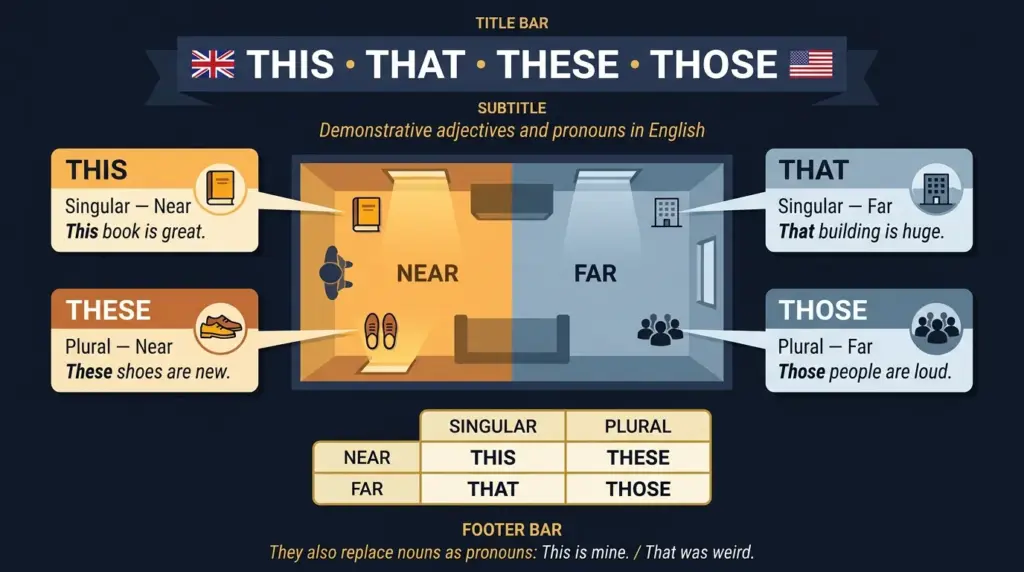
- This: refers to a singular item that is near.
- That: refers to a singular item that is far.
- These: refers to plural items that are near.
- Those: refers to plural items that are far.
- Physical or temporal distance: proximity applies in both space and time.
In English, when pointing out something or someone, your choice of word depends on two simple factors. You need to know if there is one or multiple items, and whether they are near or far from the speaker. Here is how to correctly use the demonstrative adjectives this that these those.
Singular and near: This
The word this is used for a singular object, person, or idea. The item referred to must be near the speaker. This proximity can be physical or temporal.
Physical proximity
We use this when we can touch the object or when it is right next to us. Here are some concrete examples:
- This book is interesting. (The book is in the person’s hands.)
- Look at this cat. (The cat is right nearby.)
- This coffee is too hot. (The person is drinking the coffee.)
Temporal proximity
This is also used to talk about a present moment or a time very near in the future or past. We use it for the current day, the ongoing week, or an immediate situation:
- I am working this morning.
- We have a meeting this week.
- This is a difficult situation. (The situation is happening right now.)
Singular and far: That
The word that is also used in the singular. The difference from this is the distance. The item referred to is far from the speaker. This distance applies in both space and time.
Physical distance
We choose that to point out an object we cannot touch directly. The object is further away, across the room, or down the street:
- That house is beautiful. (The house is in the distance.)
- Who is that man? (The man is at a certain distance.)
- Pass me that pen, please. (The pen is out of reach.)
Temporal distance
That allows us to talk about a past moment. We use it to recall a memory or a bygone era:
- That day was amazing.
- I remember that summer.
- At that time, I was living in London.
Plural and near: These
When talking about multiple items near us, we use these. It is the plural of this. The rule of physical or temporal proximity remains exactly the same.
Multiple items within reach
If the objects or people are very close and plural, these is the appropriate word:
- These apples are delicious. (The apples are in the basket right there.)
- I bought these shoes yesterday. (The person is pointing to the shoes they are wearing.)
- These documents need a signature. (The documents are on the desk in front of the person.)
Plural proximity in time
We use these to talk about current periods in the plural:
- These days, everything is expensive.
- I am very busy these weeks.
Plural and far: Those
To point out multiple items that are far away, we choose those. It is the plural of that. The rule of spatial or temporal distance applies here in the plural.
Multiple distant items
When objects or people are far away, we use those:
- Look at those birds. (The birds are flying high in the sky.)
- Those boxes are heavy. (The boxes are across the hallway.)
- I don’t know those people. (The group of people is on the other side of the room.)
Plural distance in time
Those is used to evoke past periods in the plural:
- Those years were the best.
- In those days, we had no phones.
Summary of demonstrative determiners
Here is a clear summary to help you memorize the rule. The choice is made by combining number and distance.
| Distance | Singular | Plural |
|---|---|---|
| Near (here / now) | This | These |
| Far (over there / past) | That | Those |
The role of demonstrative pronouns
These words play two roles in a sentence. They can be demonstrative determiners or demonstrative pronouns. The meaning remains the same, only the sentence structure changes.
Use as a determiner
When the word accompanies a noun, it acts as a determiner. It is placed right before the noun it modifies. This is the case in most of the examples seen previously:
- This car is fast. (This accompanies car.)
- Those mountains are high. (Those accompanies mountains.)
Use as a pronoun
These words can be used alone to replace a noun. This avoids repeating the noun. They then take on the function of a demonstrative pronoun:
- This is my friend, Paul. (This replaces the person being introduced.)
- That is a good idea. (That replaces the idea just proposed.)
- These are my keys. (These replaces the objects being shown.)
- Are those your bags? (Those replaces the distant objects.)
Usage on the phone
English speakers use a specific rule to introduce themselves on the phone. We use this to talk about ourselves. We use that to ask for the identity of the person on the other end.
- To say “It’s Sarah” on the phone, we say: Hello, this is Sarah.
- To ask “Is this John?” or “Who is calling?”, we say: Is that John? or Who is that?
This rule applies only during phone calls or when knocking on a door without being seen.
Practical exercise
Test your knowledge by choosing the correct demonstrative:
Question 1: You are holding a pen in your hand. What do you say?
Question 2: You point to clouds far away in the sky. What do you say?
Question 3: How do you say “That year” when talking about 2010?
Question 4: You have several books on your lap. How do you say “These books are heavy”?
Question 5: How do you introduce yourself on the phone? “Hello, it’s Marc.”
Question 6: You see a car across the street. How do you say “That car is expensive”?