

In short
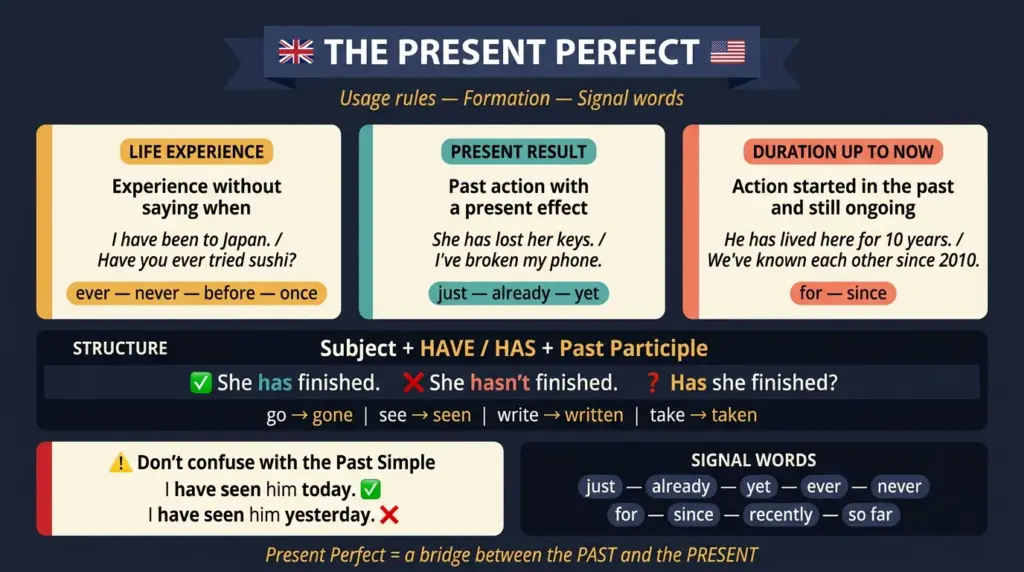
- Construction: The tense is formed with the auxiliary verb have followed by the past participle of the verb.
- Golden rule: The past action always has a visible consequence in the present.
- Time markers: The adverbs just, already, yet, ever, and never often signal the use of this tense.
- Duration: The words for and since accompany actions started in the past and still ongoing.
In English, a past action with repercussions on the present moment requires a specific tense. The choice between the simple past and this tense depends on one question: does the event influence the current situation? Mastering the present perfect rules and exercises will help you understand this connection.
Forming the present perfect
The construction of this verb tense follows a simple logic. The sentence requires two mandatory elements. The first element is the auxiliary verb to have conjugated in the present tense. The second element is the past participle of the main verb.
The conjugation of the auxiliary verb depends directly on the subject. The third person singular takes the form has. All other persons use the form have.
| Subject | Auxiliary verb | Past participle |
|---|---|---|
| I, You, We, They | have | played / seen |
| He, She, It | has | played / seen |
The affirmative form simply combines these elements. Native speakers almost always use the contracted form in spoken English. The word have becomes ‘ve. The word has becomes ‘s.
Here are some concrete examples:
- They have finished the project. (They finished the project and it is complete now.)
- She has lost her keys. (She lost her keys and still does not have them.)
- I’ve worked hard today. (The day is not over yet, and the hard work is relevant now.)
The negative form
The negation is added directly to the auxiliary verb. The word not is placed right after have or has. Contractions are also very common.
| Full form | Contracted form |
|---|---|
| have not | haven’t |
| has not | hasn’t |
Examples of use:
- We have not seen this movie. (We lack the experience of seeing this movie up to now.)
- He hasn’t called back. (We are still waiting for his call.)
The interrogative form
Questions require subject inversion. The auxiliary verb moves to the beginning of the sentence. The subject is placed between the auxiliary verb and the past participle.
Examples of questions:
- Have they arrived ? (Are they here now?)
- Has she eaten the cake ? (Is the cake gone?)
Managing past participles
The past participle takes two different forms. The form depends on the type of verb used. English separates verbs into two distinct categories.
Regular verbs
The rule for regular verbs is very simple. You just need to add the ed ending to the base verb. This form is identical to the simple past.
| Base verb | Past participle |
|---|---|
| work | worked |
| play | played |
| clean | cleaned |
Irregular verbs
Irregular verbs do not follow any logical rule. Learning them by heart is the only effective method. The past participle corresponds to the third column of traditional verb lists.
| Base verb | Past participle |
|---|---|
| go | gone |
| see | seen |
| take | taken |
| write | written |
Using it for life experiences
This tense often describes a personal assessment. The exact date of the event has no importance. The relevant information is the completion of the action during a lifetime.
The time of the action remains vague or unmentioned. The focus is on the current result. The speaker expresses an experience acquired up to the present moment.
Examples of life experiences:
- They have traveled to Japan. (They have the experience of visiting Japan.)
- I have read this book. (I know the story because I read it at some point in my life.)
The adverbs Ever and Never
Life experiences are often accompanied by specific adverbs. The word ever is used in questions. It asks about the occurrence of an event at any time in life.
The word never expresses the total absence of an experience. It replaces standard negation. The verb remains in the affirmative form because never already carries the negative meaning.
Examples with these adverbs:
- Have they ever eaten sushi ? (In their entire lives, have they tried sushi?)
- She has never visited London. (She lacks the experience of visiting London.)
Recent actions with a present result
A very recent past action also uses this tense. The result of this action is directly visible now. The current situation depends entirely on this past event.
The word just signals an action completed a moment ago. It is placed between the auxiliary verb and the past participle.
Examples of recent actions:
- I have just washed the floor. (The floor is wet right now.)
- The train has just left. (You can probably still see it leaving the station.)
The adverbs Already and Yet
The word already indicates an action completed earlier than expected. It is used in affirmative sentences. Its usual place is between the auxiliary verb and the main verb.
The word yet works differently. It is used only in questions and negative sentences. It is always placed at the very end of the sentence.
Examples:
- We have already bought the tickets. (There is no need to buy them again.)
- Has the mail arrived yet ? (I am expecting the mail and want to know its status.)
- He hasn’t answered yet. (We are still waiting for his answer.)
Actions started in the past and still ongoing
Some actions begin at a given moment in the past. These same actions continue into the present. The tense used bridges the gap between the start of the action and today.
Many language learners mistakenly use the present tense in this case. English requires the use of the present perfect. This logical difference requires careful attention.
Examples of continuity:
- They have lived here for ten years. (They moved here ten years ago and still live here.)
- She has worked there since 2015. (She started her job in 2015 and is still working there.)
The difference between For and Since
Expressing duration uses two different words. The choice between for and since depends on the time information provided. A strict rule separates the two uses.
The word for introduces a calculated duration. It is accompanied by an amount of time. We count days, months, or years.
The word since indicates a specific starting point. It signals the exact moment the action began. The date, time, or starting event is named.
| Use of For (duration) | Use of Since (starting point) |
|---|---|
| for three weeks | since Monday |
| for five months | since January |
| for a long time | since I was young |
Contrasting with the simple past
The simple past describes a completely finished action. The event is disconnected from the present. The context often includes a specific date in the past.
Here is how to tell the difference. Adding a date like yesterday or in 2010 forces the use of the simple past. The absence of a specific date often points to the present perfect.
Direct comparison:
- I lost my keys yesterday. (Finished action, specified date = simple past.)
- I have lost my keys. (Past action, but the keys are still missing now = present perfect.)
Practical exercise
Test your acquired knowledge with this validation exercise:
Question 1: What is the correct form to say that you have the experience of visiting Spain?
Question 2: Which word completes the sentence: “She has lived here ___ 2010”?
Question 3: Where is the word “just” placed in a sentence?
Question 4: Which sentence describes a finished action with no connection to the present?
Question 5: How do you ask if someone has already eaten?
Question 6: What is the past participle of the verb “to see”?
Score