

In short
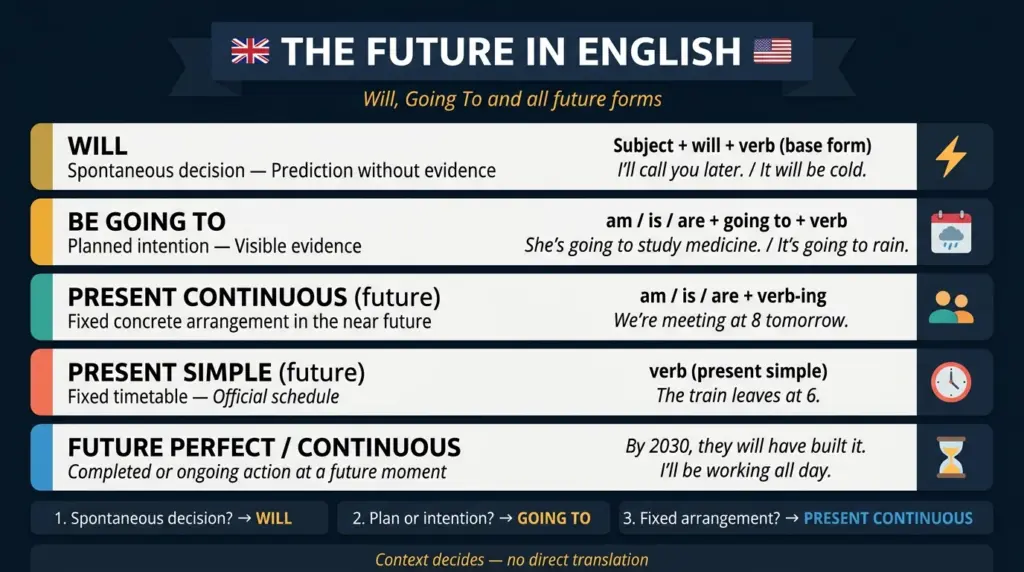
- Will: Used for spontaneous decisions and promises.
- Be going to: Indicates a thoughtful intention or an already planned schedule.
- Present continuous: Used to talk about a fixed and confirmed appointment.
- Present simple: Applies only to official schedules and programs.
English has several methods to express a future action. The choice of the verb depends on a specific detail: is the decision spontaneous or planned in advance? Here are the rules to correctly build each form.
The future with will for spontaneous decisions
The word will is used to form the simple future. It is mainly used for a decision made at the very moment of speaking. A person realizes a fact and reacts immediately.
For example, the phone rings. The person decides to answer on the spot. We say I will answer it (I will answer it). No premeditation exists.
This form also expresses a promise. A person commits to doing something in the future. We say I will help you tomorrow (I will help you tomorrow). The commitment is made in the present for the future.
We use will to offer help. Someone is carrying a heavy bag. We say I will carry this bag for you (I will carry this bag for you). The decision is instantaneous.
Finally, will is used to make a prediction without concrete proof. We give a personal opinion about the future. We say I think it will rain next week (I think it will rain next week). No visible element confirms this theory.
The construction remains very simple. We place will between the subject and the infinitive verb. The verb does not take to.
| Form | Structure and example |
|---|---|
| Affirmative | Subject + will + verb. He will come. (He will come.) |
| Negative | Subject + will not (won’t) + verb. They won’t win. (They won’t win.) |
| Interrogative | Will + subject + verb? Will she arrive soon? (Will she arrive soon?) |
In spoken language, will is often contracted to ‘ll after a personal pronoun. We hear I’ll, you’ll, she’ll. The negative form will not very often becomes won’t in everyday conversation.
The be going to structure for intentions
The be going to form is used for an already planned action. The intention exists before the moment of speaking. The decision has been the subject of prior reflection.
A person has bought tickets to Spain. They say I am going to visit Spain (I am going to visit Spain). The plan is concrete and the decision is old.
We also use this form for a prediction based on visual evidence. The present elements announce a future event in an obvious way.
We look at the sky filled with dark clouds. We say Look at those clouds, it is going to rain (Look at those clouds, it is going to rain). The physical proof justifies the prediction.
The construction requires conjugating the verb be in the present tense. We then add going to and then the infinitive verb.
| Form | Structure and example |
|---|---|
| Affirmative | Subject + be + going to + verb. She is going to study. (She is going to study.) |
| Negative | Subject + be not + going to + verb. We aren’t going to sleep. (We aren’t going to sleep.) |
| Interrogative | Be + subject + going to + verb? Are they going to eat? (Are they going to eat?) |
The conjugation of be always agrees with the subject. We use am, is or are depending on the person. In informal spoken language, going to sometimes transforms into gonna.
The present continuous for confirmed arrangements
The present continuous is often used to talk about the future. This form applies to fixed appointments. The event is planned with certainty. Concrete arrangements have taken place with other people.
The date and time are generally fixed. A person has a dentist appointment on Tuesday at 3 PM. We say I am seeing the dentist on Tuesday (I am seeing the dentist on Tuesday). The action is guaranteed.
This nuance differs from going to. The going to structure indicates a simple intention. The present continuous implies a confirmed organization.
To build this tense, we conjugate the verb be in the present tense. We add the -ing ending to the end of the main verb.
| Form | Structure and example |
|---|---|
| Affirmative | Subject + be + verb in -ing. He is leaving tomorrow. (He is leaving tomorrow.) |
| Negative | Subject + be not + verb in -ing. They aren’t coming tonight. (They aren’t coming tonight.) |
| Interrogative | Be + subject + verb in -ing? Is she working later? (Is she working later?) |
We almost always add a future time marker. Words like tomorrow (tomorrow) or next week (next week) clarify the meaning. Without these words, the sentence could describe an action in the present.
The present simple for official schedules
The present simple expresses the future in a very specific context. It is used for events subject to an official schedule. This concerns transportation, shows or meetings.
A train has a departure time set by the company. We say The train leaves at 8 AM tomorrow (The train leaves at 8 AM tomorrow). The schedule does not depend on personal will.
A movie starts at a specific time at the cinema. We say The movie starts at 9 PM (The movie starts at 9 PM). The program dictates the event.
This rule applies to things and sometimes to people. The program remains the main cause of the action.
| Form | Structure and example |
|---|---|
| Affirmative | Subject + verb. The flight arrives at noon. (The flight arrives at noon.) |
| Negative | Subject + do/does not + verb. The shop doesn’t open tomorrow. (The shop doesn’t open tomorrow.) |
| Interrogative | Do/Does + subject + verb? What time does the class end? (What time does the class end?) |
The use of the present simple for the future remains limited to regular programs. It is not used for individual decisions without an official framework.
The future continuous for actions in progress
The future continuous describes an action that will be happening. The action will last during a specific moment in the future.
We imagine a scene at an exact future moment. Tomorrow at 10 AM, a person will be in the middle of their work. We say At 10 AM tomorrow, I will be working (Tomorrow at 10 AM, I will be working).
The action starts before the indicated moment. It continues after this moment. The given time serves as a reference point in the middle of the activity.
This form is built with will be followed by the verb in -ing. The structure does not change according to the subject.
| Form | Structure and example |
|---|---|
| Affirmative | Subject + will be + verb in -ing. They will be sleeping. (They will be sleeping.) |
| Negative | Subject + won’t be + verb in -ing. She won’t be studying. (She won’t be studying.) |
| Interrogative | Will + subject + be + verb in -ing? Will you be waiting? (Will you be waiting?) |
This tense is also used to ask a question politely. Asking about someone’s plans becomes very courteous. We say Will you be using the car later? (Will you be using the car later?). The approach is gentle and indirect.
The future perfect for completed actions
The future perfect indicates that an action will be completely finished before a specific moment. This tense creates a limit in the future.
A project must be submitted on Friday. The work will be completed on Thursday. We say I will have finished the project by Friday (I will have finished the project by Friday). The action is carried out before the deadline.
We often use the word by (by) with this tense. The word by introduces the time limit.
The construction associates will have with the past participle of the verb. The past participle is formed with -ed for regular verbs. Irregular verbs use the third column of their table.
| Form | Structure and example |
|---|---|
| Affirmative | Subject + will have + past participle. We will have arrived. (We will have arrived.) |
| Negative | Subject + won’t have + past participle. He won’t have eaten. (He won’t have eaten.) |
| Interrogative | Will + subject + have + past participle? Will they have left? (Will they have left?) |
This form measures the accomplishment of a fact. We evaluate the result obtained at a future date.
The future perfect continuous for duration
The future perfect continuous emphasizes the duration of an action. The action starts in the past or the present. It continues up to a reference point in the future.
The focus is on the length of the event. In December, a person will celebrate their three years in a company. We say By December, I will have been working here for three years (By December, I will have been working here for three years).
We highlight the time elapsed before the deadline. The action generally continues after this reference point.
The structure uses will have been followed by the verb in -ing. This construction remains identical for all subjects.
| Form | Structure and example |
|---|---|
| Affirmative | Subject + will have been + verb in -ing. She will have been sleeping. (She will have been sleeping.) |
| Negative | Subject + won’t have been + verb in -ing. They won’t have been playing long. (They won’t have been playing long.) |
| Interrogative | Will + subject + have been + verb in -ing? Will you have been waiting long? (Will you have been waiting long?) |
This tense is almost always accompanied by an indication of duration. We very often find the word for followed by a period of time.
State verbs do not use this continuous form. Verbs like know (know) or be (be) remain in the simple future perfect. We say I will have known him for ten years (I will have known him for ten years).
Practical exercise
Test your knowledge of future tense conjugation in English:
Question 1: Which sentence expresses a spontaneous decision made at the moment of speaking?
Question 2: Complete the sentence according to the clue (a fixed arrangement with the doctor): “I ___ the doctor at 4 PM.”
Question 3: Which form to choose for an official train schedule?
Question 4: What do we say when looking at very dark clouds that announce certain rain?
Question 5: How to express that an action will be happening tomorrow at 10 AM?
Question 6: Which structure indicates that an action will be completely finished by the end of the week?
Your score